
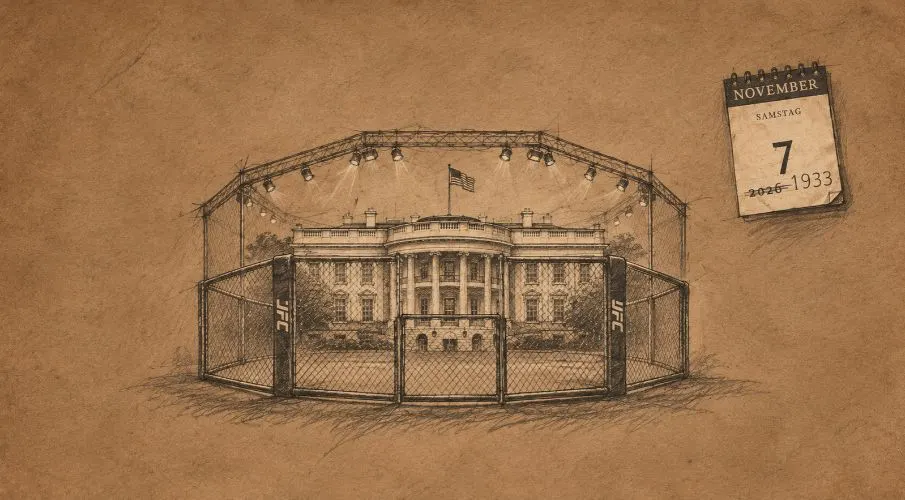
An empty podium is the most honest spokesperson a government can have. It makes no claims and denies nothing. It stands in the White House briefing room, waiting. Someone is supposed to stand behind it and answer questions. That seems to be exactly where the problem lies.

It's been waiting in vain for weeks. Karoline Leavitt left her position in late August. Katie Zacharia came after her, facing reporters and looking visibly overwhelmed during her one and only appearance. Just five days later, she was gone. The podium has belonged to no one since. In an administration that creates new legal and political conflicts almost daily, choosing the next person for the job would seem to call for some careful thought. Donald Trump does his thinking on Saturday at his golf club in Florida. The answer is Dana White.
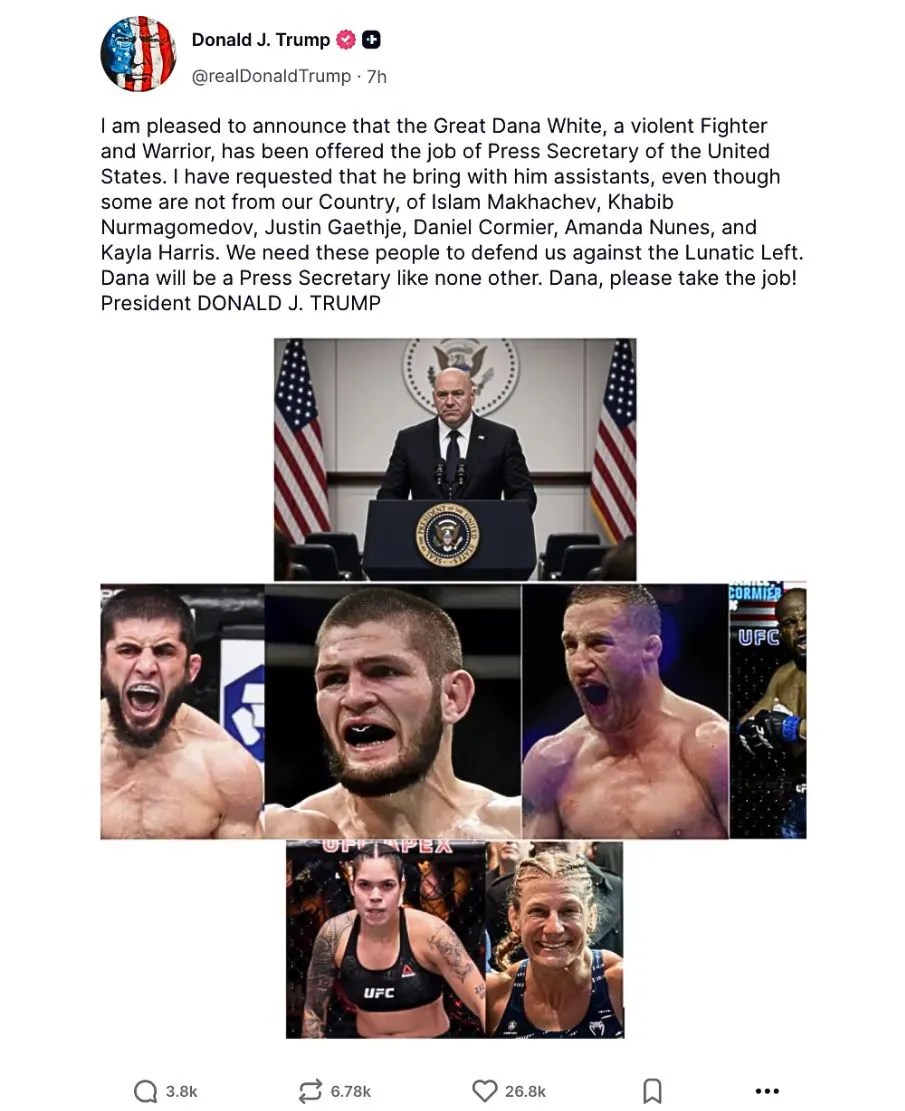
White runs the UFC, a combat sports organization. His business consists of putting people in an eight-sided steel cage, letting them fight each other, and selling tickets to watch it happen. Trump offers him the job of White House press secretary. White should bring along some of his fighters. They need those guys to defend themselves against the "Radical Left Lunatics."
Press briefings would probably last three rounds. And anyone asking an uncomfortable question might have to tap out.
Now all that's missing is Gianni Infantino as Treasury secretary, since he's already handed over a large sum of money once before. They could probably find a referee for secretary of state, someone who knows when to look the other way at the decisive moment. The idea is ridiculous, certainly. Under this president, though, nobody knows anymore whether being ridiculous is enough to disqualify someone from an appointment. And the man putting these ideas out into the world is commander in chief of the United States military.

Behind everything happening this Saturday is a defeat. On Tuesday, Americans stripped Republicans of control of both the House and the Senate. Democrats won even in districts that had been considered safely Republican for decades. Trump had explicitly turned the election into a referendum on his own presidency. Now he wants nothing to do with the results. The candidates are to blame.
Defeat speaks quietly. Anyone who wants to understand it has to lean down and listen.
Trump would rather lean over desks. On his social media platform, he shares a black-and-white picture of himself, both fists planted on a desktop, with "MR. VETO" written above him in huge letters. It sounds like a professional wrestler's stage name, and that's probably the idea. The defeat has visibly hit him hard, and he apparently takes the loss of his congressional majorities as a personal insult. All that's missing is the entrance music and a smoke machine. You can photograph powerlessness and make it look like strength.
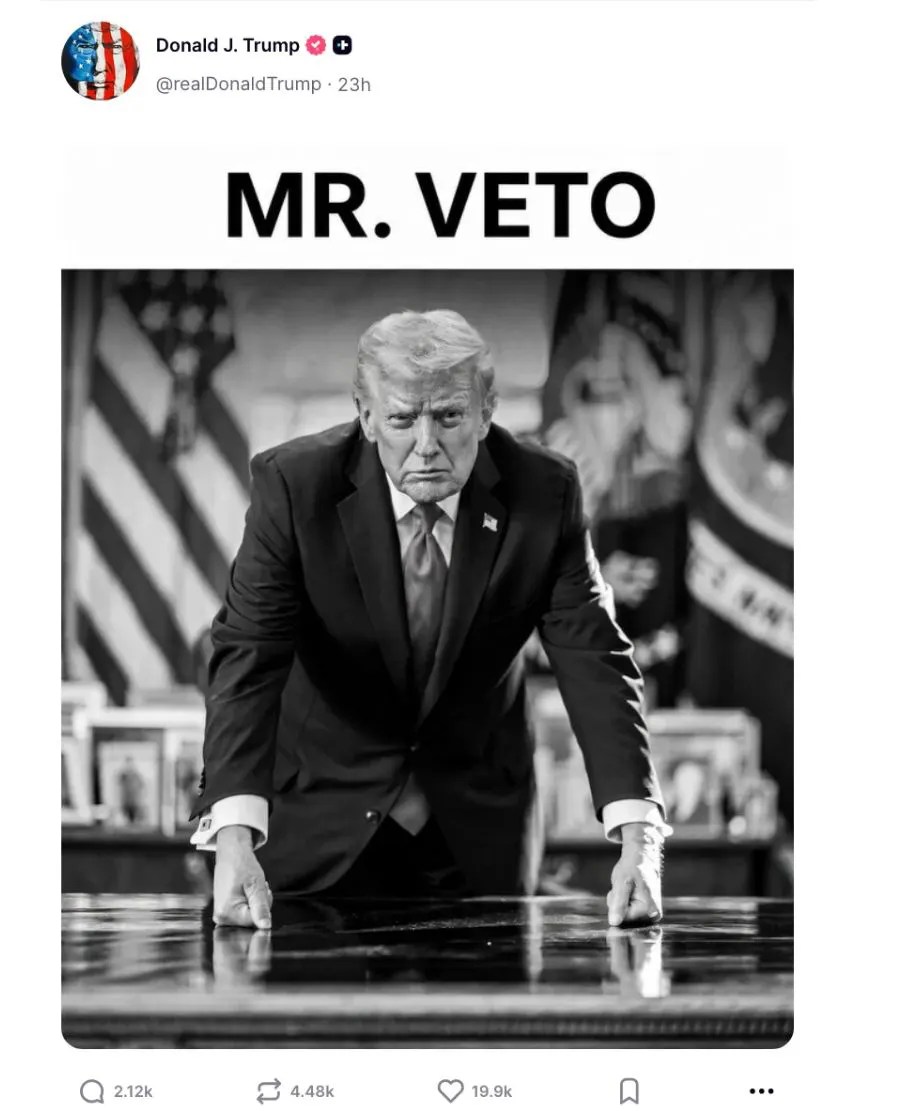
The veto is, in fact, one of his constitutional powers. He can use it to reject legislation, and Congress can override it with a two-thirds majority in both chambers. It's not much help against investigations. Starting in January, Democrats will be able to demand records and subpoena administration officials. In the photograph, Trump is hunched over as though he could force Washington into submission through sheer force of his stare. The Constitution stands in his way. Unfortunately for him, it's harder to correct with a felt-tip marker than a map.
Maps, after all, are something he loves correcting. While his party loses its congressional majorities, the president is busy contemplating the size of his future empire. He shares a newspaper front page showing him with his fists raised beneath the headline "HOW THE WEST WAS WON." Another image reads "UNITING STATES OF AMERICAS," with a map underneath already showing Canada as the 51st state. Greenland is part of his territorial fantasies, too. Cuba appears alongside it as the next target.
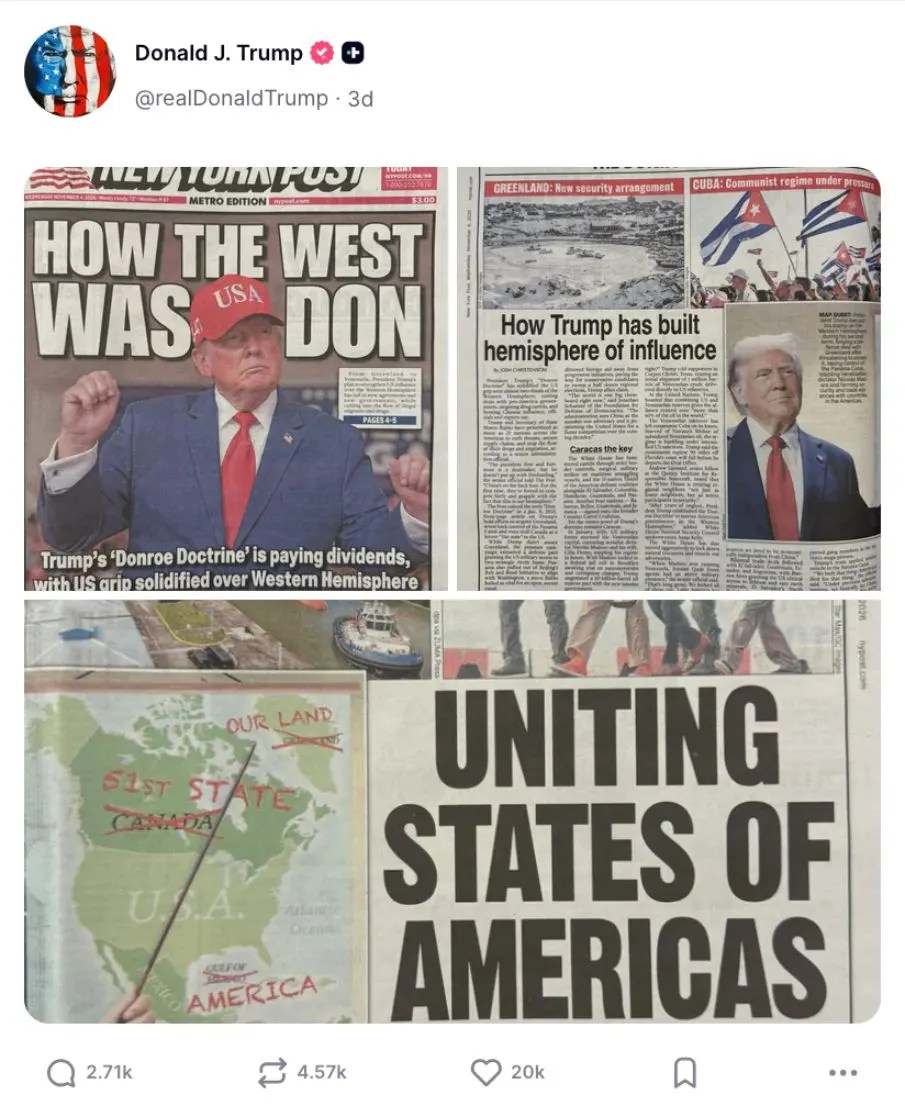
Maps are patient. They don't have voters. You lose Congress on a Tuesday, then conquer a continent on paper.
Nobody asked Canada. In that respect, at least, it has something in common with Tuesday's American voters, who were asked but whose answer apparently went unheard at the White House. Other countries have their own citizens and their own governments, with the right to decide their own futures. That probably ruins the beauty of Trump's picture considerably. The president looks at the Western Hemisphere like a piece of property whose fence he can move whenever he feels like it. So here stands a man whose party has just suffered a historic defeat at the hands of its own voters, presenting himself as the conqueror of half a continent. Reality is easy enough to ignore when the map is printed big enough.

When bones break and blood flies, Donald Trump is happy. On June 14, 2026, he sat in the front row at the UFC fights at the White House. Violence as birthday entertainment, right there on the grounds of the American president's residence.
Back to the cage. "Dana, please take the job!" Trump writes on Truth Social. He praises his friend as a "violent fighter and warrior." He'll be a press secretary unlike anything America has ever seen. That's probably true. Until now, the job of a government spokesperson has been to inform reporters about government decisions. There was nothing about putting people in headlocks in the job description. Trump even provides the backup crew, naming six people. Islam Makhachev and Khabib Nurmagomedov come from Dagestan, a republic within Russia. Justin Gaethje and Daniel Cormier are from the United States. He also names Amanda Nunes, who is Brazilian. Rounding out the list is a "Kayla Harris," presumably meaning Kayla Harrison. Some of them are from other countries, the president generously acknowledges.
Generosity is a rare visitor to this White House. The very same man relentlessly portrays immigrants as a threat to American society. Foreign origins apparently stop being frightening the moment someone looks capable of intimidating political opponents. The passport matters little. The fist matters. Immigrants without a championship belt are still subject to Stephen Miller's house rules. Whether any of these men and women will ever take on a role in the White House remains uncertain. The very idea Trump is publicly playing with deserves attention. Power that can't stand questions goes looking for people who don't ask any. Preferably people who can throw a punch.
Dana White, meanwhile, is in London for a boxing event. Reporters ask him about the offer. He says he'll travel to Washington afterward and meet with the president on Monday. Whether he actually wants the job remains unclear. Asked how he would balance his many business commitments with working at the White House, he responds irritably. Yes, he already has plenty on his plate. There will be more to say after the meeting.

He was quicker on Instagram. There, he shares a picture of himself already standing at the White House podium, accompanied by the words "On to the next chapter." So the empty podium has a candidate who's already posed behind it for a photograph. At the same time, White is planning the international expansion of Zuffa Boxing, a boxing organization he operates with Saudi investors. Which responsibility would take priority if the two conflicted remains unanswered. The president's spokesperson would be wearing a second hat, and beneath that hat would sit Saudi business partners.
UFC chief Dana White confirmed to reporters that he was flying to Washington right after the event and had a meeting scheduled with Donald Trump on Monday. Asked how he could juggle the offered White House press secretary job with his many business commitments, White said he already had plenty on his plate. He declined to discuss any previous conversations with Trump about the position, pointing instead to their upcoming meeting. White did not explicitly accept or turn down the offer during the interview.
None of this comes as a surprise. White has long been part of Trump's closest social circle. UFC events were held at Trump's Taj Mahal casino as far back as the early 2000s. White supported his 2016 presidential campaign and appeared at three Republican National Conventions between 2016 and 2024. He stood alongside Trump during his 2024 election victory. Steven Cheung, a former UFC spokesperson, already serves as White House communications director. The cage supplies the president with personnel. The republic supplies the scenery.
In June 2026, the cage moved right up to the front door. Trump had a fight night staged on the White House South Lawn to celebrate the 250th anniversary of American independence and his own 80th birthday. An eight-sided steel cage rose in front of the presidential residence, with a massive metal structure holding screens and spotlights suspended above it. White later raved about the experience, calling it one of a kind. Presidents have made decisions about wars at this place and received foreign heads of state. During crises, they have held consultations here. For this president's birthday, people beat each other up here.

The dignity of a building certainly isn't measured by its lawn. But what a president chooses to put on that lawn still says quite a bit about how he understands his office. Inside the octagon, at least, a referee separates the fighters, and judges decide the outcome at the end of the night. Even the cage has more oversight than the man who had it built wants to allow Congress.
After an election defeat, presidents usually seek advice. Trump calls for reinforcements. On Friday, he named Stephen Miller his new chief of staff. Miller takes over Monday from Susie Wiles, who is expected to work for Trump's political organization. Wiles was considered one of the few people close to him who occasionally tried to rein in his spontaneous ideas. Miller is a hard-line fascist advocate of his immigration and deportation policies. Millions of Americans have just rejected those policies. The president responds by increasing the influence of their most ruthless enforcer. There has been little public reckoning with the reasons for the defeat. Instead, he's rearranging the house.

When Journalists Are Expected to Give Up Their Sources
Our work, too, will become even more dangerous with Miller in this position. One of the most troubling stories of the past 48 hours concerns Stephen Miller, and it goes far beyond verbal attacks on the press. Donald Trump has pressured the Justice Department to pursue criminal charges over leaks of confidential government information. Three people familiar with the discussions report that arrests of journalists were discussed inside the White House and the Justice Department. The objective was to force them to reveal their sources. Susie Wiles reportedly opposed the idea. Miller, on the other hand, reportedly supported it, with a remarkably simple explanation: Put enough pressure on journalists, and they'll quickly give up their sources. The Justice Department rejects the account as "absolutely false."
The personnel changes still speak volumes. On November 9, Miller takes charge of the White House, the very man who, according to these accounts, was prepared to put reporters behind bars until they talked. The woman who reportedly objected is leaving her position. An administration that already calls congressional investigations extortion would, by forcing journalists to reveal their sources, tear down yet another barrier to its power. A source is a human being who has placed their trust in another human being. A government that wants to break that trust through imprisonment is targeting more than a profession. It's targeting anyone who knows something and wants to speak out.
We're going to keep investigating and reporting anyway. Our sources stay exactly where they belong: with us. This doesn't scare us one damn bit.
Defeat holds up a mirror to a president. Trump has turned it around and put Miller in front of it.
Even more dangerous is his demand to the Justice Department. That same Saturday, Trump calls for investigations into Democrats. He claims they're threatening innocent people by announcing investigations and possible impeachment proceedings. He calls it extortion and demands criminal action. He provides no evidence of any crime. In his dictionary, look up oversight and it says: see extortion. Look up extortion and it says: see indictment.
What Democrats have actually done is considerably less dramatic. Lawmakers have published letters demanding information about government activities. These include contributions from technology companies toward the planned massive White House ballroom. Congress has the right to investigate government decisions. Its committees can subpoena witnesses and demand documents. These powers are part of the separation of powers, designed to prevent a president from exercising authority without meaningful oversight. Trump wants to prosecute the very people trying to exercise that oversight. A president calls in prosecutors because elected lawmakers are doing their constitutional jobs. In that White House, oversight counts as assault. The world is upside down, and they call it law and order.
The attack on Senator Elissa Slotkin of Michigan shows what this looks like in practice. The former CIA employee said at the University of Chicago in October that young people should think about the legal trouble they might face if they took jobs in Trump's administration. She was talking about accountability for unlawful conduct. Republican Senator Mike Lee portrayed her remarks as a threat against young Americans interested in politics. Slotkin pushed back. People who broke the law or used public money to enrich themselves had to be held accountable, she said. People who obeyed the law had nothing to fear.
The Justice Department had previously tried to pursue charges against Slotkin and other Democratic lawmakers after they urged military personnel and intelligence officials to refuse unlawful orders. A grand jury rejected the proposed indictments at the time. Trump learned little from that. He still seems to regard the idea that his own orders have legal limits as a personal insult. He wants to decide where other countries' borders lie. But the elected representatives of his own country aren't supposed to enforce the limits on his power.
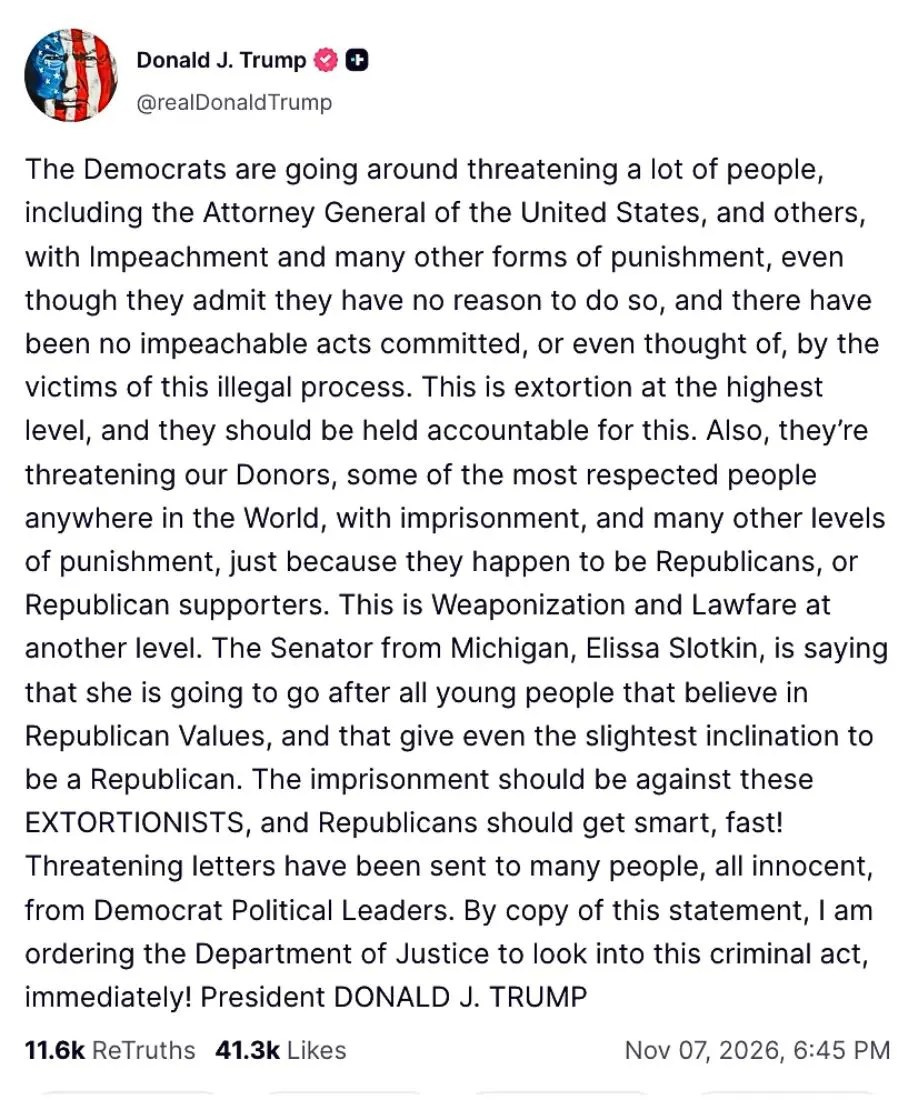
Trump Demands Prison for Political Opponents and Sets the Justice Department Against Democrats
On November 7, 2026, just days after his party's crushing election defeat, Donald Trump issued an open threat against Democrats. He accuses them of threatening Attorney General Pam Bondi and other administration officials with impeachment proceedings. He also claims major Republican donors are being intimidated with threats of prison and other punishments. Trump calls these congressional actions "extortion at the highest level," although he provides no evidence of any criminal wrongdoing. He singles out Senator Elissa Slotkin of Michigan, claiming she wants to persecute young people who hold Republican beliefs. He explicitly demands prison sentences for the Democrats he calls "extortionists." Finally, he announces that he has directed the Justice Department, effective immediately, to investigate these alleged crimes. In doing so, a sitting president is demanding criminal investigations into political opponents because they are announcing congressional oversight and possible consequences for government misconduct. Trump treats the prospect of legal accountability as a crime and is attempting to turn federal law enforcement against the very people seeking to hold his administration accountable.
Democratic Senator Elissa Slotkin sharply criticizes Vice President JD Vance on November 7, 2026, over his comments about the Iran war. She considers it insulting that Vance is now publicly criticizing the war despite having helped make the decision as vice president. Around 50,000 American troops are deployed in the Middle East, people are in serious danger, and others have already died because of those political decisions, she says. Vance can't now portray himself as a powerless voice of dissent who supposedly objected. "You're the vice president of the United States, and you made this decision to go to war. Own it."
Starting in January, the confrontation will become considerably more serious. Democrats will then be able to investigate the Trump family's business dealings. His connections to cryptocurrencies are also likely to come under scrutiny, along with possible government contracts involving Elon Musk's business interests. Deportation policy is on the list. So is the war against Iran. Even the handling of the Jeffrey Epstein files could become a subject of congressional investigations. Robert Garcia, who is expected to take over the House Oversight Committee, has already advised people around Trump to lawyer up. Washington's law firms probably welcomed that advice.
Another impeachment would be possible. Actually removing Trump from office, however, would require a two-thirds majority in the Senate. The House already impeached Trump in 2019 and 2021, and the Senate acquitted him both times. So he's familiar with the process. What he still refuses to accept is the simple principle behind it. Power owes the public an accounting.
This resistance isn't new, either. After his 2018 election defeat, Trump already announced an almost warlike approach to congressional investigations. That was when the first major confrontations with Congress began. Today, the country is governed by a president whose claims to power have grown through another term in office and years of unquestioning loyalty from those around him.
And the family? They're filming. Amazon Prime is promoting a series about Melania Trump for November 20. The poster shows the first lady in black and white, flawlessly lit, wearing a smile that looks carefully arranged down to the last detail of her face. Beneath it are the words "Melania: The Series." The camera loves faces that don't have to answer questions. Whether the series will tell the country anything about the woman in the White House remains to be seen. The timing, in any case, has an almost insulting absurdity to it. An administration loses its congressional majority, and its president threatens lawmakers with the Justice Department. From that same house comes the next opportunity for self-promotion. Congress gets committees. The family gets episodes.

Left: Melania Trump promotes her new series, "Melania: The Series," scheduled to premiere on Amazon Prime on November 20. While Republicans lose their congressional majority, the next round of presidential family self-promotion is already lined up.
Right: Donald Ward questions the unusually high vote totals received by Democrat Gina Hinojosa in the Texas gubernatorial election. The election results displayed show her lead over Republican incumbent Greg Abbott. The post, of course, provides no evidence of election fraud.
The podium is still waiting. The cage fighters may never end up with desks in the White House, and White may never stand behind that podium. But the threat against democratic oversight is already out in the open. It comes from a president who, after losing an election, would rather think about punishing his opponents than about why Americans stripped his party of its majority.
A cage shows the person inside it where their world ends. Trump has seen the bars the Constitution places around his power. He considers them an insult. So he calls for men with fists.
Updates – Kaizen News Brief
Alle aktuellen ausgesuchten Tagesmeldungen findet ihr in den Kaizen Kurznachrichten.
To the Kaizen News Brief In English


