
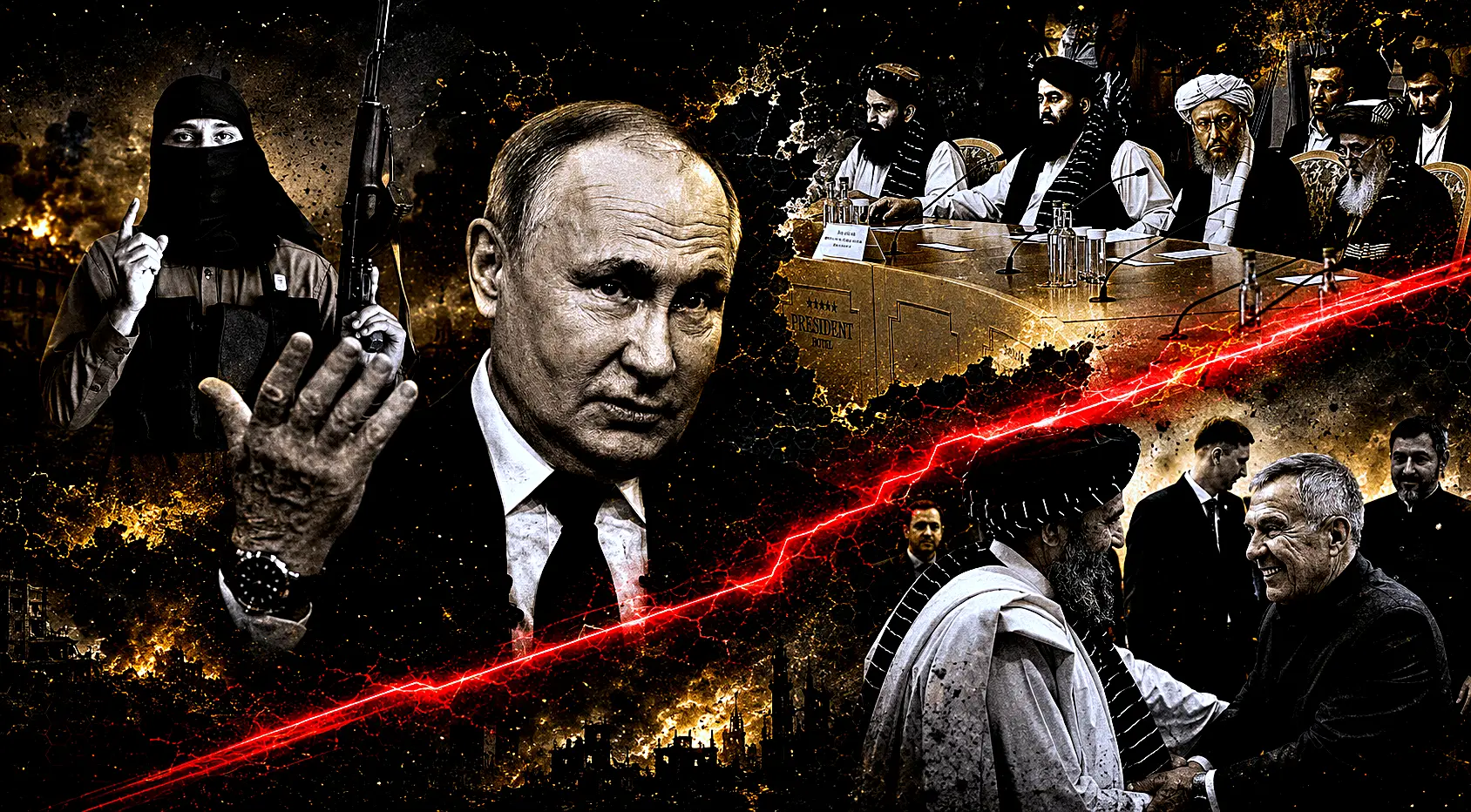
A country that was abandoned in a rushed withdrawal just 4 years ago is now being courted. A regime that was officially designated a terrorist organization is now being welcomed as a partner. Our investigation traces how this dramatic reversal became a geopolitical calculation, what Russia has lost in the process, and what Afghanistan now offers in return. It is the story of a power that no longer acts from strength, but from the necessity of preserving its reach at the lowest possible cost.
On May 27, Russia and Afghanistan signed an agreement on military-technical cooperation. The wording promises more than it actually delivers. The deal focuses on repairing Soviet-era weapons that remain in Afghanistan's arsenal. It provides for neither major arms deliveries nor significant investment, and it says almost nothing about the details. Yet this modest document ties together 2 governments that only a few years ago could not even openly acknowledge one another.

To this day, Moscow remains the first and only capital to officially recognize Taliban rule. In April 2025, Russia's Supreme Court removed the movement from its list of terrorist organizations. 2 months later came formal diplomatic recognition. Anyone familiar with Russian domestic politics understands the magnitude of that reversal.
The depth of that shift becomes clear through 2 criminal cases that stand on opposite sides of the divide. Middle East and North Caucasus correspondent Nadezhda Kevorkova was arrested in May 2024 and charged with justifying terrorism based on 2 posts published on her Telegram channel. One, written in 2020, allegedly expressed support for the Taliban and welcomed the release of imprisoned fighters. The other was a 2018 repost of an article written by a deceased colleague about the 2005 attack on Nalchik. A military court in Moscow convicted her in March 2025 and fined her 600,000 rubles while crediting the lengthy pretrial detention toward her sentence. At that time, the Taliban were still officially classified as a terrorist organization in Russia.

Just weeks later, the Supreme Court removed the Taliban from the terrorist list. Then, in June 2026, the authorities turned their attention to 19-year-old Yegor A., an employee of Aerotekh, a company that develops and manufactures drones and aerospace systems, in Rostov-on-Don. He had posted an insulting comment about the Taliban beneath an article discussing the group. A district court fined him 10,000 rubles, ruling that his comment incited hatred between the peoples of Russia and Afghanistan. Those who praised the Taliban were punished when the group was banned. Those who insult them are now punished after they have been recognized. What was once a forbidden word has become a protected one. The law no longer measures the act itself. It measures the direction in which the Kremlin is pointing. That reversal already contains the entire story.
Influence at the Lowest Possible Cost
From the outside, the alliance seems like an odd choice. Afghanistan's economy has been devastated by decades of war, the Taliban government remains under sweeping sanctions because of its treatment of women, and trade between the 2 countries is still limited. So what exactly does Moscow hope to gain from Kabul? The answer lies less in Afghanistan itself than in what Afghanistan can be used for. Since launching its full-scale war against Ukraine, Russia's ability to project influence beyond its borders has steadily declined. The fall of Bashar al-Assad in Syria was a major blow. So was the capture of Venezuelan President Nicolás Maduro by US forces, along with Armenia's growing drift away from Moscow. Great powers do not look like this. Afghanistan offers one of the few remaining opportunities to reclaim at least part of that lost influence.
The structure of the May agreement reveals just how constrained Moscow has become. The burden of the war in Ukraine and shrinking financial resources are forcing the Kremlin to seek influence wherever it can get it at the lowest possible cost. Repairing aging military equipment requires neither arms shipments nor deployed troops, yet it still creates lasting ties with Kabul. Specialists focused on Eurasia say that this strategy could secure Russia a long-term position inside Afghanistan's security sector without requiring any meaningful investment. World politics rarely comes cheaper. This is where the true nature of the policy becomes visible. There is an old idea that nature abhors a vacuum and that every empty space inevitably attracts a force that fills it. Applied to power, it means this - whenever one order retreats, the space does not remain empty. It creates a pull. Moscow is not reaching for Afghanistan from a position of strength. It is being pulled there because it has already lost the larger stages. What looks like expansion is, in reality, the survival instinct of a power that can no longer preserve its global reach through sheer strength, but only through carefully choosing places where no stronger rival stands in its way.

The relationship is rooted in something even deeper. Both governments reject a form of diplomacy built around values. Unlike Washington, Moscow demands neither liberal reforms nor respect for human rights from Kabul. When one side asks for nothing, the other has to promise nothing. In that absence of conditions, they have found a common language.
Tatarstan as the Go-Between
Military cooperation is not the only part of the relationship, even if trade remains modest. According to Russian figures, annual trade amounts to about $326 million. Afghan officials put the number closer to $500 million. For a country that once stretched across continents, that is little more than a rounding error. Roughly one-tenth of that trade passes through the Republic of Tatarstan, which Moscow has steadily turned into its primary channel to Kabul.

Mullah Abdul Ghani Baradar, Deputy Prime Minister for Economic Affairs of the Taliban government, meeting with Rustam Minnikhanov, Head of the Republic of Tatarstan, in Kazan on May 15, 2026
Russia has taken advantage of its longstanding ties with Tatar communities that have lived for generations in northern Afghanistan. Tatarstan exports KAMAZ trucks, petrochemical products, and halal goods. It operates a museum dedicated to Afghan Tatar culture in Kabul and supports Tatar-language instruction at several schools in Afghanistan's northern provinces. Since 2023, Taliban representatives have attended the Kazan Forum. Analysts specializing in Central Asia say the channel genuinely works, with many freight companies reporting that transportation under Taliban rule has become easier than it was before. What is happening here has a name - parallel diplomacy. Moscow has outsourced part of its Taliban policy to a Muslim-majority republic within the Russian Federation, allowing it to project influence into Kabul without carrying the full political burden itself. In May 2025, Taliban Deputy Prime Minister for Economic Affairs Mullah Baradar led a delegation to Kazan, met with Tatarstan's president, and signed 5 memorandums of understanding covering transportation and trade. Shortly afterward, one of Tatarstan's deputy prime ministers traveled to Kabul, marking the first official visit by a Russian regional delegation of that level since 2021. Kazan's Islamic identity makes dealing with the Taliban easier and less costly at the same time.

Its most important instrument is the Kazan Forum, which Moscow elevated to federal status in 2023 and turned into its main platform for engagement with the Islamic world. In May 2026, Russian Deputy Prime Minister Alexey Overchuk addressed the gathering. He announced that trade volume had increased by a factor of 2.6 during the first months of the year, albeit from a very low base. Negotiations were underway on investments and grain exports. The Taliban had also requested fuel, Russian pharmaceuticals, and university instructors for Afghan students. The truly ambitious projects, however, remain a long way off. The Trans-Afghan Railway, intended to connect Uzbekistan, Afghanistan, and Pakistan, still exists only on paper. Pakistan's ongoing conflict with Afghanistan and the country's vast minefields continue to stand in the way. According to regional analysts, Moscow views Tatarstan as the ideal point of entry, staying true to its long-standing habit of consolidating influence wherever it faces the fewest obstacles.
The Counterterrorism Framework
To justify recognizing the Taliban, Russia's Foreign Ministry points to the fight against Wilayat Khorasan, the regional branch of the Islamic State operating across Afghanistan, Pakistan, Iran, and Central Asia. Moscow began openly discussing cooperation with Kabul after the group claimed responsibility for the 2024 Crocus City Hall attack, which killed 151 people. Through raids and targeted killings, the Taliban have significantly weakened Wilayat Khorasan, and Moscow is eager to present that success as proof that closer ties are paying off. Yet as early as May, Kabul declared the group completely eliminated inside Afghanistan, even though it remains active. Officials explained away the contradiction by claiming the remaining fighters were operating from Pakistan and refused to acknowledge that they were still present inside Afghanistan itself. That position makes any meaningful joint counterterrorism effort far more difficult.

How determined Kabul is to push that narrative becomes clear in a statement issued by its Ministry of Defense. According to the Taliban, the country's security situation is fully under control and no major incident has occurred in 8 months. Whatever threat remains, they claim, comes from a dominant faction within Pakistan's military that allows Wilayat Khorasan to operate on Pakistani territory. From there, they say, both the Moscow attack and the assault on a memorial ceremony in Iran were planned. Kabul is demanding the extradition of several named commanders who allegedly found refuge in Pakistan. It is the convenient story every government prefers to tell - the danger always begins somewhere beyond its own border. Yet the fact that Afghanistan's northern frontier continues to burn directly contradicts the claim of complete control.
The country's broader limitations only reinforce that reality. The Taliban lack many of the technical capabilities once available to the previous government, from surveillance systems to intelligence support provided by Western agencies. Instead, they rely largely on local informants. They have also failed to eliminate other militant organizations. Al-Qaeda and the Pakistani Taliban continue to operate inside Afghanistan with the Taliban's tolerance, and those ties remain one of the main sources of tension with Islamabad. For Moscow, however, access to Afghanistan's security apparatus carries greater strategic value than counterterrorism cooperation itself.
Kabul Is Only the Lever
What Moscow is really after in Kabul is a lever for all of Central Asia. Russia's 2023 Foreign Policy Concept describes deeper ties with Afghanistan as a strategic priority, linking them to the goal of integrating the country into the Eurasian sphere while stabilizing a region Moscow considers essential to its own security. Attacks by Wilayat Khorasan, militants operating across porous borders, and the drug trade continue to destabilize Afghanistan's northern neighbors, while the Russian-led Collective Security Treaty Organization has so far failed to produce any lasting answers. The ambition is enormous. The resources are not. According to regional analysts, Moscow's primary objective remains preserving its role as Central Asia's leading security guarantor while reducing tensions along Afghanistan's borders with Tajikistan and increasingly hostile Pakistan. How fragile that role has actually become is best illustrated by the situation on the Tajik border.

Afghanistan is the cheapest stage Putin has left - a place where Russia can present itself as a security guarantor and regional power without deploying troops, spending billions, or attaching political conditions. Through Kabul, Moscow is really reaching for influence across all of Central Asia, allowing it to project the image of a global power that it can no longer afford to sustain through its own strength.
Since 2025, violent incidents along the Tajik border have become increasingly frequent, most recently with an attack on a Chinese-Tajik gold mine that left 5 Chinese nationals dead. According to a news agency report that was later withdrawn, Dushanbe had asked Moscow to deploy troops. For the Kremlin, that creates a dilemma. If Russia intervened and failed, it would reinforce the perception that the war in Ukraine has weakened its military power. If Russian soldiers were killed, the Kremlin would have to explain why it was fighting on behalf of a government it had only recently recognized as legitimate. Making matters worse, part of the personnel from Russia's 201st Military Base, its largest installation abroad, has already been redeployed to the Ukrainian front.
For now, the Russian-led alliance is responding with the one thing it still has in abundance - announcements. At the end of June, the acting chairman of the CSTO Permanent Council declared that Afghanistan remained the greatest security challenge facing Central Asia. Despite Moscow's contacts with Kabul and similar efforts by neighboring states, he acknowledged that the overall security situation remained difficult. Particular concern centered on attacks targeting allied Tajikistan, and the organization pledged to jointly neutralize militant groups along Afghanistan's northern frontier in the future. The determination has been announced. The troops are somewhere else.

Along the southern frontier, the conflict has already moved far beyond declarations. Since the beginning of 2026, Afghanistan and Pakistan have been openly at war. In late February, Islamabad launched coordinated air and ground strikes deep inside Afghan territory under the operation known as Ghazab lil-Haq, and Kabul responded with attacks of its own. A ceasefire requested by Riyadh, Doha, and Ankara during Ramadan was later abandoned unilaterally by Pakistan. Islamabad no longer treats the Taliban as ideological allies but as adversaries, seeking to establish buffer zones across the historic Durand Line. Against that backdrop, the Taliban see their agreement with Moscow as a form of deterrence. After signing the deal, Defense Minister Mohammad Yaqoob declared that Pakistan would soon no longer dare attack Afghan territory.
Hovering above everything is the question of China. Beijing has become the largest investor in Central Asia, and the further expansion of its presence depends on regional stability. Moscow is not trying to compete with China but to complement it. According to analysts, Russia has no intention of pushing Beijing aside. Instead, it wants to preserve its own influence. In this arrangement, Russia remains the security guarantor while China dominates the economy. China's long-term stability depends on Central Asia, security is Beijing's highest priority, and Russia appears determined to retain control over that field in order to preserve both its leverage with China and its position throughout the region. It is the role of the doorman standing outside a house that belongs to someone else.
For now, Moscow's gains remain limited. But because the financial and military risks are relatively small, the partnership is widely viewed as more beneficial than keeping its distance. Whether the strategy ultimately succeeds remains an open question. What is already clear is that Russia has occupied a geopolitical niche few others were willing to enter. And the first power to step into an empty space usually decides, at least for a while, who else gets to enter. For the countries caught in between, especially Tajikistan and its neighbors, that means their future security will increasingly be negotiated in places where they themselves are not sitting at the table.
Updates – Kaizen News Brief
All current curated daily updates can be found in the Kaizen News Brief.
To the Kaizen News Brief In English


Was für eine aufwändige Recherche.
Wenn man mal in der Geschichte einige Jahrzehnte zurück schaut, war Russland kriegsführend in Afghanistan GEGEN die Taliban.
Die USA kamen den Taliban gegen Russland zur Hilfe um festzustellen, dass die Taliban die USA hassen.
Viele Jahre Kämpfe und Besatzung.
Damit letztlich Afghanistan innerhalb von Tagen komplett an die Taliban zurück fiel.
Menschen- und Frauenrechte zurück in die Steinzeit.
In jedem Land stand Afghanistan auf der Terrorliste.
Moskau strich sie und unterzeichnete eine Kooperation.
Die Regierung in Deutschland empfängt, nicht offiziell, Führer der Taliban.
Die Botschaft in Berlin ist mit Taliban besetzt.
Afghanistan Personen, die die Taliban als regimefeindlich eingeordnet haben, werden nach Afghanistan abgeschoben.
Damit Afghanistan einige straffällig gewordene Afghanen zurück ins Land nimmt.
Mir macht diese Vorteilsklüngelei Angst.
Denn Menschenrechte, Humanity, Empathie all das bleibt auf der Strecke
…und deswegen sind die Recherchen so wichtig – wie sich das alles mittlerweile entwickelt ist Mittelalter und viele rennen rein, weil man sich nur noch auf schräge Videos und Bannertexte vielfach verlässt, die niemals tiefe Hintergründe in einer Gesamtheit offenlegen können. Das ist wohl das Gefährlichste an diesen Zeiten und warum viele Kollegen das Handtuch werfen und sagen, „OK, dann rennt eben rein“