
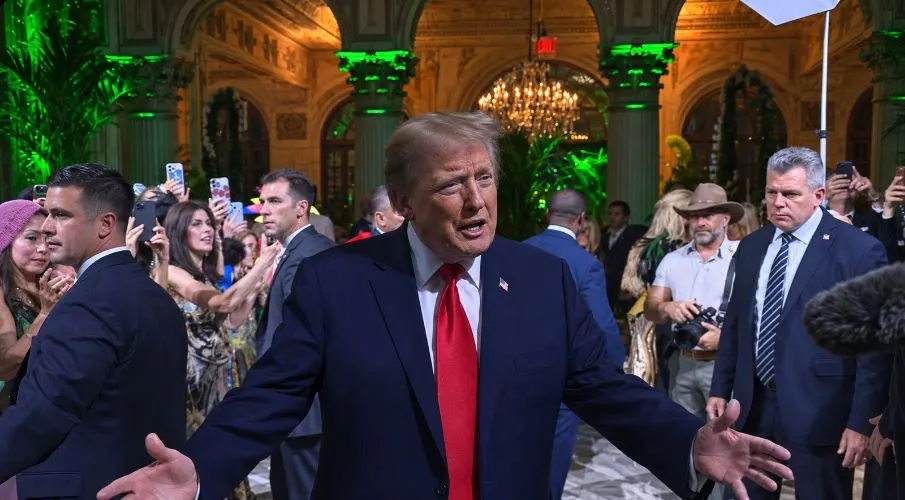
Surrounded by millionaires in costumes and a guest who apparently came dressed as a parrot, a journalist asked the American president a question about war. Donald Trump was at his Mar-a-Lago estate in Palm Beach, Florida, on the evening of Saturday, October 31, 2026. The Halloween party was in full swing, and Secret Service agents in blue suits surrounded the president. Outside, America was 3 days away from the midterm elections. Inside, the conversation suddenly turned to the possibility of another American attack on Iran. A question whose answer could determine the lives of countless people. Trump thought it was an incredibly stupid one.
"Do you expect to go back to war against Iran as soon as this week?" the journalist asked. After part of the question had to be repeated, Trump snapped: "Why would you ask such a stupid question?" Then he asked which newspaper the reporter worked for. "New York Times. Okay, let's say I did. Would I tell you?" He then pulled a mocking face, imitated the reporter, and repeated himself. "Would I tell you? Let's say I did. Would I tell you?" Finally, he declared that this was no question for the newspaper. He offered no information about American war plans.
Reporter: "Do you expect to go back to war against Iran as soon as this week?"
Trump: "Why would you ask such a stupid question? New York Times. Okay, let's say I did. Would I tell you?"
The president of the United States had turned a perfectly straightforward journalistic question into a personal insult. A journalist asks about a possible war, and the commander in chief concerns himself with how supposedly stupid the person asking it is. Nobody is demanding that secret operational plans be made public. But there's a considerable distance between military secrecy and insulting someone for asking a question, a space where democratic governments are usually expected to answer to the public. Trump used it to mock the reporter. Perhaps what makes these encounters so unsettling is that the question remains long after the laughter dies down.
A triumphal arch is usually built after a victory has already been won. Donald Trump is planning his in advance. Washington would get one, he announced, more beautiful than the Arc de Triomphe in Paris and of great military importance to boot. He blamed the Civil War and the Great Depression, among other things, for the fact that the capital had gone without such an arch until now. Other heads of state look for answers to the questions of their time. This president is looking for a place to put his monument. He didn't say what victory it was supposed to celebrate. He soon supplied a candidate himself. Iran. The United States had knocked out the country's navy and its air force along with it, he claimed. Its air defenses had been destroyed, and nearly all its military equipment had been wiped out. Its nuclear facilities had been hit as well. Only 1 or 2 targets remained. "But we can do that in, in 10 minutes. 10 minutes. So we have that, we have that plan." Then he even named the place. Pickaxe Mountain, an Iranian facility, was something they still needed to take care of.
A commercial break lasts 10 minutes. In Trump's reckoning, that's how long a war takes, too. He talks about bombs as though he's scheduling a contractor to come by. The people living in the house where the work is supposed to be done never entered the conversation. His calendar has no time for them.
He gave no date. When someone later asked whether the war would resume, he called the question stupid. Language that measures military attacks in minutes loses its weight long before the first bomb falls. He found targets at home, too. He repeatedly called Democratic Senate candidate Abdul El-Sayed of Michigan a "jihadist." El-Sayed hated Black people and Jewish people, probably everyone, Trump claimed. The president offered no evidence for the accusation. In Trump's world, repetition is proof enough, because an accusation repeated often enough becomes its own evidence through the echo of his own words.
Angie Nixon, a Democrat from Florida, had spoken about stolen Indigenous land. Trump answered by attacking her IQ, claiming it was too low for her to serve in the Senate. He said nothing about the history of the land. The quickest way to dispose of an uncomfortable question is to declare that the woman asking it lacks the intelligence to understand anything. Meanwhile, the numbers grew beyond comprehension. He claimed that $25 trillion had been generated during his presidency and that $22.2 trillion was being invested in America. He provided no accounting. Figures that size won't fit into any household budget, but they'll fit into any speech. They don't have to add up. They just have to shine. And that brings us back to the arch, quite literally. A president who wants to finish wars in minutes and finish off opponents with insults needs a monument that stands before anything has even been won. He delivers the triumph verbally. Reality will follow later, someday, in 10 minutes.
Fears of another American offensive against Iran have a concrete political background. For weeks, there has been speculation about whether Washington might launch new military strikes after the midterm elections. The war is unpopular in the United States. Asked about the matter, a White House official said the administration does not comment on sensitive military plans, whether such plans exist or not. Trump was keeping every option on the table to ensure that Iran could never possess a nuclear weapon. That kind of answer preserves military confidentiality. Publicly humiliating a journalist serves no comparable purpose.
On Friday, Trump had already spoken about domestic American politics during an appearance in Daytona Beach, Florida. Republican candidates weren't getting enough airtime on television, in his view. His party is fighting to hold on to its majorities while the president moves between campaigning and war policy. Secretary of State Marco Rubio said Saturday that no decision had yet been made about resuming military attacks. The United States was nevertheless prepared if that happened. Negotiations involving Iran are also continuing. Trump's remarks Saturday evening therefore provide no proof that an attack is imminent. What they show instead is just how unwilling the president was to give a serious answer to a legitimate question.
His treatment of the press is part of a long history of personal attacks. Just days earlier, Trump had insulted a journalist over his weight after the reporter asked about the president's health. Female reporters have repeatedly been targeted with remarks about their appearance. The White House has revoked several news organizations' access to cover events on-site. One television network was also excluded from a trip aboard Air Force One, even though its journalists were supposed to cover the president on behalf of other networks as well. Access to the president is increasingly becoming a matter of whether he personally approves. Freedom of the press still exists on paper. But exercising it can become considerably more difficult when critical questions are unwelcome.
The exchange with reporters among the Halloween guests lasted just 11 minutes. Trump seemed particularly interested in showing off his party. The wealthy guests had spent all day getting ready, he said. Some were among the biggest names on Wall Street. He himself had only had 10 minutes, so he'd come as Donald Trump. Then he complained that he would have just 15 minutes of Halloween before having to get back to work. A president marveling at his guests' elaborate costumes while, just a few feet away, someone asks about a possible military escalation. The White House did not immediately respond to a request for comment on his appearance.
On Tuesday, Americans will elect a new House of Representatives and part of the Senate. The possibility of renewed attacks on Iran still hangs in the air. At Mar-a-Lago, 1 question was enough to pull the president out of his festive mood. The reporter got an insult. The public got no answer. Behind the costumes that night stood a man who can decide matters of war and peace, and who apparently liked being asked about them even less than he liked his own reflection.
Updates – Kaizen News Brief
Alle aktuellen ausgesuchten Tagesmeldungen findet ihr in den Kaizen Kurznachrichten.
To the Kaizen News Brief In English


