
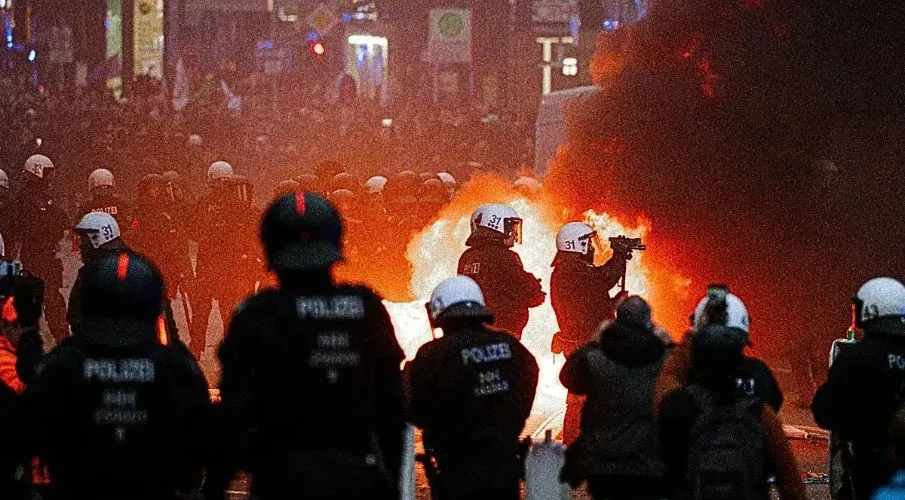
On the afternoon of October 31, 2026, young people marched through Frankfurt demanding a future they could still afford. Hours later, masked rioters smashed storefront windows, looted businesses, and threw Molotov cocktails at police officers. On one street, someone dressed as Batman stood in front of a burning trash can. A scene so absurd it seemed to capture a night when protests against social injustice collided with the destruction of other people's property. By the end, people had been injured and arrests had been made. The questions that had brought tens of thousands of people into the streets were still lying there, unanswered.

A youth movement calling itself "Gen Z regelt" (Gen Z Takes Charge) had organized demonstrations in 34 German cities for Saturday. Their demands focused on underfunded schools and the rising cost of living. Plans to bring back mandatory military service faced opposition. Cuts to social programs and healthcare were also among the reasons people took to the streets. Organizers had initially expected at least 182,000 participants. Actual turnout fell short of that. While organizers reported more than 100,000 people nationwide, the available police figures were significantly lower. A complete official nationwide count was not yet available.
In Frankfurt, up to 8,000 people attended the largely peaceful demonstration, according to police, while organizers put the number at around 9,000. The march began along the Main River near the European Central Bank and wound through downtown for several hours. Organizers explicitly urged participants to remain peaceful. Many wanted to protest policies that keep piling higher costs onto young people while schools and public institutions have struggled with inadequate funding for years. A country that talks so much about its young people's future might occasionally want to step inside the buildings where that future is being educated.

Berlin's Technical University is in terrible condition, with parts of it practically falling apart. Yet students are expected to attend classes there regularly. In Berlin, spokesperson Lina Friedrich said they were fighting for peace and freedom and opposed war and government coercion. What mattered most, she explained, was better support for education and healthcare. The burden needed to be shared more fairly. In Munich, an 18-year-old named Steve addressed Chancellor Friedrich Merz directly. The government, he said, continued to respond to his generation's concerns with cuts and additional burdens. That was why they would continue exercising their fundamental right to protest until those in power finally listened.
Then evening fell in Frankfurt. After most of the peaceful demonstrators had gone home, the violence escalated. Masked rioters smashed windows and broke into stores. Sneakers were stolen, and other merchandise disappeared from the shops. A gun shop was also attacked. Police recovered 2 weapons stolen from the business. Trash cans burned, street signs were ripped out of the ground and hurled through storefront windows. According to police, officers were pelted with rocks and bottles. Molotov cocktails were thrown as well. Police deployed water cannons and ended the demonstration early. At around 10 PM, a section of the Zeil shopping street was sealed off.

By shortly before midnight, more than 1,000 security personnel had been deployed in downtown Frankfurt. A special police tactical unit was also called in. More than 30 people were temporarily taken into custody. Several police officers were injured, with authorities fearing that one officer had suffered more serious injuries. Hesse's Interior Minister Roman Poseck blamed around 100 suspected left-wing extremists for the evening's riots. He expressed shock and promised a tough response. Even before the demonstrations, he had warned against scenes like those seen in France. The images of looting and attacks on police officers, he said, must not be repeated in Germany.

The situation also escalated in Cologne. Around 200 people gathered near the cathedral, right next to the main train station. Police officers were attacked with bottles, and bicycles were thrown at them. One person was injured, and 5 people were taken into custody. On a nearby side street, a thrown electric scooter shattered a window. After repeated clashes, police cleared the area in front of the cathedral. Smaller groups continued moving through downtown, occasionally setting off fireworks. A police spokesperson, however, said the later disturbances appeared to be more closely connected to Halloween celebrations than to the earlier youth protests. That distinction matters before every rioter gets labeled a member of the movement.
Berlin presented 2 very different scenes as well. Earlier in the day, up to 5,000 people had demonstrated peacefully at the Brandenburg Gate. In the evening, around 700 people initially gathered at Rosenthaler Platz for another march toward Prenzlauer Berg. At its peak, the crowd grew to around 3,500. Masked participants dressed in black were prominent in parts of that march, which had been organized by left-wing groups. Pro-Palestinian activists also took part. After attacks on police officers and the setting off of fireworks, the demonstration was broken up. Police reported 27 officers with minor injuries and up to 56 temporary detentions. By around 8 PM, the situation had calmed down.
In Hamburg, a largely peaceful demonstration attended by around 6,700 people was followed by disturbances near the main train station. Masked individuals tore down plastic barriers and set them on fire. Police used water cannons to put out the flames and pepper spray to disperse the crowd. In Bremen, where around 2,800 people had demonstrated, officers were punched and kicked in isolated incidents. At least 1 trash container was set on fire there as well. Even before the protests began, stores in several cities had protected their storefront windows. Along Berlin's Kurfürstendamm shopping boulevard, windows were boarded up and businesses prepared to close early.

The Federal Interior Ministry had warned that left-wing extremist groups and supporters of foreign extremist movements might join the protests. Various political organizations did, in fact, take part in mobilizing supporters. Whether the campaign was genuinely led primarily by young people had already been questioned. The German Federal Student Council distanced itself from the initiative because of unclear organizational structures and announced its own day of protest for November 20. "Gen Z regelt" condemned the violence and said it had no control over what happened after its demonstrations ended. The initiative also plans to participate in further European youth protests on November 20.
Trump-Style Rhetoric Arrives: Excuses for Political Failure
What is particularly revealing, though, is how quickly the German government turns its attention to potential extremists when people protest its policies. While young people complain about crumbling schools and describe the financial pressures of everyday life, the Interior Ministry publicly focuses on the dangers that certain parts of the protests might pose. The warnings about violent groups may well be justified. But they answer astonishingly little of what brought tens of thousands of people into the streets in the first place. The government is responsible for keeping city centers safe. It is responsible for the condition of public institutions, too. It can mobilize police forces, assess security threats, and arrange protection for businesses. Why it cannot respond with similar determination to the desperation over poorly equipped schools is a question Friedrich Merz ought to answer. In the political debate, the part of the protest night getting the most attention is precisely the part that may have the least to do with what the peaceful demonstrators were demanding.
The violence deserves unequivocal condemnation. Attacking people with Molotov cocktails is a crime. Looting businesses hurts employees and owners who have no responsibility for the German government's education policies. Those responsible must be identified and held accountable. But none of that gives the government the right to reduce a debate about social conditions to a security problem. In Cologne, police themselves questioned whether the later riots could even be attributed to the youth protests. That alone should be reason enough to exercise restraint before attaching political labels to an entire movement. Suspicions about individual violent offenders say very little about the concerns of the people who demonstrated peacefully that afternoon. Yet images of burning trash cans threaten to dominate the public conversation. A shattered storefront window is easy to photograph. The slow decay of a school requires someone to take a closer look.
The political lack of direction behind this development is hard to miss. It's easy to speak forcefully about smashed storefront windows. The culprits are identifiable, and demands for punishment win approval. Things get more uncomfortable when the question becomes why the very people who are supposed to finance pensions and generate the country's future prosperity are already being forced to deal with inadequate educational facilities. They're told that public finances are strained. At the same time, they're expected to shoulder the rising costs of their lives and fulfill obligations to a country whose services they increasingly question. A government ought to be capable of debating those concerns without first searching the crowd for its political opponents. Social problems do nothing to diminish the seriousness of destroying other people's property. And the existence of violent extremists does nothing to diminish a government's responsibilities. Friedrich Merz will have to be judged by whether he can give the young demonstrators a political answer once the streets have been cleared. The Interior Ministry can warn about left-wing extremists. The question of why children are being taught in run-down schools still belongs on the chancellor's desk.

Similar protest movements in France had already seen serious riots. In Serbia, student resistance helped remove a longtime leader through elections. Germany's younger generation faces a different political challenge. The economy is growing slowly, while the retirement of the baby boomer generation is putting increasing pressure on pension funds and public services. Meanwhile, young people are expected to accomplish more with fewer resources. Those contradictions won't disappear because storefront windows are smashed, and police lines won't make them go away either. On Saturday, tens of thousands took to the streets peacefully because they wanted to be heard. By evening, violent rioters had claimed the attention for themselves. The broken windows will be replaced. The crumbling schools will still be standing there on Monday.
Updates – Kaizen News Brief
Alle aktuellen ausgesuchten Tagesmeldungen findet ihr in den Kaizen Kurznachrichten.
To the Kaizen News Brief In English


