
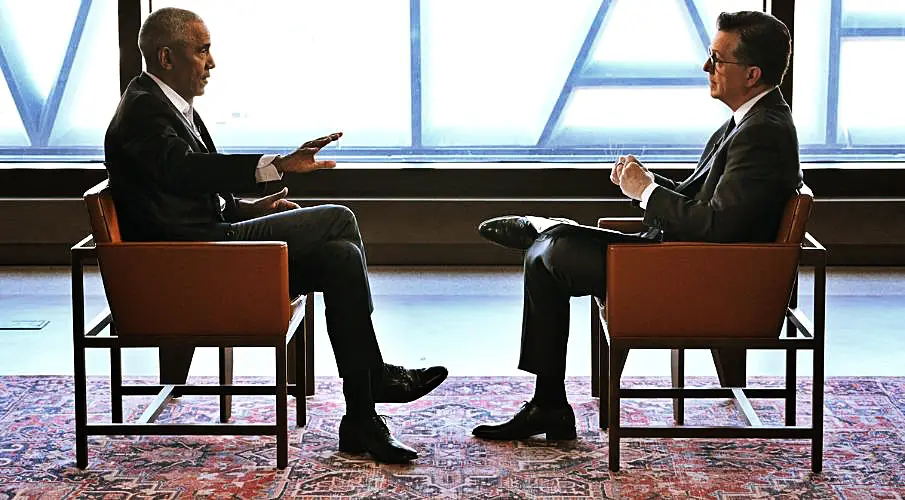
There are evenings when a single sentence carries more weight than an entire speech, and the evening in Chicago was one of those evenings. Barack Obama sat beside Stephen Colbert in the new Presidential Center, the lighting warm, the audience silent, and he said something that in a functioning democracy should never have needed to be said out loud: A president must not use the justice system against his political opponents. Ten years ago, that sentence would have fallen on deaf ears because nobody would have considered it necessary. That evening, everyone listened.
Colbert had asked which powers a president should never have. Obama answered quietly, almost thoughtfully, and it was precisely that calmness that gave his words their weight. The White House, he said, must not tell the Justice Department who should be investigated. The attorney general is the lawyer for the people, not the personal attorney of the man in the Oval Office. Obama never once mentioned Donald Trump by name. He did not have to. Everyone in the room understood who he was talking about, and it was exactly that omission that made the statement sharper than any direct accusation could ever have been.

The context was obvious to everyone as well. Since Trump’s return to the White House, reports have not stopped claiming that the justice system is being turned into an extension of personal vendettas. Pam Bondi, the former attorney general, is said by multiple sources to have received instructions to go after those who stood in Trump’s way. Adam Schiff was reportedly on that list, the man who played a central role in the first impeachment proceedings. So was former FBI Director James Comey. Trump himself has never hidden it. On Truth Social he wrote that Schiff, Comey and Letitia James were guilty as hell, it was just that nothing would happen to them. A sentence that cannot come from the White House in a constitutional state because it damages the constitutional state itself.
That was exactly where Obama aimed, without ever needing to say it directly. When the state begins rewarding friends and punishing enemies, criminal justice becomes a political weapon. On pardons he became more specific. A president, he said, should not pardon people who poured money into his campaign or took part in his business dealings. Then came the line that briefly made the audience laugh, because that laughter was the only way to endure the seriousness behind it. Obama said he had actually believed that this was a fairly obvious principle.

The numbers he did not need to mention speak for themselves. More than 1,600 pardons during Trump’s second term alone. The Wall Street Journal reported that discussions were already underway internally about blanket pardons for staff members and supporters. Trump is said to have made a remark that sounds like a bad joke and yet is not one. He would pardon anyone who had come within two hundred feet of the Oval Office.
The military also came up. A president is commander in chief, Obama said, but the military does not belong to him. The loyalty of the armed forces belongs to the Constitution, not to one individual in the White House. In recent months Trump has repeatedly tried to present himself as the sole center of state power. Critics accuse him of gradually reshaping the military, security agencies and the justice system around personal loyalty.
When the subject turned to money, Obama became the most direct of all. An American president, he said, should not maintain private side businesses into which corporations or foreign actors can invest. Again, no name. Again, everyone knew exactly who he meant. It was as if Obama were reading from a list without ever announcing it as a list, and that was precisely the elegance of his appearance.

Colbert later used the moment for a quieter strike that still landed hard. His show ends on May 21 after eleven years at CBS. A lot of people had advised him to run for president himself, he said, and he asked Obama half jokingly how stupid that idea would be. Obama smiled. The bar, he answered, has changed in recent years. He believed Colbert would perform considerably better than some people the country had seen lately.
The timing of the evening was no coincidence. Colbert had targeted Trump almost daily and lost his show after Paramount, CBS’s parent company, settled a legal dispute with Trump. Trump reacted with open mockery. On Truth Social he wrote that he absolutely loved that Colbert had been fired, and that the talent had been worse than the ratings anyway. Jimmy Kimmel got dragged in as well, with Trump claiming he had even less talent.
Obama did not need loud attacks that evening, no polemics, no mention of the name. Perhaps that was the real message. A former president of the United States had to sit on a talk show and say sentences that once had been so self evident that nobody would have wanted to hear them spoken on a stage. When the self evident has to be spoken aloud again, it has already stopped being self evident.
Updates – Kaizen News Brief
All current curated daily updates can be found in the Kaizen News Brief.
To the Kaizen News Brief In English


Ach wäre er doch bloß wieder President…
Obama repräsentiert wirklich Alles, was Trump nicht ist.
Gebildet
Empathisch
Diplomatisch
Redegewandt
Und noch viele weitere positive Eigenschaften.
Obama hat es nicht nötig Jemanden mit Namen zu nennen um auf dessen Verfehlungen hinzuweisen.
Er Hat es nicht nötig sich auf das Niveau von Trump herab zu lassen.
Leider verstehen MAGA nur polterndes aber substanzloses Geschrei.
Wie hier die Anhänger der AfD