
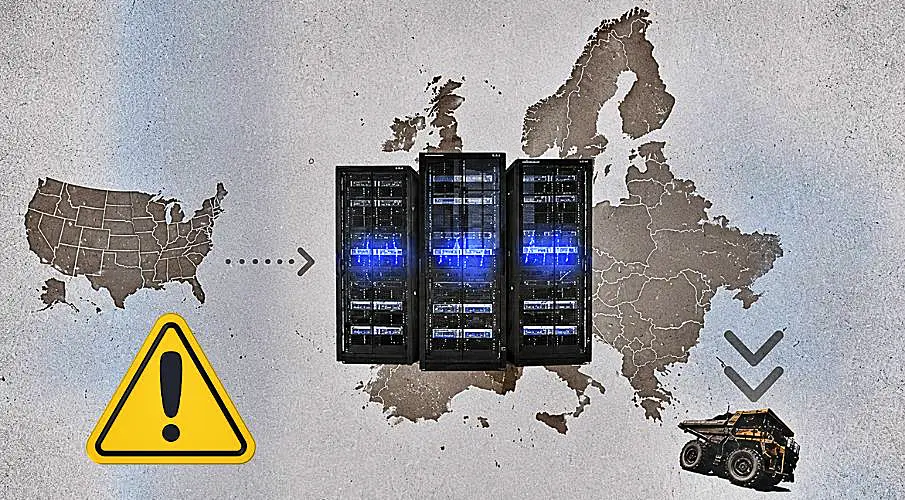
Across the United States, a coalition of journalists, human rights organizations, lawyers, various collectives, anarchists, labor organizers, Indigenous nations, and disillusioned Trump voters is rising against the data centers that consume water and electricity and call it intelligence. In Europe, too, efforts are now underway to unite forces and build common structures. Yet progress remains limited - too few are joining in. Our reporting increasingly shows that AI is giving additional momentum to right wing populist and extremist actors.
At this very moment, between four thousand and five thousand data centers are operating across the United States, drawing electricity from the grid, and the largest among them consume up to nineteen million liters of water per day. It is not enough. At least three thousand more are under construction or planned, and against them a resistance has emerged from one end of the country to the other unlike anything seen in a long time. It comes from directions that otherwise have nothing to say to one another. Indigenous communities are resisting the next seizure of their land and water. In rural areas, white residents are going door to door, some of them voted for Donald Trump, and they are furious over rising electricity bills and over water becoming scarce. Labor unions have entered the struggle, and the Graduate Employees’ Organization at the University of Michigan has taken up the slogan “AI is not inevitable” and sees artificial intelligence as a dark force made possible only through these data centers. On May 13, environmental groups and progressive lawmakers gathered at the Capitol in Albany in support of legislation that would impose a moratorium on new data centers in New York State. This is the front line in the resistance against those high tech billionaires who want to build a world in which all power belongs to them and everyone else serves them.

Krystal Two Bulls, organizer of the group Honor the Earth and a member of the Oglala Lakota and Northern Cheyenne peoples, calls what is happening a techno-feudal struggle. She says an empire is in decline, technology is the final frontier, and whoever possesses the most advanced generative AI holds power at this moment. Indigenous communities are leading the resistance in many places, from Virginia and upstate New York through Montana and the Dakotas to Arizona and Oregon. According to Honor the Earth, a nationwide organization for Indigenous sovereignty, at least 106 data centers are currently planned on or near Indigenous land. These data centers are the material foundation that makes large language models possible in the first place, those programs commonly called intelligence. They gather knowledge and generate new words from it by processing and organizing enormous amounts of language. As much as they may now appear capable of separating what sounds plausible from what is nonsense, they still work with language and not with understanding. It is not smart, writes the author of the report on this machine, it is only huge. In that one sentence lies the entire misunderstanding of this era, a scale mistaken for intellect because it devours everything that has ever been thought and understands none of it.
Read also our articles: Investigations Reveal: Congress Against the People? How Criticism of AI Suddenly Became a Matter for Intelligence Agencies

Developed within capitalism, this artificial intelligence threatens human civilization in more than one way. Companies are using it to rapidly replace human labor, on assembly lines as well as in offices. Many of those involved in its development fear that one day it may not only take jobs but destabilize entire societies and enable ever more oppressive systems of surveillance, even threatening the survival of the human species itself in the darkest scenarios. Already now, the report says, the technology is selecting military targets, and this has led to the deaths of Iranian schoolchildren and people in Gaza. Two Bulls draws the line herself. Generative AI, she says, is being used to monitor citizens and violate their right to privacy, and the same tool is then turned toward military use, the connection to violence becoming immediate. As Indigenous peoples, one honors the Earth, and for that very reason the construction of these data centers and the entire infrastructure of artificial intelligence must be resisted. Seen in the broader context, these developments push the country further away from any response to the climate crisis. For decades it has been known that burning fossil fuels destroys the climate that makes human life on Earth possible. It should stop, yet with Trump’s return to power and Republicans controlling both chambers of Congress, the little that had been achieved is being rolled back at precisely the moment when tipping points are drawing closer and collapse is accelerating.
In western New York State, the Tonawanda Seneca Nation has spent twenty years resisting the industrial development of an area known as the Science, Technology and Advanced Manufacturing Park. The roughly 506 hectares lie beside Big Woods, a natural area of cultural and practical importance to the Seneca and at the same time a protected habitat for wildlife recognized at both the state and federal level. When an attempt was made from outside, from a nearby white settlement, to establish a data center there, the Council of Chiefs asked Grandell Hallett Logan, known as Bird, the reservation’s language coordinator, to become their spokesperson. Logan says the resistance began among people in his own community, but over time a group emerged, the Allies of the Tonawanda Seneca Nation, bringing together Seneca and non Indigenous people from across the rest of the state.
According to the Sierra Club, a confidentiality agreement signed by the Genesee County Development Center prevents the community from even learning which technology company the data center is intended to serve. Before construction can begin, the planning board of the nearby town of Alabama in New York State must approve the project, and it must undergo a state environmental review, opening several possible paths to stop it. In addition, opponents are considering a lawsuit that could delay construction or stop it altogether. Much of their message, Logan explains, concerns the threat environmental damage poses to their traditions and their use of the land, and concern that the noise of a data center would drive away nearby wildlife. Some support the effort, he says, because they see their county and their state acting in ways that repeatedly violate those traditions, and because they would rather not have their government take part in it.
In Michigan, the Los Alamos National Laboratory, founded in 1943 for the Manhattan Project and heavily involved in developing the first atomic bombs, is planning a $1.25 billion data center on land acquired by the University of Michigan near Ann Arbor in Ypsilanti Township. University employees, some of whom had previously advocated for Palestine and examined how artificial intelligence is changing education, have now joined the fight against the data center. Nathan Kim, a member of the union representing academic employees, who had previously led workshops under the title of a “worker inquiry” into AI, describes the resistance in the surrounding community as inspiring because it brings together organized campus workers and local residents. It changed the way he thinks about politics, he says. Not everything is hopeless. There will always be people who resist. Many were angry, he says, but hardly anyone saw themselves as a leader from the beginning.
This is not new when ecological hardship reaches a community. Think of the people in Flint, Michigan who received poisoned drinking water, or those in the Love Canal neighborhood near Niagara Falls in New York State who lived with toxic waste. Anger and fear are often followed by disillusionment with the way authorities respond. When it comes to data centers, Kim says there is accumulated resentment, a hatred of large corporations for which these facilities have become an outlet. It is about utility networks and the constant hum of the facilities, certainly about water consumption, but above all about the fact that major technology companies have continued taking more and more without ever being held accountable.
What is remarkable about the way people organize in this part of Michigan is its horizontal structure, rooted in the anti authoritarian organizing of the anti globalization movement around the turn of the millennium and later in the Occupy movement. It is organized in the form of a spokes council, says Samantha Stewart, who lives in Ypsilanti Township and is active against the data center. There are countless working groups, she herself knows of seventeen that meet regularly, and each does what it believes makes sense. In such a model, the smaller groups send delegates into a spokes council that makes decisions. There are large monthly gatherings where everyone comes together, always with food and childcare, no one leads, every group does what it wants. What holds this free assembly together are only a few agreements, that people do not publicly condemn one another and that they do not cooperate with police if police investigate someone from within their own ranks.
Ypsilanti is more working class and has a very vibrant anarchist movement, Kim says, but the fight against data centers across Michigan is diverse. Once he attended a meeting in Augusta, held in a barn that served as a viewing space for university football games and carried the words “Faith, Family, Freedom” above the entrance. Encounters with Trump supporters, Kim says, are quite common. The campaign was so welcoming, Stewart adds.

People hated the data centers for all kinds of reasons, Stewart says. Serious health risks worried many. People feared higher bills and the destruction of a beloved park. Many opposed the escalation of war and were afraid of being connected to laboratories known for developing nuclear weapons, or feared becoming a military target themselves because of such a facility. When she knocks on doors, she says, she meets countless people with Trump signs in their front yards who deeply oppose the data center. Republicans often struggle because they usually lack experience organizing and do not really know how to make things happen together. We are a multiracial and in large parts transgender group, Stewart says, and we do not exactly fit together with them, but everyone does their own part and coordination still happens.
It is the task of the left, Kim says, to understand the legitimate concern at the core of every Trump voter’s beliefs and then recognize how to respond with a vision that transforms society, one in which people care for one another, cover everyone’s basic needs, and stand for peace.
The technology industry and the fossil fuel industry are among the largest parts of that ruling class that supports Trump and carries the transformation of the United States into an openly authoritarian state. Yet cracks are appearing within parts of the Trump movement at the grassroots level. First, Steve Bannon and other movement activists turned with racist and anti immigrant sharpness against the desire of major technology companies to grant visas to highly skilled workers. Supporters of the movement also voiced opposition to the American Israeli war against Iran and to continued American financial and military support for Israel, including during what the report describes as the genocide of Palestinians and the war in Lebanon. And now many people who voted for Trump repeatedly are opposing the construction of the technology industry’s sacred data centers in their own communities.

Where Indigenous people, labor organizers, and the left meet these disappointed Trump supporters, an opportunity emerges for mutual understanding. Perhaps these encounters broaden the perspective of those who follow Trump and remain hostile toward other working people, including those who only recently came to the country in search of a better life. Broadening a perspective requires difficult conversations. If those conversations are held with an understanding of the very real hardship that drives people toward Trump, then the space created by these unfinished alliances can be used to redirect anger away from scapegoats and toward the forces that drive ecological destruction, exploitation, and ultimately war.
The fight against data centers is only one front in the resistance against growing authoritarianism and ecological collapse, yet it stretches across political divides and could ignite a larger movement. Stewart takes the long view. She says she wants to build trust and courage across a broad group of people so that they will be ready for whatever comes next and whatever must be fought for.
That leaves the word with which everything began. We call this machine intelligence, yet it understands nothing of what it consumes. It needs the water of rivers and the power of electrical grids, and it needs the land of the living, and in return it offers scale disguised as intellect. Whoever controls the most powerful of these systems, so one hears, possesses the power of this moment. Perhaps that is the real question beneath all the noise and thirst. Not whether the machine will one day think, but whether human beings will still be necessary in a world being built so that a few own everything and everyone else serves them. That people who were once strangers to one another are coming together against this world is the only thing in this story that carries hope. And while some are fighting the machine, others have long understood what it is useful for. Our reporting increasingly shows that artificial intelligence is giving additional momentum to right wing populist and extremist actors. For those who do not value truth in the first place, a tool that can generate any desired image in the same instant is not an obstacle but a gift. Manipulation no longer costs anything, and spectacle replaces argument long before reason is even asked. In that way the same technology turns against people a second time by placing the loudest tools into the hands of those who have the least to lose if, in the end, nothing has to remain true.


