
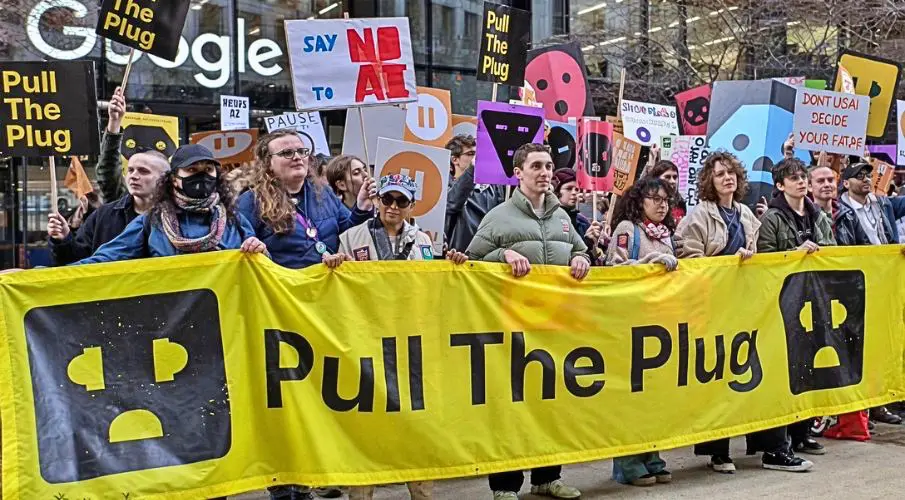
Opposition to Artificial Intelligence has been growing across the United States for months. Citizen groups are fighting against new data centers, local residents are protesting rising water consumption, environmental advocates are warning about ever increasing energy demands, and many people are concerned about how far government and private surveillance may eventually extend with the help of new technologies. All of this is part of a democratic society. Yet in Washington, this development increasingly appears to be viewed through a different lens.
An internal intelligence bulletin from the Intelligence Services Bureau of the Capitol Police, obtained by Kaizen Blog, shows what priorities security agencies are now setting. The unit was created after the January 6 attack on the Capitol and is intended to strengthen coordination between the congressional police apparatus and U.S. intelligence agencies. The agency now maintains its own analytical capabilities and distributes reports to law enforcement agencies and so called fusion centers across the country.

At the center of an April report is public opposition to data centers and AI projects. The agency states that it seeks to inform security personnel about potential threats that could be associated with resistance to data centers. Particularly noteworthy, however, is another section of the document. It explicitly states that the Capitol Police are currently investigating no specific threats against members of Congress motivated by opposition to data centers.

Particularly remarkable is the content of the intelligence bulletin itself. The Capitol Police explicitly state that they are currently investigating no specific threats against members of Congress motivated by opposition to data centers. Nevertheless, a multi page report was produced and distributed nationwide to security agencies. The document not only references an attack on the home of a local politician and older criminal cases, but also catalogs numerous social media posts containing criticism of data centers, rising energy costs, environmental impacts, or possible government AI surveillance. The report explicitly identifies these concerns as reasons for growing public resistance. At the same time, it even devotes an entire page to threats against OpenAI CEO Sam Altman, despite the fact that Altman is neither an elected official nor within the normal jurisdiction of the Capitol Police. The result is the impression that not only potential acts of violence, but increasingly the social opposition to the expansion of AI infrastructure itself, is becoming the subject of intelligence monitoring.
Nevertheless, the report portrays a picture of growing dangers. This assessment is based in part on political decisions surrounding Artificial Intelligence that, according to the authors, are likely to continue generating opposition. As a result, the focus shifts away from any specific criminal act and toward the possibility of future criticism. The analysis was apparently prompted by an attack on the home of Indianapolis City Council member Ron Gibson, which occurred during the night of April 6, 2026. Gibson supports a local data center project. According to police, thirteen shots were fired into his home. A note reading “No Data Centers” was also left behind. No suspect has been arrested to date. Gibson unterstützt ein lokales Rechenzentrumsprojekt. Nach Angaben der Polizei wurden dreizehn Schüsse auf sein Haus abgefeuert. Zudem wurde ein Zettel mit der Aufschrift „Keine Rechenzentren“ hinterlassen. Bis heute wurde kein Tatverdächtiger festgenommen.
Read also our article: AI Was Supposed to Sell the Future - Now It Is Suddenly Selling Fear: Former Google Chief Ruthlessly Booed - Our Investigations Into Musk
The report also documents various social media posts. Some users expressed themselves in extreme and at times violence endorsing terms toward politicians who support data centers. However, the Capitol Police themselves acknowledge that these statements do not constitute actionable threats. Even so, the document demonstrates that the agency is systematically monitoring public discussions concerning data centers and Artificial Intelligence. The arguments being tracked include concerns shared by millions of Americans. Among them are fears of government surveillance, environmental damage, rising energy costs, and potential job losses resulting from automation.
Germany is also familiar with questions surrounding how government agencies respond to social protest. Whether involving climate demonstrations, debates over digital surveillance, or controversial political movements, disputes regularly arise over when authorities are monitoring genuine security risks and when the monitoring itself becomes a subject of democratic debate. The report now emerging from Washington shows that similar questions are increasingly being raised regarding Artificial Intelligence and the infrastructure of major technology companies.
The agency also references older crimes connected to data centers. Among them is Seth Pendley, who was arrested in 2021 for plotting an attack on a data center in Virginia. The case is now more than five years old. Pendley is currently serving a sentence in a federal prison in Indiana. Nevertheless, he is cited in the report as an example. Another section is particularly striking. The analysis devotes considerable attention to threats against OpenAI CEO Sam Altman. Altman is neither a member of Congress nor a government official and would not ordinarily fall within the jurisdiction of the Capitol Police. Yet the subject receives extensive coverage in the report. Following one incident, Altman stated that he had underestimated the impact of public debate. In his view, sensationalized media coverage had contributed to a dangerous atmosphere. Critics see this as an attempt to shift responsibility away from corporations and onto public discussion itself.

A recent Gallup poll shows that opposition to new AI data centers in the United States is significantly greater than support. Seventy one percent of respondents oppose the construction of such facilities in their communities, including forty eight percent who express strong opposition. Only twenty seven percent support such projects. The findings underscore the growing skepticism many Americans feel regarding the consequences of the rapid expansion of AI infrastructure.
At the same time, opposition to new data centers continues to grow among the public. According to a recent Gallup survey, seven out of ten Americans oppose the construction of new AI data centers in their immediate area. The reasons range from environmental concerns and rising electricity prices to the enormous water consumption of many facilities. For that reason, the report raises important questions. It describes the concerns of the public but spends little effort examining why those concerns arose in the first place. Instead, the analysis focuses primarily on potential risks that may emerge from resistance to these projects.
The result is a remarkable picture. While more and more people are debating the social consequences of Artificial Intelligence, Congress is simultaneously expanding its own intelligence structures that monitor this very resistance. The real debate is therefore no longer limited to data centers or Artificial Intelligence. It is also about how a democratic state responds to citizens who openly criticize political decisions and organize public opposition to them.
Updates – Kaizen News Brief
All current curated daily updates can be found in the Kaizen News Brief.
To the Kaizen News Brief In English


Die Regierung gegen das Volk wäre wohl passender.
Was in den USA passiert ist so unfassbar.
Der Umbau einer Demokratie in eine Autokratie im Turbomodus.
Kritiker an der Regierung, egal zu welchem Thema, sind unerwünscht.
Das Ziel ist es zeitig Kritiker zu beobachtdn und Widerstand möglichst im Keim zu ersticken.
Ich finde es sehr gut, dass sich die Menschen gegen KI Zentren wehren.
Sie verbrauchen überproportional vuele sehr wertvolle Ressourcen.
Allem voran Wasset.
Aber auch Strom.
Es gibt Orte an denen der Strom sich drastisch verteuert hat, seitdem dort ein KI Zentrum steht.
Zeitweise haben die Bewohner gar keinen Strom.
Der nächste Sommer wird das Problem noch verschärfen.
Danke für den interessanten Bericht.