
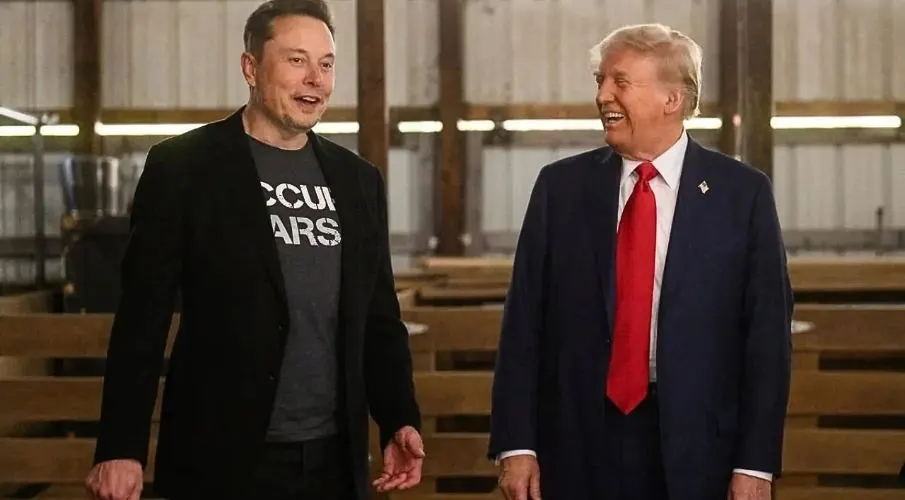
Americans haven't even elected their new Congress yet, and Donald Trump is already thinking about how to protect his closest allies from potential investigations. At the top of the list is Elon Musk. The world's richest man, whose companies make billions from government contracts, could face some uncomfortable questions if control of the House of Representatives changes hands. Trump has an answer for that. He says he'll protect Musk. He also explicitly refuses to rule out preemptive pardons for members of his administration. The right to demand accountability is running up against a president who would rather shield his friends from the consequences of such questions.
In an interview with journalist Miranda Devine released on Monday, November 2, Trump was asked about fears that Democrats could investigate Musk after the midterm elections or even seize his assets. The possibility of nationalizing his space company, SpaceX, also came up. Trump initially dismissed those ideas as talk. But if they actually turned into real actions, he said, "we'll have to protect them." Democrats have not announced any concrete plans to nationalize SpaceX. The question itself was based on fears whose factual basis remains far from clear.
President Trump says Elon Musk must be protected if Democrats target him or SpaceX.
The conversation got more interesting when Devine asked about preemptive pardons. Would Trump pardon people in his circle if Democratic lawmakers launched investigations into them? "I would if I needed to. Sure," the president replied. He wouldn't "even think about it." He would just do it. That willingness is now out in the open before anyone even knows what investigations might take place or who might be targeted. The presumption of innocence applies to everyone, of course. But granting preemptive pardons out of political loyalty would be an extraordinarily generous interpretation of presidential protection.
The distinction between congressional oversight and criminal prosecution deserves particular attention here. The American president has sweeping powers to grant pardons for federal offenses. But a pardon does not automatically prevent Congress from conducting investigations or questioning witnesses. Trump can therefore influence the criminal consequences of certain actions, while congressional oversight generally remains intact. His remarks leave open exactly whom he would protect and what potential allegations might even be involved.

Meanwhile, Musk has considerable political and financial interests in Washington. The businessman heads Tesla and SpaceX. According to American reporting, he spent nearly $500 million during the current election cycle working to defeat Democratic candidates. At the same time, his companies have extensive business relationships with the federal government. Whether political connections play a role in awarding government contracts is therefore among the questions Democratic lawmakers could investigate. Such suspicions are not proof of illegal conduct. They call for documentation if the appropriate authorities decide to investigate.

Musk himself has further escalated the political confrontation. He warned that democracy would come to an end if Democrats won both the White House and Congress in 2028. Meanwhile, his companies depend on a government whose political future he describes in such dramatic terms. The relationship between economic power and public influence has always been delicate. Especially when someone with enormous wealth helps shape political decisions and can then count on the president's protection.

The upcoming midterm elections could expose that relationship to congressional scrutiny. Polls show Republicans struggling as they fight to hold on to their majorities. If Democrats take control of the House of Representatives, investigations into administration officials and people close to Trump would be possible. That could mean 2 contentious years ahead for the president. His response already points toward confrontation. In his understanding of politics, the ability to hold power accountable seems to quickly become a threat to those who wield it.

Trump also talked about another term in office. He said he would love to serve a third term, but acknowledged that the constitutional language was "very exacting." The 22nd Amendment to the U.S. Constitution limits a president to being elected to 2 terms. Trump also pointed out that he still has more than 2 years left in the White House and that a lot could be accomplished during that time. His attention is already reaching beyond the next election, even as he considers whom he might protect from potential investigations.
The American Constitution divides power so that no one can claim it indefinitely. Trump talks about those limits with the ease of a man who would prefer to see them apply mainly to everyone else. His friends, at least, can count on some special attention.
Updates – Kaizen News Brief
Alle aktuellen ausgesuchten Tagesmeldungen findet ihr in den Kaizen Kurznachrichten.
To the Kaizen News Brief In English


