
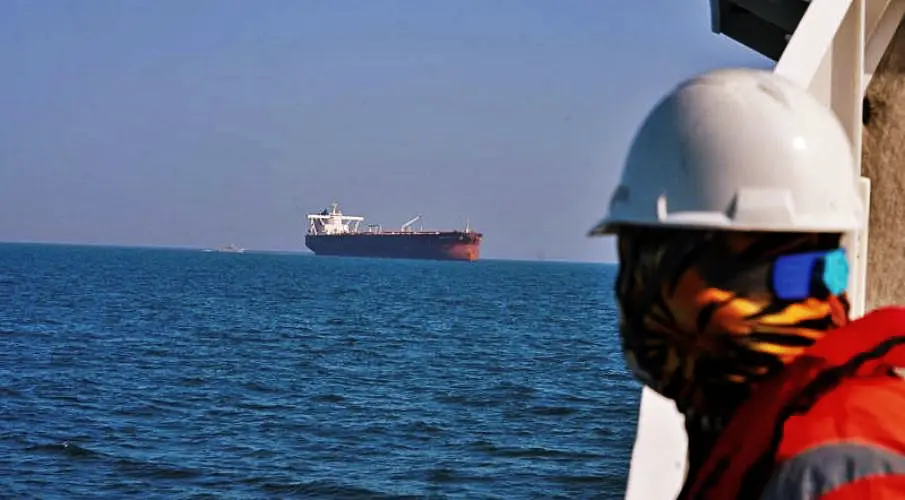
The words came in the morning. Control, order, a return to the “previous state.” What Iran meant by that became visible just hours later on the water. Two speedboats of the Revolutionary Guards opened fire on a tanker, a container ship was hit by a projectile, other ships turned around. The Strait of Hormuz was once again what it has been for weeks: a place where every passage becomes a decision.
Tehran has hardened its line. The leadership declared that the strait is once again fully under military control. Transit now exists only under Iranian rules. Ships must be approved, follow routes, pay fees. Those who do not belong or are considered hostile have no right of passage. At the same time, Iran makes clear why it has come to this. As long as the United States maintains its naval blockade against Iranian ports, Hormuz remains under pressure.

The immediate consequences could be measured. As recently as Friday and in the early hours of Saturday, according to data from the analytics firm Kpler, nineteen ships had used the passage, a cautious increase after weeks of restraint. Then that movement collapsed. The British monitoring service recorded two attacks. In one case, units of the Revolutionary Guards fired on a tanker without radio warning, whose crew remained unharmed. Shortly afterward, a projectile hit a container ship, damaging parts of its cargo. Ships turned back, others followed.
Several ships sailing under the Indian flag were directly affected. After shots by the Revolutionary Guards, at least two Indian tankers turned around, including a supertanker carrying around two million barrels of oil. Units of the French shipping company CMA CGM also turned back near the island of Larak, which has developed into a control point for Iranian authorities. India reacted immediately, summoned the Iranian ambassador, and demanded the restoration of safe passage. The Danish company Maersk suspended its transits. In total, more than twenty ships have been attacked in recent weeks, and most recently only about one ship per day has passed the route on average. The next 72 to 96 hours are considered decisive. Within this short time window, it will become clear whether shipping companies return or whether the strait is effectively avoided.
While shots are being fired at sea, talks continue in the background that barely match the situation anymore. In Islamabad, Pakistan is continuing to prepare for a new round between Washington and Tehran. Prime Minister Shehbaz Sharif has returned from talks in Saudi Arabia, Qatar, and Turkey. Army chief Asim Munir had previously been in Tehran, delivering proposals that Iran is now reviewing. Officially, the talks are described as complex and requiring time. Unofficially, every new incident at sea shows how far apart both sides still are.
Washington is at the same time maintaining pressure. The U.S. military says it has forced more than twenty ships to turn back since the beginning of the blockade. President Donald Trump speaks of good talks but accuses Iran of once again trying to close the strait. The United States will not be blackmailed. These are sentences meant to sound like control, while outside the exact opposite is happening.
Tehran is also sending clear signals. The National Security Council declares that free passage will only be possible again once the war ends and the U.S. blockade is lifted. Until then, Iran intends to register, certify, and control every ship. Ayatollah Mojtaba Khamenei speaks of a navy ready to inflict new defeats. Whoever uses Hormuz moves on Iranian terrain.
At the same time, fragile calm is breaking elsewhere. In southern Lebanon, a UNIFIL soldier was killed and three others injured. France confirmed the attack, while Hezbollah denied any responsibility and called for an investigation. Here too it becomes clear how thin any ceasefire is.

And above all stands a voice that deliberately withdraws. Pope Leo XIV says it is not in his interest to argue with Trump. He will continue to speak for peace, regardless of who feels addressed.
What is visible on this day is not a new escalation. It is the return to the reality of this war. One day is enough to turn an alleged opening back into military control. A few hours are enough to turn talks into new threats. And a few shots on the open sea are enough to show that the most important waterway in the world remains in the hands of those willing to close it at any moment.
To be continued ...
Updates – Kaizen News Brief
All current curated daily updates can be found in the Kaizen News Brief.
To the Kaizen News Brief In English


Es war leider zu erwarten.
Die Positionen liegen weit auseinander.
Trumps Arroganz und öffentliche Lügerei verschärfen die Lage.
Jetzt eskaliert der Iran.
Von Papst Leo bin ich enttäuscht.
Nach diesen guten Reden, jetzt ein abmildern.
Warum hat er es nicht einfach stehen gelassen?
Ohne weiter darauf einzugehen?