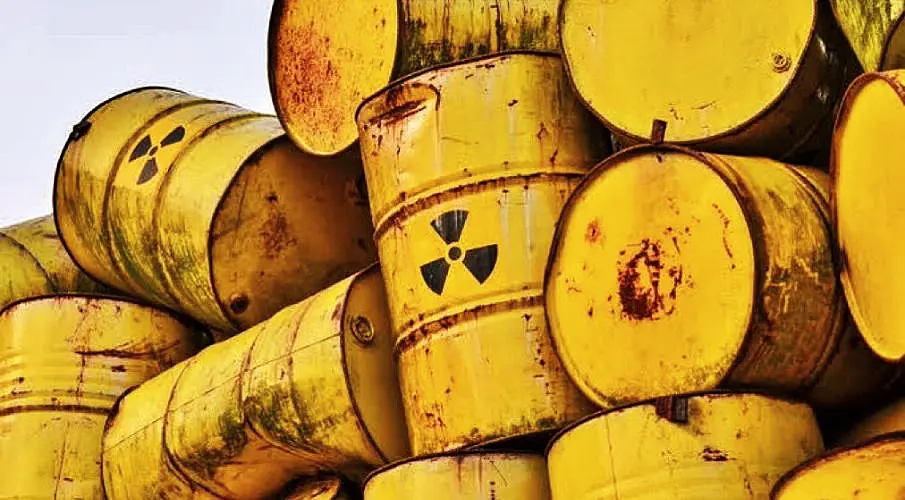
Our investigation indicates that Beijing is prepared to take in highly enriched uranium from Iran. It is about 440 kilograms of material - an amount that fits on a sheet of paper and is still heavy enough to tip any negotiating table. After American strikes on Iranian nuclear facilities, this uranium is still believed to be inside the country. Not openly visible, not secured, not forgotten.
This material is the hard core of the negotiations over a possible end to the war. Donald Trump is demanding that it be removed from Iran. In Washington, there are considerations to take control of it directly. And then, almost quietly, a second option emerges. China signals behind the scenes that it would be ready to take over the uranium or blend it down to a level suitable for civilian use. An offer that no one says out loud, but everyone hears.

This willingness is tied to conditions that act like locks requiring multiple keys. Both the United States and Iran would have to agree. Officially, Beijing does not comment on it. But diplomatic sources confirm that this possibility is being examined internally. China is Iran’s most important trading partner. That gives the country a role that goes beyond simple mediation. It could not only exert influence, but take on direct responsibility - a word rarely used voluntarily in this region.
The decision is not simply on the table. It lies beneath it. The material is located under damaged facilities, partly buried, difficult to access. What can be decided politically cannot be implemented technically right away. Every attempt to reach it would be a risk, every transport an operation of its own, every movement a sentence that must be written before it can be spoken.
At the same time, a second question hangs over everything, and it carries more weight than any recovery effort. Who gets control? If China takes possession of the material, a central part of it would no longer be in American hands. For Donald Trump, that is exactly the point at which a technical solution becomes a political problem. Control here is not a tool. Control is the objective.

Among the parties, the foundation needed to carry such steps is missing. Decisions are made while being questioned at the same time. Every proposal remains conditional, every movement feels provisional - as if one were stepping onto bridges without knowing whether they are finished.
Trump speaks of “nuclear dust.” A phrase that creates impact, but is not substantiated. No independent body confirms this description. The only clear fact is that the material exists and that it does not simply disappear. Dust settles. This material does not.
And that is where the pressure lies. The quantity seems limited, but it is enough to shape any agreement. 440 kilograms that weigh more than any words at the negotiating table. As long as this material remains unresolved, everything else stays provisional. A war that could end, but cannot, because a number has not yet found its place.
Such a step would not be without precedent. In 2015, as part of the nuclear agreement at the time, Iran transported around 11,000 kilograms of low enriched uranium to Russia. At the time, it was a requirement for implementing the deal. A difficult step, but a workable one. Today, the situation is more complex. The quantities are smaller, the mistrust greater, the military escalation still present. The material lies partly under damaged facilities, difficult to access, yet still relevant - like a bill pushed under a stack that does not stop existing.
The question is not only who gets it, but whether it can be moved at all. China is positioning itself. Not publicly, but visibly. Like someone standing at the edge of a room, waiting to be asked to step closer.
And that brings the conversation to where it has to go. Away from promises, toward concrete actions. Away from talking. Toward handling it. And it is precisely there, at the moment of handling, that the real tension begins.
Updates – Kaizen News Brief
All current curated daily updates can be found in the Kaizen News Brief.
To the Kaizen News Brief In English


Scheint wie ein Schimmer einer möglichen Lösung. Ob daraus mehr Licht wird oder noch größere Dunkelheit ist offen
Ob die USA bereit sind hoch angereichertes Uran nach China zu verbringen (unabhängig von der Tatsache, dass der Iran sicher nicht alle Lager preis gibt, sondern vor allem die, die stark verschüttet sind)?
Wer soll kontrollieren, was damit geschieht?
Wer soll es bergen?
Der Iran wird keine dauerhafte Militärpräsenz in seinem Land dulden.
Private Internehmen? Wer soll es bezahlen.
Ich fürchte eher, dass Trump da mit seinem „Buddy“ Putin einen Deal macht.
So wie recht still die Sanktionen für russisches Öl und Gas für einen weiteren Monat ausgesetzt werden.
Kurz nachdem es noch von offizieller Seite hieß, die Sanktionen werden nicht weiter ausgesetzt.
Ein Schelm, wer böses dabei denkt.🤬
Inwieweit China hier deeskalieren kann, wird sich zeigen.
Fragen über Fragen.