
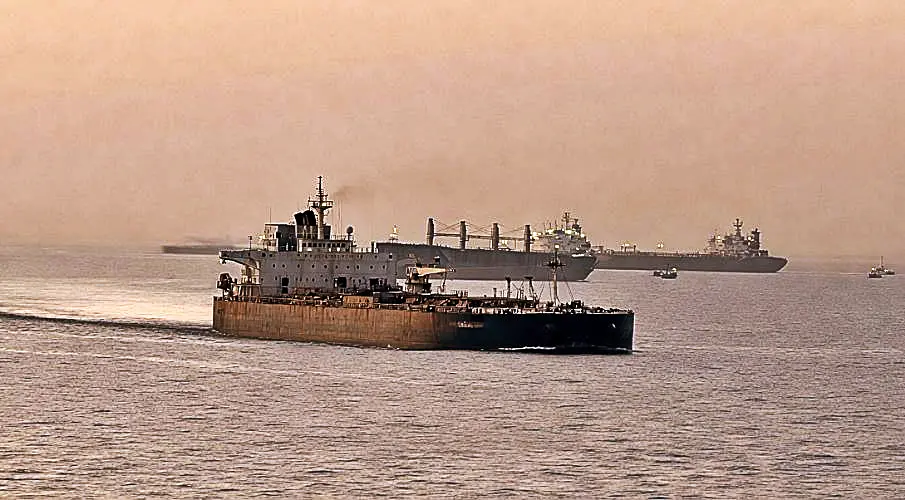
One day after the announcement that the Strait of Hormuz would be reopened, Iran’s Revolutionary Guard closed it again on Saturday. No ship should move from its anchorage in the Persian Gulf or the Arabian Sea, according to a statement broadcast through state media. Anyone approaching the strait would be treated as cooperating with the enemy - and handled accordingly.
The immediate trigger was an American maneuver that Tehran views as a violation of the ceasefire. Trump had declared the Strait of Hormuz open, but the U.S. blockade of Iranian ports remained in force. For the Revolutionary Guard, that was not a nuance but a contradiction that had to have consequences. “It is impossible for others to pass through the Strait of Hormuz while we cannot,” said Mohammad Bagher Ghalibaf, Iran’s parliament speaker and chief negotiator in the talks in Islamabad. “If the United States does not lift the blockade, transit through the Strait of Hormuz will certainly be restricted.”

While these statements were still unfolding, two Indian-flagged ships were fired upon near the strait. India reacted quickly: the foreign ministry in New Delhi summoned the Iranian ambassador, described the incident as “serious,” and demanded that Iran restore safe passage for Indian vessels. Before the ceasefire, India had still negotiated safe passage for eight of its ships - that agreement now appears to be void.
Somewhere in the Strait of Hormuz, a captain reaches for the radio. He has authorization. He has a position. He has done everything required for a ship to legally pass through a strait. And yet now he hears things that do not match what was promised just minutes earlier. He calls in. Names the ship. Gives the coordinates. Reminds them that passage had been cleared. His voice does not break, but it searches - for someone on the other side who answers, who explains, who at least listens. “You cleared me to pass. Now you are opening fire.” Silence.
Units of the Revolutionary Guard have already approached. The shots have already been fired. And over the same radio channel on which the captain is still speaking, a new broadcast goes out to all ships in the region - the strait is closed, no one may pass. The same strait that minutes earlier had been open. No transition, no explanation, just a new reality replacing the old one while the Sanmar Herald is still in the middle of it.
Ghalibaf spoke on Saturday in a live broadcast address to the Iranian population. He described the ceasefire as a success for Iran - the United States and Israel had neither overthrown the government nor secured international support for controlling the strait. “If the enemy does not achieve its goals, that means it has been defeated,” he said. At the same time, he emphasized that Iran continues to control the Strait of Hormuz and will respond with full military force to any American step Tehran considers a violation of the ceasefire - including mine-clearing operations. “We are fully prepared. If they make the smallest mistake, we will respond with full force.”
Mohammad Bagher Ghalibaf: “The Strait of Hormuz is under the control of the Islamic Republic of Iran. We responded decisively to the U.S. attempt to clear mines and treated it as a violation of the ceasefire. The situation escalated to near direct confrontation, but the opponent withdrew. If traffic is currently taking place through the strait, it is only because control of the waterway is in our hands.
The Americans have announced a blockade in recent days - that is a reckless and ignorant decision. It is impossible for others to pass while we cannot. If the United States does not lift the blockade, movement through the Strait of Hormuz will definitely be restricted.”
“Iran played a little cheeky, they wanted to close the Strait of Hormuz again - but they cannot blackmail us.”
The negotiations between Iran and the United States have made progress, Ghalibaf said, but remain far from an agreement. Any deal must be gradual and reciprocal. The United States must “earn the trust of the Iranian people” and move away from unilateral pressure. Militarily, Iran cannot match the United States, he acknowledged - but that gap has been offset by strategy and asymmetric warfare.
At the same time, Naim Qassem, Secretary General of Hezbollah, spoke from Beirut. He described the ten-day ceasefire with Israel, which came into force overnight Friday, as a victory for his organization. He tied a lasting peace to two conditions: the complete withdrawal of Israeli troops from Lebanon and a permanent end to Israeli attacks. Israel has so far stated that its troops will remain in southern Lebanon during the ceasefire and has signaled that a buffer zone in the south may remain occupied afterward. The U.S. State Department had stated in its ceasefire announcement that both sides had agreed Hezbollah should be fully disarmed. Qassem said his organization is “fully open to cooperation with the Lebanese authorities in a new chapter based on Lebanon’s sovereignty.” What that means in concrete terms, he did not specify.
What becomes clear on this Saturday: the ceasefire exists on paper, but the positions that led to this war remain unchanged. Iran holds the strait. America holds the blockade. And somewhere between those two decisions lie two ships under fire and a negotiation that, by both sides’ own admission, is still far from an end.
Updates – Kaizen News Brief
All current curated daily updates can be found in the Kaizen News Brief.
To the Kaizen News Brief In English


Iran öffnet die Strasse von Hormus, die USA blockieren sie.
Iran schließt sie wieder.
Die Positionen liegen genau so weit auseinander, wie am Anfang des Krieges.
Ebenso bei Israel und Hisbollah.
Man redet, man unterzeichnet…..
Besser als wenn Bomben fallen.
Aber noch lange kein großer Schritt hin zum Frieden
… es muss eine diplomatische lösung her, bevor es wirklich vollkommen aus dem ruder laeuft