
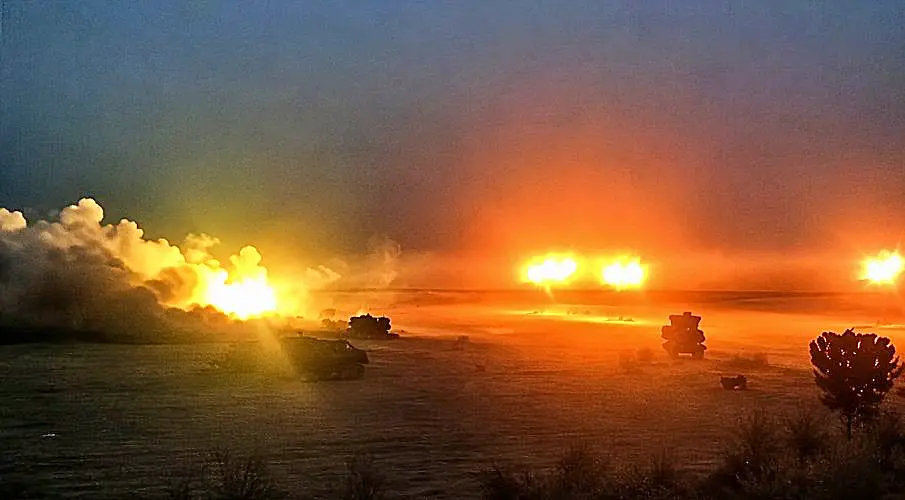
The war between the United States and Iran is no longer being fought only through missiles, airstrikes, and diplomatic statements. Increasingly, the confrontation is shifting onto trade routes, ports, financial flows, and control over who is still allowed to move through one of the most important regions of the global economy. On Tuesday, U.S. Central Command reported another incident in the Persian Gulf. According to the military, American forces stopped the seventh commercial vessel that had allegedly attempted to break the American blockade of Iranian ports. The vessel involved was the Botswana flagged M/T Lexie.
According to the military’s account, the crew ignored repeated warnings from U.S. forces for more than 24 hours. An American aircraft ultimately fired a Hellfire missile into the ship’s engine room, disabling it. According to later reports, the incident took place near Kharg Island in the Persian Gulf, an area that has been central to Iran’s oil economy for decades. The M/T Lexie was not the first case. Just days earlier, American forces had stopped another commercial vessel, the Lian Star, in a similar manner. According to the military, this brought the number of disabled commercial ships to six, although one was later allowed to continue its voyage. In addition, 122 vessels have now reportedly been redirected.
This visibly changes the American strategy. The blockade is no longer directed solely at individual companies or sanctioned entities. It now intervenes directly in trade movements and shifts the question from economic pressure to operational control over transportation routes.
At the same time, the military situation across the region continued to intensify.
The U.S. military stated that Iran launched missiles and drones on Tuesday against Bahrain, Kuwait, and civilian vessels in regional waters. Several projectiles were intercepted or failed to reach their targets. Later, Central Command additionally reported another Iranian drone wave directed at American forces in Kuwait. American air defense systems reportedly destroyed multiple drones. According to the military, there were no damages or injuries.
Iran presented the situation differently.
The Revolutionary Guards stated that they had attacked the headquarters of the U.S. Fifth Fleet in Bahrain as well as an American ship referred to by Iran as Panaya. The United States responded with strikes against an Iranian military ground control station on Qeshm Island off the Iranian coast. Washington again described the action as self defense and pointed to Iran’s conduct. Tehran in turn cited those same attacks as justification for its own military measures. This continues a development that has been visible for days. While ceasefire language continues publicly, the number and intensity of military contacts continue to rise.
Secretary of State Marco Rubio told the Senate on Tuesday that a preliminary agreement with Iran could be reached today, tomorrow, or next week. At the same time, he made clear that nobody could guarantee whether such an agreement would prove politically sustainable. Rubio also stated that Washington was unwilling to meet two of Iran’s central demands, easing sanctions and releasing frozen funds, in order to restart talks or stabilize traffic through the Strait of Hormuz. And then this followed:
„Der Krieg ist vorbei“ “The war is over.” - (At this point one seriously has to ask whether this administration still knows what it says and what it is actually doing: Editorial note)
President Donald Trump also commented on the negotiations and stated that nobody could say where those talks would ultimately lead.
The conflict continued to expand beyond Iran as well.
Representatives of Israel and Lebanon met in Washington for new talks under American mediation. At the same time, Israel continued its operations in southern Lebanon. Marco Rubio stated that the United States was deliberately trying to separate talks between Israel and Lebanon from negotiations with Iran. According to the American position, Tehran is instead attempting to connect both developments and thereby gain political leverage.
At the same time, Washington increased economic pressure. The U.S. Treasury Department imposed sanctions on Nobitex, Iran’s largest cryptocurrency exchange, several of its founders, and additional associated actors. According to the American government, the platform helped circumvent sanctions, maintain international financial flows, and facilitate financial transactions benefiting Iranian structures. Treasury Secretary Scott Bessent stated that despite the economic crisis, Iran’s leadership was deliberately using digital assets to stabilize its own power structures.
According to the Treasury Department, assets totaling nearly half a billion dollars have now been frozen. At the same time, international financial networks and supply structures have come under increased pressure.
An additional escalation occurred at sea. Mediterranean Shipping Company, the world’s largest container shipping company, stated that its vessel Sariska V was struck by two projectiles while departing the Iraqi port of Umm Qasr. The crew remained unharmed. Iranian authorities later claimed responsibility and linked the attack to American actions against Iranian vessels in the Gulf of Oman.
Markets reacted accordingly with nervousness. After oil prices initially rose sharply, they fell back again on Tuesday. Uncertainty nevertheless remained. The conflict is continuing to develop in a direction where military measures, economic pressure, and control over trade increasingly overlap. At the same time, it is becoming more difficult to recognize where economic sanctions end and direct confrontation begins.
Updates – Kaizen News Brief
All current curated daily updates can be found in the Kaizen News Brief.
To the Kaizen News Brief In English


Wie oft hat Trump oder seine Regierung jetzt den Irankrieg beendet?
6x? 7x?
Ich habe komplett den Überblick verloren.
Was USA und Iran sagen, weicht weiter voneinander ab, als die Entfernung zwischen den Ländern groß ist.
Mit solchen Angriffen von beiden Seiten, ust eine diplomatische Lösung sicher nicht in Kürze zu erwarten.
Die Märkte reagieren, Trump und seine Entourage kassieren.
Kein Wunder, dass Trump persönlich erstmal kein Interesse am Kriegsende hat.😞
Und der Kongress hält ihn nicht auf.