
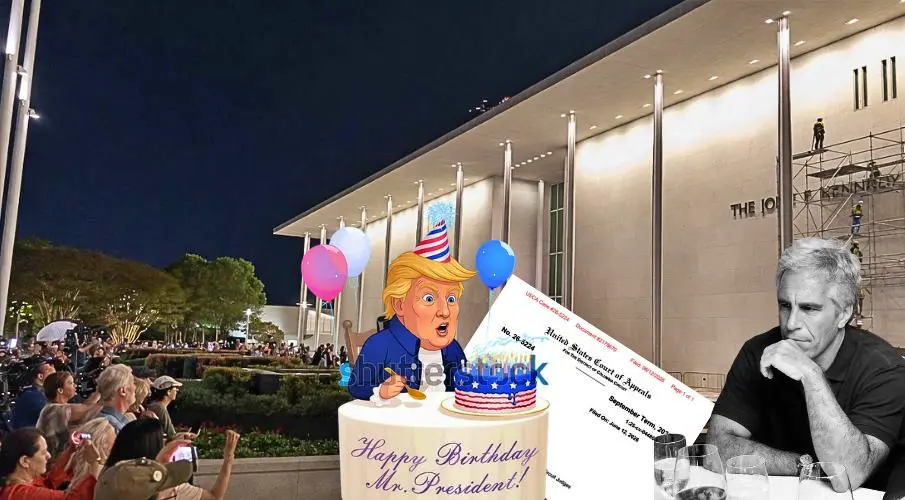
Trump brought down Republicans who voted to release the Epstein files, yet right on time for his eightieth birthday, a reading room bearing both his and Epstein’s names opens in Washington, three million pages in more than 3,400 volumes. At the center stand fourteen hundred candles for the victims!

While Donald Trump is having a cage for fistfighting placed on the White House lawn and planning a grand fair to celebrate the country’s two hundred and fiftieth anniversary and his own eightieth birthday, an exhibition on the other side of the city threatens to steal the show from him. It is called the Donald J. Trump and Jeffrey Epstein Memorial Reading Room, a memorial reading room, and it invites visitors to read the Epstein files with their own eyes, printed and bound.

It was conceived by curator David Garrett and the Institute for Primary Facts. Spread across two floors at 737 7th Street NW are more than three million pages released by the Department of Justice in December and January under implementation of the Epstein Files Transparency Act, which Congress passed almost unanimously last year. The partially redacted documents about Epstein and his powerful circle of acquaintances have been bound into books of eight hundred pages each, more than 3,400 volumes that visitors can pull from the shelves and read at will. The exhibition opened in New York on May 8, and now it is in the capital, where five hundred people attended opening night on a Tuesday. Five venues in New York and a dozen in Washington had turned it down, but Garrett hopes to bring it to five or six more states.

For all the mockery the circumstances invite, the serious center of the exhibition cannot be overlooked. It begins with a timeline of what is publicly known about encounters between the president and the late financier, supported by documents, and displays works by Maria Farmer, one of the women who accused Epstein of sexual abuse. Fourteen hundred candles commemorate the victims. Garrett says this is not protest art but an attempt to drown out the noise online and give people room to reflect on the seriousness of Epstein’s crimes and on the suffering of his victims, which continues to this day as they pursue justice. The declared strategy of those who, in his words, seemed intent on bringing down democracy was to flood everything with noise. That, he said, keeps people scrolling.
Epstein, the billionaire financier and convicted sex offender, died in August 2019 in a New York jail cell, officially ruled a suicide while awaiting trial. His shadow hangs over Trump’s second term since his Justice Department and the FBI attempted to draw a line under the case with a brief joint memo stating that the convicted sex trafficker left no client list and that there was no indication he had been murdered. The result was only that calls grew louder to bring any surviving accomplices to court, especially within Trump’s own base, which had long been fed conspiracy theories. The president is not formally accused in the matter, but questions about his former friendship with Epstein continue to follow him, a friendship that according to Trump ended in 2004 after he accused Epstein of poaching staff from Mar-a-Lago.

But anyone who pushed for releasing the files felt Trump’s anger. On Tuesday, Representative Nancy Mace of South Carolina lost the Republican primary for governor, in part because Trump had backed Lieutenant Governor Pamela Evette. Mace attributed her defeat to joining the bipartisan effort by Representatives Thomas Massie and Ro Khanna to force a vote on releasing the Epstein files. What makes it notable is that during the process she explicitly told the media that no one had threatened her, that the president had not threatened her, and had not asked her to withdraw from the initiative.

Mace, herself a survivor of rape, appeared visibly shaken after meeting survivors connected to Epstein’s circle and subsequently advocated for release of the files. The same Mace, who had shifted from moderate Republican to MAGA Republican, had previously targeted Representative Sarah McBride, the first openly transgender member of Congress. She will not return to Washington. Mace is the third Republican lawmaker to lose a primary after pushing back against Trump on the Epstein issue. Massie lost last month, and Marjorie Taylor Greene resigned months ago after a public break with Trump over the same matter and openly called him a traitor in his handling of the files. Trump has already turned his attention to Representative Lauren Boebert because she supported Massie, even though the deadline to challenge her has long passed.
“The retaliation will continue,” Massie told The Independent on Wednesday. The good thing, he said, was that those three women had helped him pass a law. No subpoena, no resolution. The president had signed it. Asked whether he would name Epstein’s accomplices on the House floor, he replied that people should stay tuned, there were still seven months left. Mace and Massie remain in Congress through the end of the year and can continue making noise.
How much time Trump has devoted to containing unrest within his own party is said to be illustrated by an excerpt from the new book by Jonathan Swan and Maggie Haberman, which became public on Wednesday. According to the excerpt, Trump’s closest advisers met in the White House Situation Room to discuss how to handle Epstein: Vice President JD Vance and Chief of Staff Susie Wiles, along with then Deputy Attorney General Todd Blanche, while then Attorney General Pam Bondi and FBI Director Kash Patel joined by speakerphone. The situation was reportedly treated as a severe public relations crisis, and Vance even suggested that right wing provocateur Tucker Carlson interview Epstein’s former companion and accomplice Ghislaine Maxwell. Former Deputy FBI Director Dan Bongino reportedly described the affair as Trump’s Iran-Contra moment. Perhaps worse than that.
In the end, the affair contributed to Bondi having to step down as attorney general. Trump appointed Blanche, once his personal attorney, as acting attorney general and nominated him for the department’s top position. Confirmation hearings begin next month, and one may expect that he will be questioned sharply on this very issue, especially since he has declared that no further Epstein files will be released.
Democrats are placing the issue at the center of the 2026 midterms. Khanna from the progressive wing coined the phrase Epstein Class, and Senator Jon Ossoff of Georgia adopted it for his campaign. Graham Platner, newly chosen as the Democratic candidate for Senator Susan Collins’ seat in Maine, while himself facing numerous questions over earlier comments about sexual abuse, campaigned with the line that the government would be taken back from the Epstein Class. In Ohio, former Senator Sherrod Brown is campaigning against Senator Jon Husted and accusing him of accepting money from people close to Epstein. And Robert Garcia, the highest ranking Democrat on the House Oversight Committee, announced that if Democrats regain the chamber, Epstein will become their issue, the most bipartisan issue in the country.
And then there was this...
The final attempt to stop the removal also failed. On Thursday, one day before the deadline expired, a filing was submitted to the courts seeking to block the removal of Trump’s name from the facade, but a judge rejected it, just as appellate courts had previously rejected emergency requests to suspend the order. The final obstacle fell, and all that remained was to physically remove the letters from the wall.

That happened on Friday. Workers in yellow vests arrived and erected scaffolding before beginning to remove the letters at around 3:30 p.m. Eastern Time. A crowd had gathered to watch, and when the removal began, applause broke out. Take them down, the crowd shouted toward the worksite, and passing drivers honked while the workers continued.
At the end of May, Judge Cooper had given the cultural center in Washington two weeks to remove the Trump name from its official presentation, and even before the deadline it had already disappeared from the website and YouTube presence, as well as from social media accounts. The founding statute of the Kennedy Center leaves no doubt, Cooper wrote, that the institution is named after President Kennedy and cannot carry another formal name simply because the board decides so on its own. Congress gave the center its name, and only Congress can change it.
The federal judge ruled that the name had been added unlawfully. The case had been initiated by Representative Joyce Beatty, who sits on the center’s board by virtue of office. Trump had attached his name in December to the John F. Kennedy Center for the Performing Arts after taking control of the cultural center in February 2025. Now it is being removed again, letter by letter, and there is a lesson of its own in that: a name one man forces onto someone else’s memory can be undone again with scaffolding and a few screws while applause drifts in from the street.

What emerges is an image of peculiar force. A man has a cage and a fairground built for his birthday, and while he floods the area with spectacle, a quiet room opens a few streets away that interrupts the endless scrolling, stacked three million pages high and carrying his own name above the entrance beside Epstein’s. He removed the lawmakers who demanded the files, but he cannot remove the files themselves. The closing line his administration tried to draw produced the opposite effect, and the retaliation aimed at those asking questions leaves the question untouched. At the center, beyond all politics, stand fourteen hundred candles and the works of a woman who survived abuse. And there remains the struggle of the victims, continuing while the powerful circle around it. Seven months left, one of those brought down says, and it sounds less like a threat than like a clock running against the spectacle. In the end, a man who builds monuments to himself now shares one with a dead man, one that he could not dismantle again for anything in the world.
“Happy Birthday Mister President”
Updates – Kaizen News Brief
All current curated daily updates can be found in the Kaizen News Brief.
To the Kaizen News Brief In English


Diese Epstein-Akten-Ausstellung muss Trump bis ins Mark wurmen.
Denn er hat keine Kontrolle darüber.
Hoffentlich rutscht Epstein wieder mehr in den Fokus.
Wegen der Opfer, für Gerechtigkeit!
Und passend zu Trumps Geburtstag ist sein Name vom Kennedy Center entfernt.
Es scheint noch Karma zu geben.
… das wird auf jeden fall den druck zur aufklärung hochhalten