
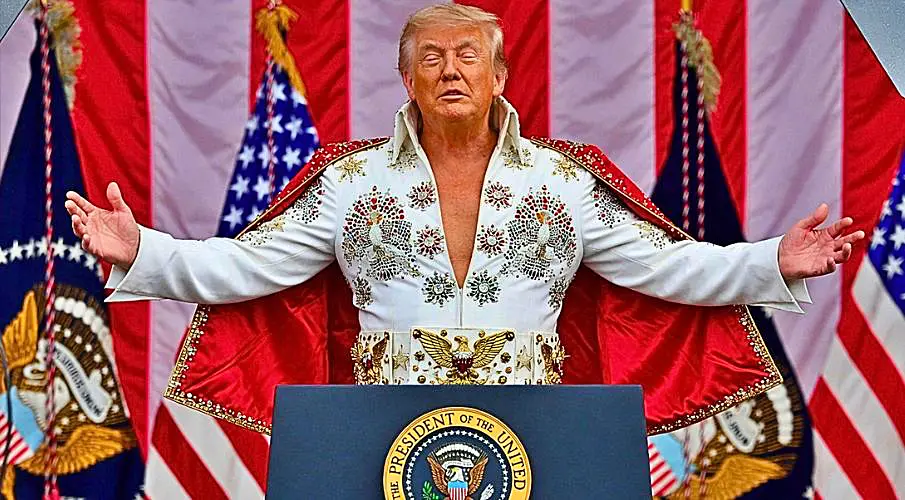
Notes on a weekend in which a president decided that the world was a stage and he was its only performer worth mentioning
There are weekends that, in retrospect, feel like a monologue that ran slightly too long, and this one unquestionably belonged in that category. Within just a few hours, Donald Trump weighed in on a war in the Middle East, on a football player from the New York Giants, on a group of musicians who had just abandoned him, on a ballroom planned for the White House, on a fighting arena to be built on the South Lawn of that same White House, and on the entirely serious question of whether he himself might not be the most suitable main attraction for the 250th anniversary of the United States. That he also mentioned drawing larger crowds than Elvis Presley fit into the program almost organically.
Donald Trump often mocks France, whether on the military or trade, but when it comes to staging power, he turns to it directly. After the military parade he copied from Emmanuel Macron in Paris in 2017 and later recreated in Washington, the next step now follows: a triumphal arch in the United States, larger than anything Europe has to offer. More precisely, larger than the Arc de Triomphe.
Lara Trump:
(Editor's note: When the questions themselves already adopt the interview subject's central message and simultaneously portray his predecessors as lacking courage, it appears less like a critical interview and more like a prepared script for agreement. That a family member assumes this role can only be described as a political joke.)
“You were consistently willing to do the difficult things, the things your predecessors said needed to be done but did not have the courage to do.”
Donald Trump:
“We only have a very small window. If you want to play this game, somebody would wait until after the midterms and only attack Iran in the hour afterward because Iran cannot have a nuclear weapon. But then that could possibly stretch all the way into the next election, whether midterms or not. So you only have a very short window to do anything that has to do with war. But I don't see that window that way. I have to do what is right.”
Each of these episodes, considered individually, would not simply be a passing moment forgotten after two days. Taken together, however, they create an astonishingly precise portrait of how the president understands his second term, namely as a total work of art in which governing, family, entertainment, loyalty, and the relentless cultivation of his own image have long since become impossible to separate. Where antiquity once distinguished between the person and the mask worn on stage, persona was the word for that mask, that distinction has here disappeared in an unexpectedly pure form. There is no longer a mask. There is only the face that believes itself to be the mask. persona hieß sie, die Maske —, ist diese Unterscheidung hier auf erfrischende Weise verschwunden. Es gibt keine Maske mehr. Es gibt nur noch das Gesicht, das sich für die Maske hält.
Trump is playing here with a form of low grade wordplay. In English, “dumb” is indeed spelled with the letter “b,” even though the “b” at the end is not pronounced. The line is therefore not a substantive statement but rather a flat joke, a play on English spelling.
The starting point was, as one might guess, a television interview. The setting was Fox News, more specifically the program My View with Lara Trump, in which Lara Trump, married to Eric Trump and therefore daughter in law of the family, welcomed her father in law as a guest. It would be difficult to imagine a more comfortable arrangement for a man who dislikes being contradicted. Confrontation was predictably absent. Follow up questions appeared with the rarity otherwise associated with nature documentaries about endangered species. While the host nodded, the president spoke about nearly everything occupying his mind at that moment, and the mind of such a man occupies itself with many things.
“Eric Trump is a really good builder. He has the gene. The same gene that I have. I have it, and Eric has it too, really.”
That detail triggered considerable reaction. Clips of the interview spread across social media within hours with the speed of good news arriving in bad times. One viewer remarked that Trump spoke for minutes “like a madman” while Lara Trump sat beside him nodding in agreement. Another compared the entire thing to a wind up toy car that had somehow lost its steering wheel along the way, an image more precise than one normally expects from the internet. Especially widespread was the comment describing it as a “fourteen minute tornado of complaints,” while the host remained beside him like one of those nodding dashboard figures people once placed in cars. No critical challenge, no objection, only uninterrupted agreement.
Trump presents Lara Trump with the picture of the autopen and calls it “a disgrace to our country” and the moment feels almost surreal. It exposes the performance and the absence of accountability within his circle.
The background: Trump and his allies have for some time accused Joe Biden of relying too heavily on the so called autopen for important documents and decisions, a device that reproduces signatures automatically. From this they derive the political argument that Biden did not personally control decisions sufficiently or was not sufficiently present. No evidence has been presented, however, showing that presidential decisions were invalid or not authorized by the president because of it. The autopen itself has been a standard tool in Washington for decades and was also used under previous presidents.
Some went further and suggested that even his daughter in law appeared to reveal concern about her father in law’s physical condition. Others described the program as a family podcast that accidentally found its way onto television, a diagnosis that may come closer to reality than its authors intended.
But while the audience was still reflecting on the form of the conversation, the leading actor personally delivered the headlines. At the center initially was his handling of a small organizational mishap surrounding the celebrations for the nation’s 250th anniversary. A concert series had been planned as part of the Great American State Fair on the National Mall. Freedom 250, the organization behind the festivities, had announced several well known artists and hoped for a patriotic celebration that would attract people from across the country.

Read also our article: When the Artists Leave, Trump Steps In
Then the cancellations began, and they began with a certain persistence. Young MC withdrew. The Commodores as well. Bret Michaels canceled. Morris Day and the Time followed. Martina McBride stated publicly that she had originally believed the event would be bipartisan, an assumption that, as she later realized, had been mistaken. Bret Michaels explained that he had initially been promised a celebration of the country, but that it had since turned into something considerably more divisive than what he had agreed to. There is a peculiar skill involved in organizing a birthday celebration in such a way that guests begin leaving before it even starts.
There was reportedly nervousness inside the administration as well. A senior official described preparation for the concert series as chaotic and said that behind the scenes people had already begun discussing blame, specifically who was responsible for invitations and artist communication. According to sources close to the administration, personnel consequences were even being considered, which in those circles is roughly equivalent to a letter of condolence elsewhere.
Read also our article: The Great Cancellation - How Trump’s Anniversary Celebration Became a Problem
The president responded according to a method uniquely his own. Rather than attempting to win back the departing artists, he proposed replacing them. With himself. On Truth Social he described the musicians as “highly paid, third rate artists” whose music bored people, who earned too much and remained endlessly dissatisfied. Instead, according to his own words, he preferred surrounding himself with “Happy People, Smart People, Successful People, and People that know how to WIN,” meaning people who understand winning, a quality that, in the present birthday planning, had not yet appeared in overwhelming abundance.

Then came the most remarkable passage of the entire weekend. Trump declared himself the “Number One Attraction anywhere in the World.” He claimed to draw “much larger audiences than Elvis in his prime,” and added that he did so without even needing a guitar. Furthermore, some people, according to him, considered him the “Greatest President in History (THE GOAT).” His proposal therefore was to replace the concerts with a large “AMERICA IS BACK” rally at whose center, naturally, he himself would stand. At this point the episode almost touches the metaphysical. A man declares himself the greatest attraction on Earth while, in the same breath, one musician after another declines to appear. Reality and its description have separated and have since been living in different apartments.
Not everyone fled, however. Vanilla Ice publicly confirmed his participation and clarified that politics did not matter to him, he performs for the fans and, he added generously, he would also perform for Vladimir Putin or in Iran because music is not a political matter. Such pure indifference possesses something almost elevated. How the remaining announced names decide remains unclear. C+C Music Factory is still evaluating. Flo Rida remains silent. But the most curious twist belongs to Milli Vanilli, the duo once famous for building its career on lip syncing. Although officially announced as part of the program, singer Jodie Rocco stated that nobody had ever asked the group whether it even wanted to perform. Thus the circle closes almost too perfectly, a celebration of authenticity opened by a group nobody invited and that, at one point, was not even singing itself.
Trump gives Lara Trump a tour of the ballroom construction: “This is a massive complex very much related to the military.”
While the concert series was therefore falling apart piece by piece, Trump guided his daughter in law through another construction site, this time in the literal sense. A new ballroom is being built on the White House grounds with an estimated cost of around 400 million dollars. The president described the project as a gift to America, financed by himself, by Apple, and by additional companies and donors, and spoke about it with the undisturbed satisfaction of a man erecting a monument to himself while simultaneously considering it an act of selflessness. Future presidents, he said, would use this ballroom for another two hundred years, while he himself would only have a few months left to enjoy it, a form of modesty whose scale recalls the donor inscriptions of medieval churches.
President Trump says his ballroom is a gift to America, from himself and from companies like Apple, and that it will become the most secure facility in America. Trump says the military is involved in the project and so is the Secret Service. “We doubled the capacity because they need more space.”
“Describing the project as an entirely private gift becomes politically vulnerable the moment state resources, security structures, or public follow on costs become part of the project. At that point, it is no longer only the donor paying, but also the public. The share of taxpayer money could reach as much as 400 million dollars.”
He appeared especially proud of the intended use. The next inauguration, he explained, should take place inside this ballroom. His own ceremony at the Capitol had been beautiful, but only 902 people could fit there. The new hall would be significantly larger and safer. According to him, both the military and the Secret Service are involved in planning. Lara Trump defended the project with the cheerful observation that left wing commentators were having a complete breakdown over the ballroom and were “melting down.” Critics, meanwhile, point to the historical significance of the White House and note that major changes to the building inevitably trigger political debate, an objection that only makes the project more appealing to people who admire permanence.
President Trump gives Lara Trump a tour of the UFC arena at the White House.
Trump on the planned UFC arena at the White House:
“He’s building an arena and doing a great job. Brand new cranes and everything is beautiful, and everything costs money, money, money.” (That taxpayer funds may also be involved is something Mr. Trump prefers not to mention: Editorial note)
The ballroom did not remain the only exhibit during the tour. Trump also showed his daughter in law preparations for a UFC event on the South Lawn, where an arena is planned for his 80th birthday. Cranes and construction equipment already shape the landscape. The president became enthusiastic. Someone was building an arena there and doing an outstanding job, everything was beautiful, cranes were everywhere, and everywhere, according to his repeated phrase, there was “money, money, money.” One is tempted to add that there is a certain ancient logic in celebrating one’s eightieth year with fistfights in front of the seat of office. The Caesars would have nodded.
Trump on Giants quarterback Jaxson Dart: “He’s a young boy. He’s got tremendous potential. If he stays healthy, he’ll be great. I won the popular vote.”
At the same time, the president spoke extensively about football, especially about Jaxson Dart, quarterback of the New York Giants. At first, Trump admitted, he thought the young man was a male model. Dart, he said, was exceptionally handsome and had assured him, “I love you, sir.” It is telling that this president’s admiration for an athlete appears directed less at his throwing arm than at his appearance and his admiration. Dart himself had previously made headlines after introducing Trump at an event, an appearance that even caused criticism inside his own team. His teammate Abdul Carter publicly argued that representing the Giants means representing more than oneself. Dart responded by pointing to his family’s military service and argued that the office of the presidency deserves respect regardless of political affiliation. It is an honorable distinction, although it assumes there is still enough space left between the office and its current occupant for respect to fit through.

Eventually, even the president’s physical stature once again became the subject of public discussion. In a promotional clip for the program, Lara Trump stood beside her father in law and appeared almost as tall as he did, even though Trump is officially listed at 6 feet 3 inches. The debate spread quickly. Lara Trump herself is just under 5 feet 11 inches tall and often wears high heels. Even so, many observers took the image as an opportunity to question the official measurements. Similar discussions had already emerged after photographs with Prince William, in which the British heir to the throne appeared visibly taller despite sharing the same official height. There were older references as well. A previously published copy of Trump’s driver’s license listed him at 6 feet 2 inches, while later health reports listed him at 6 feet 3 inches. In short, one is dealing with a man whose height appears almost as flexible as his relationship with Elvis Presley.
From there, the familiar questions about age followed. Trump is the oldest president ever elected. The administration regularly assures the public that he remains in excellent mental and physical condition. Critics point instead to that very age, to his publicly known chronic venous insufficiency, and to other health related changes over recent years. It is the eternal tension between the image a person creates of himself and the body required to carry that image, a tension as old as vanity itself and one that no ballroom in the world can ultimately remove.
All of this, it is worth remembering, happened within just a few days. A president speaks with his daughter in law about a war, about football, about musicians walking away, about a ballroom for the next two centuries, about fistfights on the lawn of his official residence, and about his supposed superiority to Elvis. Meanwhile, the audience is left wondering whether it just watched a political interview or a family performance.
And then there was this:
And This Man Is Supposedly Healthy According to His Medical Checkup?
People thought this man had already pushed the boundaries of the absurd beyond recognition - and yet he somehow finds another basement beneath every basement. This time he outdid himself so thoroughly that it almost deserves recognition as an Olympic discipline. For Mr. Trump, madness is essentially standard equipment, the base model. This weekend, however, he unveiled a special edition.
Perhaps that is where the real story lies, and it is philosophical in nature. Since antiquity, Western thought has known the idea of the world as a stage, the theatrum mundi, where each person plays an assigned role before exiting. What made that image comforting was always the belief that behind those roles there remained a stage, solid ground, an outside world. What we witnessed this weekend was the disappearance of that outside. The stage is no longer standing in front of the White House. The White House itself has become the stage, complete with ballroom, arena, family, and quarterback. And the man moving across it has stopped playing a role because he abandoned the final distinction separating performance from seriousness and image from reality. Narcissus, the myth tells us, was destroyed because he mistook his reflection for someone else. Here, someone simply turned the mirror into a governing program and the most astonishing part is how many people remain willing to nod while watching him look into it.
Updates – Kaizen News Brief
All current curated daily updates can be found in the Kaizen News Brief.
To the Kaizen News Brief In English


Mit Lara Trump hat Trump doch die beste und kritikloseste Interviewerin.
Er kann abschweifen, Unsinn schwafeln und sich selbst in den Mittelpunkt stellen.
Er zieht mehr Publikum als Elvis an?
Ja, das hat man letztes Jahr bei seiner Geburtstagsparade deutlich gesehen.
Ganz Washington war dicht, weil so viele Leute ihn sehen wollten (Ironie)
Trump bleiben ja noch die Bands der Streitkräfte als musikalischer Rahmen. Die konnen sich nicht wehren.
Und da wären noch Kid Rock, paar Country Sänger und P-Diddy (wenn er ihn begnadigt)
Die Creme de la creme 🤣🤣🤣
Vor der Kulisse des White House, was aussieht wie ein Six Flag Freizeitpark nach Insolvenz und einem Tornado.
…auf jeden fall war diese aufgeteilte interview unterhaltung pur – soviel schwachsinn, wow, das muss man echt drauf haben . wie gesagt, man konnte 180 minuten nach dem essen erst anfangen