
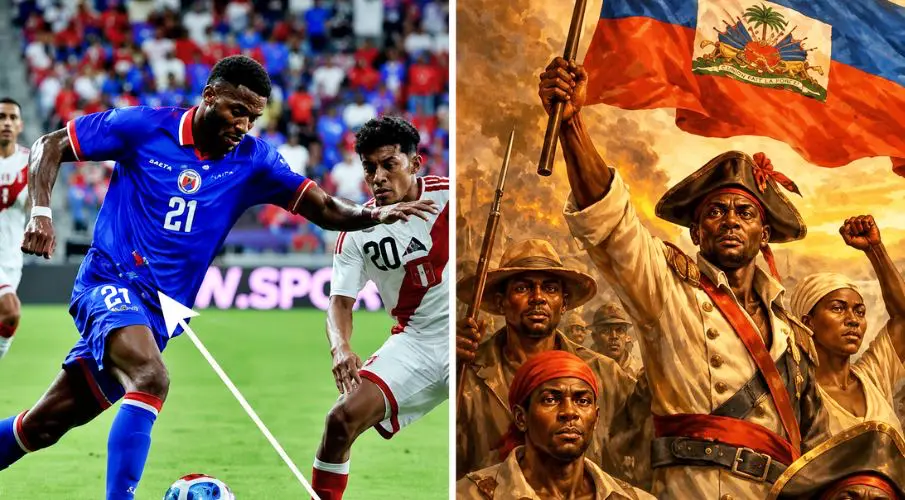
For its World Cup jersey, Haiti chose the Battle of Vertières, the end of the only successful slave revolution in history. FIFA decided the image was too political and had it removed, even though not even France, the country once fought against, objected.
Something strange happened this week when the official player portraits for the 2026 World Cup were released. They are images of all participants wearing their national jerseys, mostly serious, here and there playful, Sweden’s coach Graham Potter, for example, wears a cowboy hat in his portrait. But the strangest thing about the collection, which appeared late Tuesday, was something else. Haiti’s players were wearing a different shirt from the one unveiled months earlier and worn in matches before the tournament. The jersey in the official images is simple, blue, with a red collar and a few additional accents, nothing more. The shirt people had expected, however, carried an unusual and powerful image. Colombian manufacturer Saeta had placed on it a scene from the Haitian Revolution, the uprising in which freedom fighters under former slave Jean-Jacques Dessalines overthrew their French colonial rulers. A group of men raises a worn blue and red flag during the Battle of Vertières on November 18, 1803, just months before the declaration of independence.

It was not a literal rendering of history. As Marlene Daut, a professor at Yale, expert on Haitian history, and author of The First and Last King of Haiti, explains, there is no reliable evidence that such a flag was raised during that battle. It is the symbolic end of the Haitian Revolution, Daut says, and on January 1, 1804, the Haitians formally declared independence. In Cap-Haïtien, the major port city through which roughly 900,000 displaced and enslaved Africans once passed, there stands a monument to Vertières. It is regarded as the only slave revolution in history in which those once held captive overthrew their rulers and then governed the country themselves. They created the first state free from slavery in all of the Americas and became the first nation in the world to abolish slavery permanently by law, Daut says.

Across all three jerseys the image was the same, blue for home, white for away, and red for the third kit. A major social media campaign introduced it, saying this was more than a jersey, it was a tribute to the people of Haiti, their history would not merely be told, it would be worn and defended, and played with pride. The shirt was well received, the first run sold out within hours, admittedly more because Haiti is appearing at a World Cup for the first time in fifty two years than because of the image itself. It was worn in matches before the tournament, the blue home version against Peru and the white away version against New Zealand.
But by this Tuesday the jersey had disappeared and been replaced by the simpler version. That evening Saeta issued a statement. The design had been intended as a tribute to the men and women contributing to Haiti’s future every day, not as a political statement. During the review process, FIFA determined that certain elements of the image could be interpreted differently under its equipment regulations and ultimately requested changes. That interpretation differed from Saeta’s original intent, but the company respected the process and implemented the requirements.

FIFA insists this was not a last minute matter. Weeks earlier, it had approached Saeta and the Haitian federation, both had understood the concerns and willingly removed the disputed image. Saeta confirms this, but Haiti’s federation sounded less enthusiastic. After what it called a misunderstanding, a spokesperson said FIFA representatives asked the federation to remove the image of Vertières and several independence heroes raising the flag. Vertières was the site of the final battle on the road to independence, fought on November 18, 1803. Ironically, the team qualified for the tournament on November 18, 2025. The federation offered no further explanation and simply asked Saeta to make the change.

So why did the change have to happen? From FIFA’s perspective, the answer is simple. Article 28.1 of the 2026 regulations governing clothing and team colors prohibits messages and slogans of any kind, political or religious, including personal ones, in any language or form, on player uniforms and officials’ apparel, on outerwear before and after matches, and on equipment down to bags, drink containers, medical kits, even the body itself. Taken entirely out of context, an image of a revolution is of course a political statement. If one wanted to stretch the argument further, one could add that it depicts a revolution against France, a country Haiti could theoretically face as early as the first knockout round, potentially creating political discomfort or controversy.
But who seriously takes offense at an image more than two hundred twenty years old that celebrates the end of slavery and a people casting off their colonial rulers? One has to wonder how much those responsible at FIFA actually know about the Battle of Vertières. Not even the French raise objections. Last year, the Palais de Tokyo in Paris hosted several exhibitions on Henri Christophe, who fought in the revolution, and the Collège de France held a major conference on the compensation France once extracted from Haiti. If even the French are not offended by it, then who exactly is supposed to feel insulted? In this, a fundamental difference in the way history is viewed becomes visible. Politicians and businesspeople, and the people at FIFA are in essence both, see in history something that divides and agitates people. Haitians see in it something that brings everyone together and something everyone celebrates, even if the facts themselves remain open to debate.
But who seriously takes offense at an image more than two hundred twenty years old celebrating the end of slavery and a people throwing off colonial rule? Daut says she wonders how much those responsible at FIFA even know about the Battle of Vertières. Not even the French object. Last year, several exhibitions in Paris at the Palais de Tokyo focused on Henri Christophe, who fought in the revolution, and the Collège de France hosted a major conference on the compensation France once extracted from Haiti. If not even the French are offended, she asks, who is supposed to feel insulted? It reveals a fundamental difference in how history is viewed. Politicians and business leaders, and people at FIFA are essentially both, see history as something that divides and agitates people. Haitians see it as something everyone gathers around and celebrates, even when facts are debated.
One could argue that this is not about who feels offended at all, but rather that FIFA must enforce a simple, universal rule banning all politics for the sake of consistency. But one could just as easily argue that this reveals the contradiction inside such an absolute rule, because this World Cup contains many symbols that are either political or can reasonably be interpreted that way. Consider the Iranian flag, which after the 1979 revolution received an Islamic symbol and expresses the country’s full name, the Islamic Republic of Iran. Of course it would be sensitive to ban a state’s flag, and that does not mean one should, but strictly speaking it includes a religious and undeniably political symbol that conflicts with the rule itself.
On a larger scale, it is not the end of the world if a team has to wear a slightly different jersey. The change has been made, nobody seemed particularly upset by it, and yet the situation remains rather ridiculous, and FIFA would do well to spare participating teams such disruptions. But perhaps something good comes from it. Daut believes FIFA created a kind of Streisand effect for Haitian history, where the attempt to hide something only makes it more widely known. In a roundabout way, she says, FIFA contributed to more people learning that history it sought to suppress, because now there are all these articles and discussions and people are looking into it and asking what the problem actually is.
As this is being written, the original jerseys, the blue home version and the red third kit featuring the Vertières image, are still available for purchase on Saeta’s website, the World Cup jersey banned at the World Cup, now a collector’s item. That contains the entire inversion of the story. A rule that banishes every message in the name of neutrality ultimately banishes the memory of freedom itself, and an organization that sees history as something divisive erases precisely the image of a people who see in their history something unifying. What remains, as with the ski suit, is the empty horse from which Toussaint was cut away, a more fitting image of erasure than its creators intended. And yet the ban only carried further what it sought to hide, so that in the end the image, detached from the jersey, is carried by more people than before, in the minds of those who now begin asking questions.
Updates – Kaizen News Brief
All current curated daily updates can be found in the Kaizen News Brief.
To the Kaizen News Brief In English


Wenn die FIFA und andere Verbände behaupten unpolitisch zu sein.🤣🤣🤣
Aber gut, dass dieses Shirt so viel mehr Aufmerksamkeit erregt hat, als es vielleicht bei der WM erreicht hätte.