
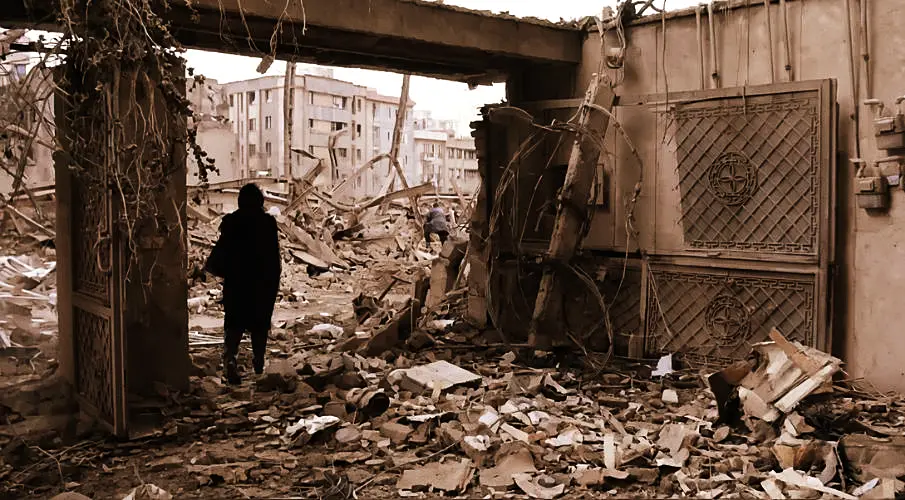
Donald Trump had declared on March 11: “We won.” Back on February 28, the first day of the war, he had described Iran as largely destroyed, even obliterated, and announced that the bombing would continue for as long as necessary to achieve “PEACE THROUGHOUT THE MIDDLE EAST AND, INDEED, THE WORLD!” More than 6 months later, the war is still going; 2 ceasefires have failed. World peace has not been reported. Iran’s announced unconditional surrender never happened. After weeks of relative calm, the fighting escalated again in late August, and in early September the United States once again launched massive attacks on Iranian targets. 18 U.S. troops have been killed since the war began, and more than 790 have been wounded. The Pentagon had repeatedly downplayed its own losses and at times tried to conceal them, while Iranian civilian casualties were barely investigated. Among them was a family of 8 with 5 children, including a 20-day-old infant. Nearly 40,000 Iranians have been killed or wounded. The earth doesn’t keep casualty lists, but it forgets very slowly.
Double standards define this war, the way they always define war
Esmaeil Baqaei, spokesperson for Iran’s Foreign Ministry, had warned of growing environmental devastation. Oil pollution in the Persian Gulf was now reaching Iranian shores. The visible damage, he said, was only part of a much larger contamination of the Persian Gulf and the Gulf of Oman. Baqaei had asked who should pay for it: energy consumers or those states that had turned the sea into a war zone. Objectively, though, that division of responsibility doesn’t hold up. Iran, too, is attacking facilities in this war whose destruction can cause serious environmental damage. On March 2, Iranian drones struck the Ras Tanura refinery in Saudi Arabia and caused huge clouds of smoke. At the Egyptian port of Damietta, a drone attack set 2 liquefied natural gas ships on fire. Who was responsible remains unknown to this day. The Conflict and Environment Observatory has accordingly concluded that all sides in the war had attacked facilities carrying high environmental risks.


By March, the Conflict and Environment Observatory had documented more than 300 potential incidents of environmental harm in 12 countries across the region. Major commercial satellite providers had withheld or delayed data from the Middle East at the request of the U.S. government. Presumably, the aim was to make it harder to assess the extent of damage to U.S. military facilities. At the same time, images that environmental researchers needed disappeared. According to the Observatory, all sides in the war had attacked facilities carrying high environmental risks, including oil infrastructure and seawater desalination plants.
According to calculations by the Climate and Community Institute, U.S. and Israeli attacks during the first 14 days of the war alone produced around 5 million metric tons of greenhouse gas emissions, roughly as much as Iceland produces in 1 year. After that, missile sites and ammunition depots were hit. Power plants and water treatment facilities also came under attack. Damaged desalination plants can release sulfuric acid. Rubble in cities contains asbestos. Struck weapons depots spread explosive residue and highly toxic propellants; attacks on nuclear facilities carry the risk of radioactive releases all the way up to a reactor meltdown.
In early March, Israel struck more than 2 dozen Iranian oil depots. Toxic smoke hung over Tehran, a city of around 9 million people. Black carbon and sulfuric acid fell over the city as dark precipitation. The destruction continued at sea as well. Off Sri Lanka, the United States sank an Iranian frigate. Oil and fuel spilled into different bodies of water.

American wars have been leaving behind bills like this for decades. In Southeast Asia, the United States sprayed Agent Orange throughout the 1960s and 1970s. During the 1991 Gulf War, oil depots burned across Iraq. Later came the open-air burn pits on U.S. military bases. The 2022 PACT Act therefore expanded access to medical care for several million veterans suffering from cancer or chronic obstructive pulmonary disease after such exposures. Reproductive disorders have also been linked to wartime toxic exposure.

Fallujah shows how long a war can live inside the human body. In 2004, more than half of the Iraqi city was destroyed during a siege led by U.S. Marines. Hospitals and water systems were hit. In 2014, the takeover by the so-called Islamic State brought another wave of devastation; in 2016, heavy bombing followed during the city’s recapture by Iraqi and U.S. forces. People returning home found ruins and chemically contaminated land.

One study found that from 2005 to 2009, children in Fallujah faced a 12.6-times higher cancer risk compared with the reference data used from Egypt and Jordan. Doctors had also reported more early-onset cancers and respiratory illnesses. Miscarriages and fatal birth defects in newborns had never returned to their previous levels since the first U.S. invasion. Reports from Fallujah Women and Children’s Hospital led to a research project involving Purdue University and Newcastle University on the intergenerational effects of heavy metals.
The United States has used depleted uranium munitions in combat since the Gulf War. On impact, they shatter and burn, releasing radioactive uranium particles and other heavy metals into soil and water. Researchers found elevated heavy-metal levels in heavily bombarded parts of Fallujah. People who returned to the city carried higher levels of contamination in their bodies. Uranium had been detected in the bones of 1 third of the people studied who had been children during the 2004 siege. The levels were more than 300 percent higher than those found in comparable people of the same age in the United States. Uranium could also point to broader exposure to heavy metals.

Kali Rubaii, a cultural anthropologist and assistant professor at Purdue University, had described the process bluntly: war means combustion. Toxic substances are redistributed into the air and food. Every breath can carry the pollutants of war into the body. Her research links the later rise in birth defects and respiratory illnesses in Fallujah to wartime exposure. Recommendations for people returning to bombed areas were therefore published in Arabic and Ukrainian.
This war is hitting Iran in a landscape that was already wounded. A drought now in its 5th year threatens Tehran’s water supply. Coral reefs and mangrove forests in the Persian Gulf have been suffering for years from rising water temperatures and heavy shipping traffic. The oil disasters of the 1991 Gulf War are still visible there today. A study by the University of South Florida’s College of Marine Science found that oil slicks in the Persian Gulf covered roughly 4 times as much area in March 2026 as they had 1 year earlier.

Images from Monday, May 11, 2026, showed that the oil slick had spread significantly farther by then. According to current assessments, the pollution stretched across roughly 75 kilometers of the Gulf and was located about 45 kilometers south of Kharg Island. The first traces had already been detected west of the island the week before.
The International Committee of the Red Cross had repeatedly affirmed that the environment itself is considered a civilian object in war and must be protected. Under the 1998 Rome Statute, environmental damage on a massive scale and of extraordinary severity can constitute a war crime. Attacks on energy facilities or bridges also increase the risk of retaliatory strikes on similar civilian targets. The Iran war has already triggered a global fuel crisis and put future harvests at risk. Tens of millions of people are threatened by hunger.
The latest escalation is making that danger even greater. On September 10, only 7 ship movements were counted through the Strait of Hormuz, compared with around 125 a day before the war. Attacks on tankers and Saudi Arabia’s East-West Pipeline are creating new fires and leaks from which pollutants can keep doing damage long after military victory has already been declared. Donald Trump’s statement on September 13 that the United States could stay in Iran and take control of its oil puts one bitter sentence over all this destruction: the resource lies underground, while people and the landscape above it pay the price.
Rubaii’s sentence stands on its own: The most effective way to protect against heavy-metal poisoning from war is not to bomb cities. Sick landscapes make people sick over time, too. When the final bomb has fallen, the longest part of the war is only beginning for some of its victims. In Fallujah, 22 years later, it is still in their bones.
Updates – Kaizen News Brief
Alle aktuellen ausgesuchten Tagesmeldungen findet ihr in den Kaizen Kurznachrichten.
To the Kaizen News Brief In English


