
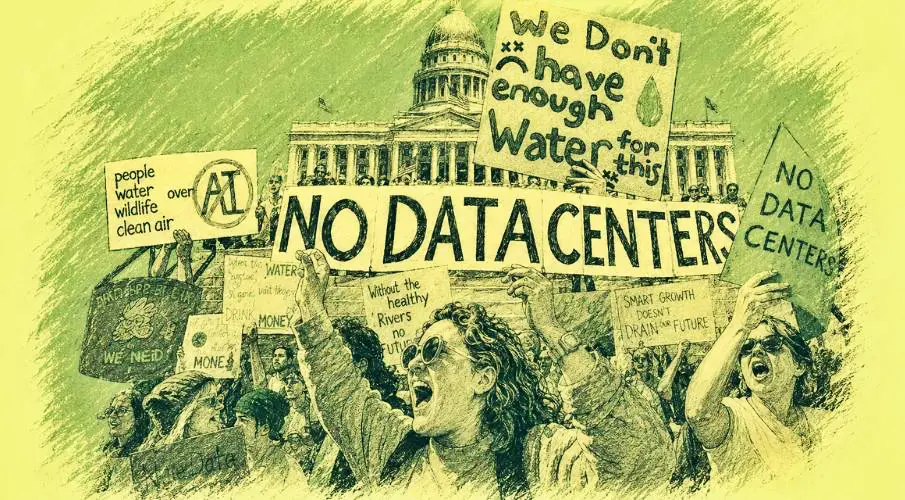
In Chile, activists stopped Google’s expansion plans in 2024. In the Netherlands, protesters blocked access this month to a Microsoft construction site. In Malaysia, citizens in the state of Johor publicly objected for the first time nationwide to a planned data center. In Utah, thousands took to the streets against the Stratos data center in Box Elder County. In Mexico, residents living near a Microsoft data center report more frequent power outages and water disruptions lasting for weeks that affect schools and hospitals. Similar protests are underway in Spain, Australia, Brazil, and the United Kingdom.
Germany remains divided so far. A recent survey shows at the same time that a majority generally supports data centers. The representative YouGov survey from June 2026, commissioned by the Alliance for Strengthening Digital Infrastructure under the internet association eco, found that 60 percent consider the expansion of data centers in Germany important or very important, while only 7 percent consider it somewhat or very unimportant. At the same time, 50 percent would support the construction of a data center in their own region, while 11 percent oppose it there. The greatest concerns, however, relate precisely to environmental and infrastructure impacts: 43 percent cite electricity consumption, 31 percent the burden on power grids, 29 percent water consumption, and 22 percent land use.

In Ireland, a mass movement has emerged because data centers in Dublin alone consume more electricity than all urban households in the country combined - more than twenty percent of national electricity consumption. An investigation by Friends of the Earth shows that the centers rely heavily on fossil fuels and drive up energy prices. Households are expected to face additional costs of up to 740 dollars on their electricity bills in the coming years. In the United States, seven out of ten people oppose data centers in their neighborhoods. University graduates boo at commencement speeches whenever AI is mentioned. By June 2026, more than one hundred moratorium proposals had been introduced at local, regional, and national levels. In May 2026, the AI Resistance List was founded, a publicly accessible global database documenting resistance actions against AI-driven land capture around the world. Anarchists, labor activists, Indigenous organizations, and disappointed Trump voters stand side by side.
Read also our articles: AI Was Supposed to Sell the Future - Now It Is Suddenly Selling Fear: Former Google Chief Ruthlessly Booed - Our Investigations Into Musk
Not Smart, Just Huge” - The Resistance Against AI
What unites these people is not hostility toward technology. It is the experience that data centers consume land, drain water, increase electricity prices, generate noise, and destroy communities - and that nobody is asked. Corporations decide where construction happens. Communities pay the price. Of the 809 planned data centers in the United States, 517 are located in areas that experienced continuous drought over the past year. A single hyperscale data center costs more than 100 billion dollars, generates more than one gigawatt of electricity - comparable to a nuclear power plant - and stretches across thousands of acres. The data center currently being built in Utah will, once completed, cover twice the area of Manhattan Island, consume more electricity than the entire state of Utah, and require enormous amounts of water in one of the driest regions of the country. The United Nations projects that global AI development will require 945 terawatt hours of electricity and 9.3 trillion liters of water annually by 2030 - equivalent to the water needs of 1.3 billion people. Sam Altman, CEO of OpenAI, has stated that he expects large parts of the world to eventually be covered with data centers. It was not a warning. It was an announcement.

The boom follows capital, not need. In Southeast Asia, clusters are emerging in Malaysia, Thailand, Vietnam, the Philippines, Indonesia, and Singapore. In Latin America, the network is expanding through Mexico, Brazil, Chile, Colombia, and Peru, connected by undersea cables. Africa has its hubs in South Africa, Kenya, Nigeria, and Morocco. Saudi Arabia made the world’s largest single investment in AI in 2024 with a 40 billion dollar fund. The United Arab Emirates announced plans of 100 billion dollars each in the same year. The U.S. State Department calls this new world order Pax Silica. “If the twentieth century ran on oil and steel, the twenty-first runs on computing power and the minerals that feed it,” said Jacob Helberg, Under Secretary of State for Economic Growth, Energy, and the Environment, in December 2025. Behind this term lies no neutral technological development. It is the most comprehensive round of capitalist land appropriation since the colonial era - this time without flags, but with the same structures: land is seized, energy extracted, labor squeezed, resistance suppressed.
Read also our article: Investigations Reveal: Congress Against the People? How Criticism of AI Suddenly Became a Matter for Intelligence Agencies
The labor conditions along the AI value chain confirm this. One investigation tracked the workers supplying ChatGPT from OpenAI with data. Wages were so low that several of these workers could not afford housing. They were homeless. At the same time, AI is accelerating the devaluation of labor across all other sectors. Nearly one hundred percent of American economic growth in 2025 came from investments in digital technologies. Global AI spending for 2026 is projected at 2.5 trillion dollars, an increase of 44 percent compared with the previous year. Private investment in digital infrastructure in the United States has risen to 1.5 trillion dollars by 2026 - up from 17 billion dollars in 1970. In his farewell address in January 2025, Biden called this an emerging technology industrial complex, an oligarchy formed through the dangerous concentration of power in the hands of a few ultra-wealthy individuals. It was a new version of Eisenhower’s warning about the military-industrial complex in 1961. This time without uniforms, but with the same structures: an industry grows so deeply into state structures that its interests and those of the public can no longer be distinguished.

Bernie Sanders and Alexandria Ocasio-Cortez introduced the AI Data Center Moratorium Act in March, calling for a pause to ensure safety for humanity. Sanders additionally proposed that the public should receive a fifty percent ownership stake in AI companies. Altman met Sanders at his own request and signaled general openness to public participation - but not to a stake that would threaten corporate control. In early 2026, the U.S. government invested ten billion dollars in stakes in private AI companies, including Intel, defense contractor L3Harris, and rare earth firms. Trump ordered the defense industry by executive order to prioritize military readiness. In this framework, state participation in AI is not a counterweight to corporate power. It is its extension.

Security agencies are responding to growing resistance with surveillance. There are concrete indications that police and intelligence services are already monitoring critics of data centers and preparing the criminalization of resistance. This is not surprising. Whoever builds an infrastructure in which 78 percent of all organizations surveyed worldwide already use AI - 82 percent in North America, 80 percent in Europe, and 77 percent in emerging economies - and whoever plans to integrate this infrastructure into the military, intelligence agencies, and state repression has a strong interest in ensuring that nobody takes to the streets against it.
The people who do so anyway are not fighting against technology. They are fighting to ensure that decisions about their water and electricity supply are not made without them. That is not a small goal. It is the only one that matters.
Updates – Kaizen News Brief
All current curated daily updates can be found in the Kaizen News Brief.
To the Kaizen News Brief In English


KI kann man nicht essen, sie still keinen Durst.
Rechenzentren fressen Ressourcen, wie kein anderer Industriezweig.
Da darf die Frage nach der Notwendigkeit von noch nehr Rechenzentren erlaubt sein.
Noch mehr Rechenzentren dienen nicht den Menschen, nicht der Umwelt.
Sie vernichten genau die Ressourcen, die für Mensch und Umwelt unabdingbar sind.
Der Nutzen?
Mehr wie fraglich.
Die Techmilliardäre schaufeln novh mehr Geld und konnen für sich die Versorgung mit den Ressourcen sicher stellen, die sie der Bevölkerung stehlen.
Die Aussichten sind nicht gut.
Umso wichtiger sind die Aktionen dagegen.
In den USA werden die Aktivisten dann wohl der Antifa zugeordnet und verhaftet.
Die Anderen werddn dann aus Angst schweigen.
…man wird schon weitermachen, es muss einfach ein Kompromiss gefunden werden, da datencenter gebraucht werden, aber die verteilung, nutzung und versorgung brauht eine reform