
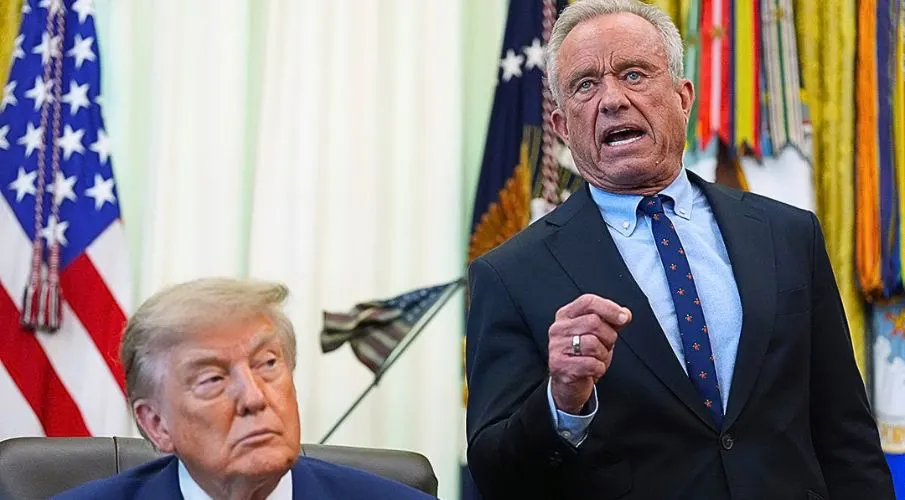
Donald Trump is intervening by executive order in the vaccine protection of American children, even though leading pediatricians and now even a Republican doctor in the Senate are pushing back hard against his decision on medical grounds. The president is demanding longer intervals between vaccinations and wants the combined vaccine against measles, mumps and rubella to be replaced with separate vaccines against the three diseases. The White House presented no new scientific findings that would justify this intervention. Instead, Trump's spokesperson Kush Desai said the president was one of countless parents who had questions and concerns about the combined vaccine. Separate vaccines, he said, would give parents more options when it comes to timing and frequency and, according to the White House, ultimately even increase vaccination rates.
But studies involving babies and toddlers in the United States show something different: Combination vaccines increase the likelihood that children will actually receive all recommended vaccinations by the age of two. The American Academy of Pediatrics is pushing back against Trump accordingly. Aaron Milstone, pediatric director of infection prevention at Johns Hopkins Health System, points to many years of scientific data demonstrating the safety of vaccines in children. The timing of vaccinations has also been thoroughly studied. Children are vaccinated early because the vaccines are safe at that age and because their bodies need to develop protection against infections in time. Trump is now reaching out from the White House and interfering with precisely this medically proven schedule.
Effective immediately, vaccinations against hepatitis B, COVID-19 and influenza, as well as other vaccines, will no longer be universally recommended for all young children, according to the Trump administration. The new policy also calls for vaccines to be administered during separate doctor visits rather than all at once. In addition, the Attorney General is being directed to take legal action against states that violate children's rights to religious or medical exemptions from vaccination requirements.
The practical consequence of his demand would be more individual shots and additional vaccination appointments to achieve the same protection. At the same time, there is a risk that children will remain without full protection against measles, mumps and rubella for longer if individual vaccinations are postponed or skipped. The administration calls this greater freedom of choice and hopes it will build additional trust among vaccine-hesitant parents. Pediatricians, on the other hand, see a danger that this very policy will deepen existing doubts and make it harder for children to complete their vaccinations.
Even more serious is the fact that Trump is simultaneously bringing the old claim of a possible link between vaccines and autism back into American health policy. He presented no new scientific evidence for it. More than 40 well-designed studies from over seven countries involving a total of more than five million children have already examined this question. Andrew Racine, president of the American Academy of Pediatrics, says hardly any medical question has been studied this thoroughly. The result is unequivocal: Vaccines do not cause autism. Nevertheless, the National Institutes of Health has been funding research teams for more than a year to investigate the causes of autism, with some of them once again examining the claimed role of vaccines. NIH Director Jay Bhattacharya appeared at Trump's signing and said that science takes time and answers do not come immediately. He, too, did not claim there was a proven link between vaccines and autism. Instead, Bhattacharya said the administration had given scientists permission to answer this question honestly and to look for a link for the first time. That statement stands alongside decades of research and data from more than five million children. It creates the impression that scientists previously had not been free or honest in looking for such a connection. Bhattacharya provided no evidence for that. Nobody has to prohibit researchers from studying a question again that has already been examined many times. But something entirely different happens when a government simultaneously makes political decisions that can give parents the impression that a suspicion circulated for years is still medically unresolved.

And now, of all people, a leading Republican is pushing back against exactly that. Senator Bill Cassidy of Louisiana is a doctor and chairman of the Senate committee that oversees America's health agencies. His reaction to Trump's order is devastating. The order is wrong, Cassidy said, and the president does not have the expertise to make changes like these. Vaccines are overwhelmingly safe and effective, and they do not cause autism. Cassidy also warns about the simple practical consequence of Trump's demand to split up vaccines: Children would have to get more individual shots to achieve the same protection. In his assessment, that will increase vaccine hesitancy and make children less safe. Parents should listen to their child's pediatrician when making vaccination decisions, not to an inaccurate order from the president. Cassidy ends his statement with a sentence that could hardly be harsher coming from Trump's own party: This is so wrong.
The conflict can no longer be dismissed as the usual fight between Trump and Democrats. A Republican doctor who, as committee chairman, oversees the country's health agencies is publicly saying that his own president lacks the medical expertise to make this decision. But Trump's intervention does not end with measles, mumps and rubella. The universal recommendation for childhood influenza vaccination is also being dropped under his new policy, even though leading medical organizations explicitly stood by it as recently as January. The American Academy of Pediatrics published its 2026 vaccination recommendations at the beginning of the year and continued to recommend influenza vaccination for children. Twelve medical organizations backed that recommendation, including the National Medical Association and the Pediatric Infectious Diseases Society. Behind it is a number that cannot simply be brushed aside: More than 80 percent of influenza-related deaths among children involved children who were unvaccinated or not fully vaccinated. Children under the age of five are particularly vulnerable. Trump now says the influenza vaccine will no longer be recommended for all children. His administration is therefore turning a medical recommendation on its head that leading pediatricians and infectious disease specialists jointly reaffirmed only a few months ago. The White House presented no new scientific findings to support that reversal either.
Medical recommendations can be changed when new data demand a change. No such new data were presented here. Instead, Trump is changing several parts of the existing childhood vaccination system at the same time, while doctors are pushing back, data from more than five million children stand against the revived autism claim, and even a Republican doctor in the Senate is explicitly telling parents to listen to their pediatrician instead of the president. Trump can sign an order and use it to change American vaccination policy. But his signature cannot erase decades of research or suddenly turn a disproven connection into a scientific suspicion. And when more than four out of five children who died in connection with influenza were unvaccinated or not fully vaccinated, ending a universal vaccination recommendation is not some trivial change on a guidance sheet. This is about protecting children from diseases that can cause severe illness and kill. Twelve medical organizations have spoken out in favor of that protection. Donald Trump irresponsibly puts himself above them and decides otherwise.
Updates – Kaizen News Brief
All current curated daily updates can be found in the Kaizen News Brief.
To the Kaizen News Brief


Warum ziehen den nicht die eigene Leute vom Fenster weg. Er schadet schwer der eigenen Bevölkerung.
Da sich der Präsident so etwas nicht selber ausdenkt, sondern diese Änderungen möglicherweise Teil eines größeren Planes sind , kann man schon mal darüber nachdenken, ob damit nicht gezielt der Bevölkerung geschadet werden soll 🤔
Das ist die Pro-Life-Partei, did für jeden Zellklumpen einer Schwangerschaft kämpft.
Vorsorge in der Schwangerschaft? Nein, da wurde Medicaid ja auch gekürzt
Vorsorge nach der Geburt? Nein, auch hier wurden die Gelder gekürzt.
Und nun die Impfungen.
Impfungen, die nicht mehr empfohlen sind, werden nicht von Medicaid übernommen. Der Impfschutz dafür fällt dann weg.
Bisher gibt es keine Einzelimpfstoffe, wie Trump es möchte.
Und die Pharmahersteller werden die Produktion mit Sicherheit nicht jmstellen können. Das mal nur am Rande.
Mehr Impftermine bedeuten mehr Stress. Für die Eltern und für die Kinder.
Da wird dann nit Sicherheit der eine oder andere Impftermin vergessen/verschoben/ausgelassen werden.
Mehr einzelne Impfungen werden weder die Impfskepsis mindern, noch die Impfquote erhõhen.
Aber es wird viel Geld gespart, weil mit Sicherheit weniger geimpft wird.🤬
Das man dafür dann höhere Kosten für Erkrankungen hat, trifft ja wieder die Armen, die keine Versicherung haben.😞
Es sind die Kjnder, die durch eine rückwärtsgewandte Politik leiden.
Manchmal frage ich mich, ob das ganze ein groß angelegtes Experiment „zur Auslese nach dem Prinzip der Stärkere überlebt.“ ist.
Selbstverständlich sind Trump, seine Familie, RFK Jr und seine Familie geimpft.
Finde den Fehler.