
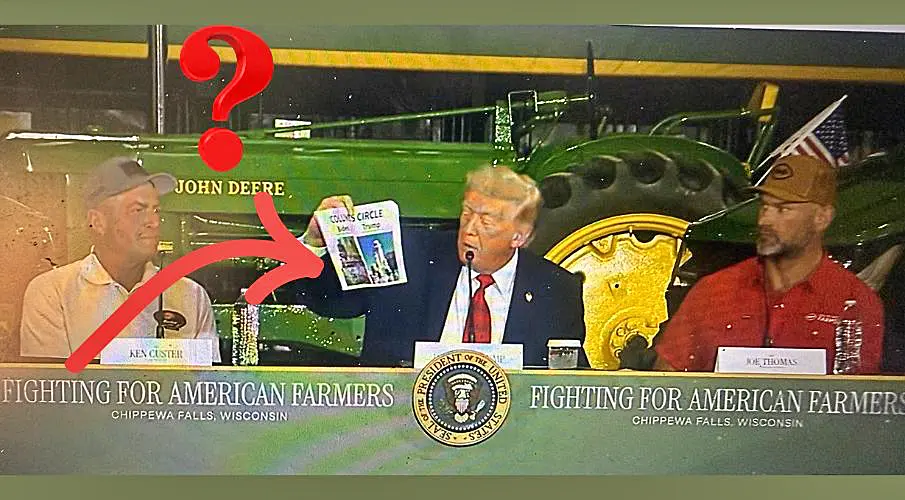
The president flew to Wisconsin to speak with farmers about agriculture and then spent large parts of his speech talking about something entirely different, his recent efforts to beautify Washington. At length, he explained how he was having the reflecting pool in front of the Lincoln Memorial and the capital's fountains renovated, showing charts that not everyone in the room could even see. It takes a special kind of skill to show people something they cannot see and speak about something other than what they came for.
When he finally returned to the farmers, he said the sentence that explains the entire trip. "I'm standing up here today. I don't need this. I got elected." And right after that: "What the hell am I doing here? I could be home right now in the beautiful White House enjoying watching somebody else talk on television." Think about that for a moment.
A man travels to the people whose votes he seeks and tells them he would rather be sitting at home watching someone else speak. In between came the usual lines. "We love the farmers, we love everything about your state," he told the gathering in a barn in Chippewa Falls, saying his party was the only choice for farmers, that Democratic policies were "just tremendously bad" and "really bad for the farmer." He again assured the audience that the war with Iran would soon end and gasoline prices would fall. Ahead of the November midterms, the White House said he would travel across the country campaigning for Republican candidates. "As they say in the farming business, we had to take care of business," he concluded. The question remains whose business is being taken care of here, because an elected official who tells voters he does not need them has already said everything about his relationship to them.

Behind this appearance stands a reality the president no longer seems able to see, because he has lost contact with it. Under his administration, farmers are suffering losses in the billions, and while he was talking about fountains in Wisconsin, we still had the images from Brookland, Arkansas from our own reporting in mind. They are disturbing, even for us, and revealing at the same time.
Hundreds of farmers, many with deep lines carved by sun and worry, packed into a gymnasium as early as 2025. They step up to the microphone, they speak, they complain, they pray. “I have never been this afraid that my children and grandchildren will no longer be able to take over the farm,” one says. Another describes Trump’s tariffs as the icing on the cake of the perfect storm. What emerges inside the hall is anger and fear, carried by the desperate hope of finally being heard in Washington, and it shifts between devotion and accusation. “Dear God, we are so close to You because we work Your land every single day. We need help,” one farmer pleads.
And it does not stop with losing farms. Agricultural dealers in the region report twenty seven suicides within twenty two months, twelve of them in the last ten weeks alone. That is how deep the despair runs. Maybe the promised money will come, maybe it will not. The farmers no longer believe the president, and out of despair grows anger, also for the sake of the dead. Until then, prayer remains.
Read also our articles: The Price of Harvest – How Trump’s Policies Pushed America’s Farmers into the Abyss and Death
The Green Colossus Staggers - How Trump's Tariff War Shatters John Deere and the Farmers

How Trump Is Turning America’s Cattle Ranchers Against Him – An Investigative and Disturbing Report
What appeared in Arkansas is appearing across the country. In Iowa, families sit at dinner asking themselves how much longer they can hold on. In Kansas, machinery is being put up for sale that no one can afford to buy anymore. And in Arkansas, multiple crises collide at once, the trade war and inflation, together with natural disasters that flooded fields and destroyed roads and diesel prices that have surged. Above all of this stands a president claiming agriculture is "stronger than ever." The irony is hard to miss, and it is the bitterest kind because it comes at the expense of people who spend all day working the soil and do not know in the evening what comes next.

In the end, the image returns that farmers live every day. Those who sow, reap, and what was sown in Washington, tariffs and promises left unfulfilled, is now being harvested by the farms, and they are harvesting it in loss and in death. The man who flew to Wisconsin and asked what he was even doing there has the answer in front of him without seeing it. He should be there because that is where the people are whose lives his policies are damaging. A president who can no longer recognize that has lost touch with the reality over which he governs and talks about fountains while outside the harvest spoils and the farms die.
Updates – Kaizen News Brief
All current curated daily updates can be found in the Kaizen News Brief.
To the Kaizen News Brief In English


Warum, zum Teufel, haben sie ihn nicht in die Wüste gejagt. Das wäre DIE Gelegenheit gewesen möglichst laut und vehement ihren Frust und ihre Not zu beklagen! Warum lässt man diesen Menschen wieder gehen ohne seinen Frust mal herauszuschreien?
…das ist leider die sache mit der tradition, man wählt dort republikanisch, selbst so eine pfeife
Aber irgendwann muss man doch mal anfangen zu denken…!!!!! Wenn man natürlich glaubt, dieser Sektenführer ist eine gottgesandte Prüfung, dann hilft natürlich nur weitermachen und beten … Man möchte sie alle schütteln, damit sie endlich aufwachen. Ob sich die Demokraten als Problemlöser und Menschen erweisen, die den Trümmerhaufen Amerika aufräumen und das US-System modernisieren können – oder ob sie nur unter neuem Namen alte Politik in einem toten System betreiben werden, so sie die Regierung übernehmen sollten,muss sich zeigen. Sie werden heftigen Widerstand von rechts bekommen und der wird sicher maximal unfair sein.
…denkt man sich immer, aber jetzt… bei denen ist eine Revolution, wenn die die trump fahne abhängen, haben wir mal in indiana eine reportage drüber gemacht, es ist einfach irre …
Da kenne ich mich deutlich weniger aus, als Du/Ihr. Aber es wird sich wohl auch unter den Demokraten am System selbst nichts Wesentliches ändern. Denn ernsthafte Systemkritik hört man eigentlich nicht – oder? Ich meine Kernelemente wie ein Mehrparteiensystem, keine privat finanzierten Kandidaturen, Direktwahl, keine Wahlmänner…