
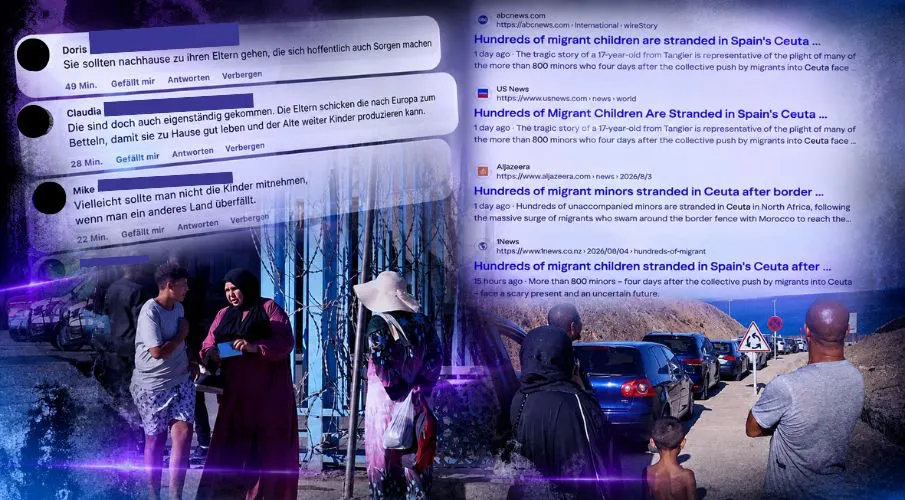
What we had to witness today beneath our report is almost beyond words. It deserves contempt, but that would be too easy. These have become, in many ways, deeply empathy-starved times. Open hatred is no longer hidden. Behind it often stand loneliness and fear of the unknown, along with a racism that no longer bothers to disguise itself. Parts of society are moving backward, to a place where the future, diversity, and even basic humanity itself are treated as something to be sacrificed to evil.
A society doesn't reveal its true character by how it treats its own people. It reveals it by how it treats those who are the most foreign and the most vulnerable. And the opposite of humanity isn't always hatred. More often, it's shrugging at the suffering of a child.
We've spoken among ourselves and moved this issue to the very top of our agenda. We're reshuffling our plans and reaching out to German politicians. The requests have already been sent. There has to be resistance against this open racism. There has to be an end to these far right crusades. And there have to be limits for the opinion makers on both sides of this uproar, the ones who fuel exactly what these children are suffering from through disinformation and their obsession with clicks.
We don't investigate and write to make people happy. We investigate and write so what is happening remains visible, and so that in the end, one question remains. Which side would you have wanted to be on?
Beneath the report about the stranded children in Ceuta sits a single sentence, followed by a chain of 26 thumbs-up reactions. "They should just go back," Monika R. writes, and those little symbols turn rejection into a celebration. The suffering isn't merely dismissed. The dismissal itself is openly enjoyed. Anyone who scrolls through the comments over the course of the day doesn't see a public discussion. They see a struggle for dominance. On one side, resistance that hardened and spread throughout the morning. On the other, people pushing back with compassion, sources, and ridicule. The two camps barely speak to one another. They speak past each other. And in the middle sits a report about more than 800 children, a report both sides use to reinforce something they already believed before reading a single word.

You can find the article in question here: Alone in Ceuta for Days: The Fate of More Than 800 Children
The most obvious reaction is the demand to send them back, and by now, it has faces. Wolfgang S. demands, "Back to Morocco, immediately!" Anna J. says the children could "simply go back and would be home in five minutes." Beate M. wants them handed over to the Moroccan border guards. In every one of those comments, the border becomes a front door, and Morocco becomes the living room next door. Our explanations that Tangier is about 90 kilometers away and that some of the children fled with siblings go nowhere, because these comments aren't interested in distances. They want a door they can slam shut.
Monika W. provides the justification for exactly that by squeezing suffering into a ranking system. These children, she writes, are "simply not as badly off" as those who walked "3,000 kilometers" in 2015, so they could "just go back those few miles," and should be "simply taken back across the border." Distance becomes the measure of whether someone deserves protection. If you haven't walked far enough, you've lost your claim to compassion. The idea that a child can be completely lost 90 kilometers from home, without parents, without food, never enters that calculation. Doris B. shows the same coldness by writing that the children "should go home to their parents, who are hopefully worried about them," as though their families were all standing safely in their kitchens while the report itself speaks of drowned and missing relatives.
The second tactic is to deny that they are children at all, and it appears over and over again. Siegfried F. puts the word "children" in quotation marks. Helmut G. writes, "Children with beards!!!!!!!!!!" Monika H. asks, "Why hasn't anyone shown all 800 children yet?" Antonia K. asks, "Teenagers maybe, but children?" Because some of the minors are 16 or 17 years old, people act as though the younger ones were simply invented. Our reply to Antonia K., explaining that children between the ages of 5 and 10 are among them, became necessary because even the word "minor" immediately triggers suspicion. "Children with beards" isn't really about age. It's a phrase that has been repeated for years to portray refugee minors as grown men pretending to be children. The individual disappears, leaving behind nothing but a suspicious group supposedly trying to cheat its way into protection.
The third tactic shifts the blame onto the children and their parents, wrapping judgment in questions that were never really questions to begin with. Hans-Uwe L. asks, "Who brings children along on something like this?" Regina J. immediately follows her question with, "Highly irresponsible." Franz M. asks, "Did these children just fall out of the sky??" Mike R. pushes it even further with a war metaphor, saying people "shouldn't bring children along when they invade another country," turning flight into an invasion. Christina B. sounds more measured. She calls the entire situation "irresponsible and inhumane" while also asking about Morocco's responsibility and the lack of humanitarian assistance, a legitimate point. But even in her comment, blame directed at the parents comes before concern for the children.
The coldest comments are the ones that reinterpret the children's suffering itself as part of a deliberate strategy. Birgit K. writes that the children "planned this pretty well because now Spain's child welfare system has to take care of them." Claudia E. goes even further, claiming in the same breath that the children "came on their own," while also saying their parents "sent them to Europe to beg so they could live comfortably back home while the old man keeps making more kids." The contradiction doesn't bother her because she isn't trying to explain anything. She's trying to excuse herself from feeling any responsibility. The children's suffering becomes a family business, and the children themselves become tools. One of the oldest principles of morality holds that no human being should ever be treated merely as a means to someone else's ends. That is exactly what happens here, where separation and begging are interpreted as calculated strategy. When Elfriede L. replies that Claudia E. is "proof that not everyone should have internet access," she correctly identifies the coldness, but shifts the argument onto the individual instead of keeping the focus on the child.
The most revealing example is Eleonore W., because her comments show just how flexible this kind of rejection can be. She begins with something that sounds reasonable, saying the parents or relatives should be found and the children returned to them. When we explain that this is already happening, that parents are standing at the border and journalists are helping search for missing family members, and when Sabina K. adds that local websites are filled with missing person notices, Eleonore W. doesn't step back. She simply shifts her position. Now the teenagers are supposedly "at home there" and "all have parents and relatives," something she cannot possibly know. Sabine V. responds with compassion, saying she hopes Eleonore W. never finds herself in such a situation, but Eleonore W. sticks to her formula, saying that in that case it would still be best if they were reunited with their parents. Kris D. points out that this is exactly what the authorities are trying to do, and she replies, "Exactly, and that's a good thing," as though the matter has now been settled. When the possibility of orphaned children is raised, she simply asks, "How do we even know they're orphans?" Every new fact is ignored and immediately turned into another assumption that reinforces her original position. This is not a discussion. It's a carousel that keeps turning just far enough to question the need for protection all over again.
Another striking pattern is how completely ineffective the article itself is for some readers. Gudrun S. writes, "I didn't see any children." Christian D. asks how the children got there and how old they are. Marianne R. asks whether the parents are even looking for their children, despite the article already answering every one of those questions. Our reply to Marianne R., telling her to simply read the report, gets straight to the point. These people respond to the headline and the picture, not to the content. For them, the comment section isn't a place to absorb information. It's a place to unload opinions they already had. Siegfried F. responds to Christian D.'s sincere question with nothing but sarcasm, "They swam, like everyone else?" Even where someone is genuinely asking, mockery immediately steps in.

Elifa K.'s comments deserve special attention because they feed the suffering of these children into an antisemitic worldview. She calls the King of Morocco an "Israeli slave" and claims the entire crisis was staged solely to remove Spanish Prime Minister Pedro Sánchez because of his support for Palestinian rights. She provides no evidence whatsoever. This is the most dangerous kind of appropriation because it dissolves real children into a political narrative where they exist only as scenery. Political interests behind border policy absolutely deserve scrutiny. These claims are not scrutiny. They are unsupported accusations, and the language used makes them even more unacceptable.
Standing in sharp contrast is the strongest fact-based thread, led by Rieke B. She provides figures, around €193 million in EU migration funding for Morocco between 2021 and 2023, an additional €152 million program agreed upon in 2023, and at least €234 million since 2015 through the former EU Trust Fund, all earmarked for border management, returns, and migrant protection. She also links directly to the official documents. Here, outrage turns into a question that can actually be verified, whether Morocco has used those earmarked funds for their intended purpose. Christian F. adds that Morocco itself was "responsible for creating this crisis." That distinction between coldness and simple lack of knowledge matters. Otherwise, every misunderstanding ends up being mistaken for malice.
Another way responsibility gets pushed away is by handing it off to an institution. Christine G. argues that the UNHCR must act immediately to prevent these children from becoming victims of human trafficking, a serious concern when dealing with unaccompanied minors. Paula W. calls for both the UNHCR and the Red Cross. Be K. asks where the children's aid organizations are, even mentioning "RTL Wir Helfen Kindern." Angelika L. responds that the Red Cross is already overwhelmed caring for the thousands of others. Much of this reflects genuine concern. At the same time, it creates the impression that simply naming an organization somehow fulfills one's own responsibility. Our replies, explaining that documentation is already on its way to Geneva and that two members of our own team remain on the ground, shift the discussion away from outrage alone and toward action. That is the difference between expressing concern and actually helping.
The thread isn't defined by coldness alone. Marlit H. speaks of the "trauma these poor children will carry." Lili F. writes that the story is "so heartbreaking it's almost impossible to bear." Ingrid E. says she "already had tears in her eyes just reading it." Wiebke B. calls it "a tragedy of unimaginable proportions." None of these people invent facts or make compassion dependent on nationality or age. Their focus stays where it belongs, on the children. Sandra H. thanks us for reporting on a story she says has been largely ignored by the news, only to be met almost immediately by Jürgen Z., who snaps, "You just have to think. It doesn't hurt!" His anger spills over so far that it even targets people standing on the same side. The strongest response comes from a sentence Irene S. shares: "If you should ever need help yourselves, may you encounter people exactly like yourselves." It turns the moral test around. It asks whether anyone would truly want to be treated according to the same standard they are now applying to others. That cuts deeper than any appeal to compassion ever could. Finally, Jutta B. puts into words what many others seem to feel. She says she is horrified by the comments because she isn't used to seeing this here, and reminds everyone that none of us earned the good fortune of not being born into circumstances like these. It was simply luck. That is the quietest comment in the entire thread, and also the most devastating.

The sarcastic pushback is a double-edged sword. Jürgen Z. does more than anyone else to confront the cruelty. His suggestion that all 800 children be "kept at Eleonore's house until their parents pick them up by 8 p.m." exposes the absurdity of her proposal. His question to Helmut G., asking whether his own children had beards at fourteen, dismantles the "children with beards" slogan. Angelika K. uses the same kind of irony with her remark, "Sure, because that's so easy to do." But Jürgen Z. repeatedly slips into political labeling. His comment, "That's exactly why never AfD," may reflect his own convictions, but it also hands Gabriele W. the perfect opportunity to reply with, "Always stirring up hatred," shifting the conversation away from the children and into partisan politics. The moment the discussion turns into insults and political labels, those being criticized no longer feel challenged. They feel confirmed, and the side showing the least compassion suddenly gets to portray itself as the victim.
We ourselves opened another layer of the discussion. In our reply to Jutta B., we explained that we are intentionally leaving certain comments visible in order to show what kind of people stand behind these statements, and that we have already begun researching them. There is genuine journalistic value in that because the thread documents how people speak about defenseless children the moment they convince themselves they are merely talking about migration. At the same time, it is also the most delicate step. The line between documenting and publicly exposing private individuals becomes increasingly narrow. That approach remains defensible only as long as there is a clear distinction between public figures and private citizens, the goal remains documentation rather than provocation, and everything ultimately published rests on a solid legal foundation.
The hardest conclusion remains exactly the same as it was this morning, only now it is supported by far more examples. A portion of the commenters are not looking for information. They are looking for justification not to help, and they search through the report only for reasons to reject it. If the children are older, they become "children with beards." If they are younger, then the parents are irresponsible. If the parents are missing, they should simply be found. If the parents are already searching, the children should still be sent back. If Morocco is responsible, Spain should do nothing. If Spain is responsible, then the children supposedly planned the whole thing. Their rejection is fluid. It adapts to every new fact. That is what separates it from an opinion that is still capable of changing in response to evidence.
And yet, coldness does not have the final word. Alongside Monika R., Monika W., Claudia E., and Helmut G. stand Jutta B., Irene S., Ingrid E., Sabine V., Kris D., and Rieke B. This thread is not the portrait of a completely hardened readership. It is a struggle over whether these children are seen first as human beings or first as migrants. What it ultimately reveals is not merely the political beliefs of those writing the comments, but the condition some people require a child to meet before that child's suffering counts at all. That condition is origin, and the fact that it is now spoken aloud so openly is the most disturbing part of all.
Updates – Kaizen News Brief
All current curated daily updates can be found in the Kaizen News Brief.
To the Kaizen News Brief


Kinder sind Kinder.
Sie verdienen den größtmöglichen Schutz der Gesellschaft.
Unabhängig von Landesgrenzen oder politischer Gesinnung.
Wer Kinder nicht schützen kann oder will, hat versagt.
Ein Dank an all die, die sich kümmern.