
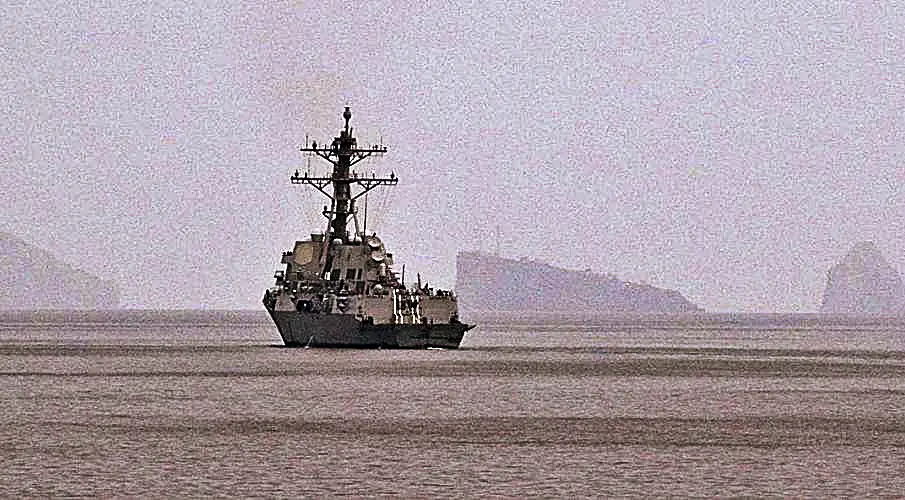
The blockade of Iranian ports took effect on Monday at 10 a.m. Washington local time. Trump confirmed it personally and said one could not allow a country to blackmail the world. Shortly after, he posted on Truth Social that Iranian warships approaching the blockade would be immediately destroyed - with a “fast and brutal” attack, using the same methods applied against drug traffickers at sea. Hours later, Trump said outside the Oval Office that the other side had called. The right people, the appropriate people. They wanted a deal.

All of this happened on a single Monday
The US Central Command had clarified on Sunday that the blockade applies only to ships heading to or leaving Iranian ports - not to all shipping in the strait. Trump’s own announcement had still promised a complete blockade of all ships in the Strait of Hormuz. Two different statements, one administration. How the blockade is to be enforced in practice is still “in development,” according to a defense official. No American warship is currently in the Persian Gulf, which forms most of Iran’s coastline - that was confirmed by a second defense official.

Immediately after the blockade began, at least two tankers turned around that had approached the strait. Ship tracking company MarineTraffic reported that the vessels changed course within minutes. One had been traveling from the emirate of Sharjah toward China. Nevertheless, between 15 and 20 ships passed through the Strait of Hormuz in the past 36 hours - from China, Russia, Pakistan, and Iran. The blockade is officially in place. Whether it is followed appears to be a matter of individual choice.

Mr. Trump only forgot to add in his post: these were ships from China, Russia, Pakistan, and Iran.
Iran responded with threats against all ports in the Persian Gulf and the Gulf of Oman. Foreign Ministry spokesman Esmaeil Baqaei described the blockade as “revenge at the expense of the global economy” and asked: “Is it worth cutting off your own nose to spite your own face?” Finland’s President Alexander Stubb said at an event at the Brookings Institution in Washington that Iran currently holds most of the cards. Control over the Strait of Hormuz had become a “de facto nuclear weapon” for Iran - a situation the Trump administration had itself created by initiating a “war of choice.”

JD Vance said in an interview with Fox News that the talks in Islamabad had made “some progress” on the issue of nuclear disarmament. The Iranians had moved in the American direction but had not been able to finalize a deal because they needed backing from Tehran first. Vance said Trump would be “very happy if Iran were treated like a normal country, if it had a normal economy.” What that means in detail he did not specify. “There really, I believe, is a big deal that is possible here. But it is up to the Iranians to take the next step.”
Pakistan has meanwhile proposed a second round of talks in Islamabad - before the ceasefire expires on April 22. Two Pakistani officials confirmed this on condition of anonymity. The talks are not a one time event but part of an ongoing diplomatic process. Geneva was mentioned as a possible alternative location. Thursday was floated as a possible date. The White House did not respond to inquiries. Press secretary Karoline Leavitt only said that Iran’s desperation for a deal would increase further with the blockade.
Two American government officials and a diplomat from a mediating country both said that both sides are weighing a new round of direct negotiations. The diplomat went further and said Tehran and Washington had already agreed. All four spoke on condition of anonymity.
Iran’s UN representative Amir-Saeid Iravani meanwhile demanded compensation from five countries that had participated in the American Israeli war effort: Bahrain, Saudi Arabia, Qatar, the United Arab Emirates, and Jordan. These countries had violated international law and must fully compensate for all material and immaterial damage, he said via Iran’s official news agency IRNA.
Egypt’s Foreign Minister Badr Abdelatty spoke by phone on Monday with Rafael Grossi, Director General of the International Atomic Energy Agency IAEA, as well as with his counterparts in Saudi Arabia and Iraq. Iran’s Foreign Minister Abbas Araghchi also spoke with Abdelatty - the topic was the failed talks in Islamabad. IAEA inspectors have had no access since June 2025, when American Israeli attacks significantly weakened Iran’s air defenses, military leadership, and nuclear program, to the highly enriched uranium Iran possesses.
China’s Foreign Minister Wang Yi said in a phone call with his Pakistani counterpart Ishaq Dar that the top priority must be preserving the ceasefire. Further escalation in the Middle East must be prevented. Spain’s Prime Minister Pedro Sánchez meanwhile traveled to Beijing - his fourth trip to China in just over three years. He spoke at a university in Beijing about the need for a multipolar world order and is meeting China’s President Xi Jinping on Tuesday.
Britain’s Prime Minister Keir Starmer and France’s President Emmanuel Macron announced that they would convene a summit with heads of state and government later this week to advance international efforts to reopen the Strait of Hormuz. Starmer said in the House of Commons that the strait must be opened without conditions and without transit fees. Germany’s Foreign Minister Johann Wadephul said in Berlin that it is urgently necessary to keep the Strait of Hormuz free and open as an international shipping route. That is required by international law, and it must be the goal of everyone.
Legal experts warned that the blockade must be officially declared, effectively enforced, and applied impartially to meet international standards. Raul Pedrozo, professor of international law at the US Naval War College, said the blockade must apply to all - not just to unfavorable countries. Todd Huntley, retired Navy captain and director of the national security law program at Georgetown University, said: “How it is conducted will determine whether it is lawful or not.” UN Secretary General Antonio Guterres, through his spokesman Stephane Dujarric, said no one must do anything that would endanger freedom of navigation in the Strait of Hormuz. There is no military solution to this conflict.
The consequences of the war are now reaching into American water systems. The Association of Metropolitan Water Agencies reported that some water utilities in the United States are having difficulty maintaining recommended fluoride levels in drinking water because Israel is a major supplier of the fluoride used. The number of affected utilities is still small, but hundreds of thousands of people are already impacted. Dentists warned that prolonged shortages could increase the risk of tooth decay, especially for children. China’s exports grew only 2.5 percent in March compared to the previous year - a sharp drop from 21.8 percent in January and February. Economists say the ongoing effects of the Iran war could dampen global demand for Chinese exports overall this year.
Somewhere in this situation lies a ceasefire that expires on April 22. Both sides believe they have won the war. Both sides are waiting for the other to take the next step. And Pakistan’s Foreign Minister Ishaq Dar is trying to arrange a second round of talks - while the clock is ticking.
Updates – Kaizen News Brief
All current curated daily updates can be found in the Kaizen News Brief.
To the Kaizen News Brief In English


Ohne Trumps und Vances herablassende und arrogante Aussagen könnten diplomatische Verhandlungen voran schreiten.
Die Permanente Beleidigungen und due Aussagen „die Iraner betteln jum einen Deal“ werden die Iraner nicht auf Verhandlungen auf Augenhöhe einstimmen.
Trump will seine Forderungen komplett durchsetzen (wie Putin) und wahrscheinlich nicht darauf verzichten.
Für den Iran sind die US-Forderungen eine komplette Kapitulation. Dem stimmen sie bicht zu.
China, Russland, Pakistan durchqueren die Strasse von Hormus.
Trotz oder sogar wegen Trumps Blickade der Blockade.
Und nicht eines der Schiffe wurde von Trump aufgehalten.
Ich hoffe sehr auf ein Halten der Waffenruhe.
Ich hoffe auf eine Verlängerung der Waffenruhe.
Ich hoffe auf echte konstruktive Friedensgespräche.
Darauf hoffe ich seit Jahren für die Ukraine
Bisher vergeblich.😞
Zu viele machthungrige Narzissten 😞