
Dubai - Oil prices have risen above 100 dollars again. Brent crude climbed by more than seven percent to about 102 dollars per barrel. West Texas Intermediate rose by more than eight percent to about 105 dollars. The stock markets followed downward - the S&P 500 and Dow Jones each lost 0.7 percent before the opening bell, the Nasdaq dropped by one percent. This is not a market fluctuation. This is a reaction to a blockade that took effect at 10 a.m. Washington time.
Ursula von der Leyen, President of the European Commission, said on Monday that the European Union’s energy bill has increased by more than 22 billion euros since the beginning of the war - in 44 days. The disruption of energy supply will continue for some time. She recommended that EU governments coordinate their oil reserves and store natural gas to ease market pressure. At the same time, she proposed temporarily relaxing state aid rules to protect vulnerable consumers and industries. She also stated that the crisis in the Middle East has made clear that “the only sustainable way out of dependence on fossil fuels is to modernize by switching to green energy and electrifying the economy as quickly as possible.”

Russia’s Kremlin spokesperson Dmitry Peskov said the blockade would very likely continue to negatively impact international markets. Many details are still unclear, which is why he refrained from substantive comments. At the same time, Russia withdrew almost all of its remaining personnel from the Iranian nuclear power plant in Bushehr. Rosatom chief Alexei Likhachev said 108 employees left the plant, with only 20 remaining to guard the facilities. The evacuation had been carried out gradually since the start of the war - initially about 600 employees in several waves, now almost all the rest. Russia had repeatedly expressed concern because projectiles had struck near the reactor.

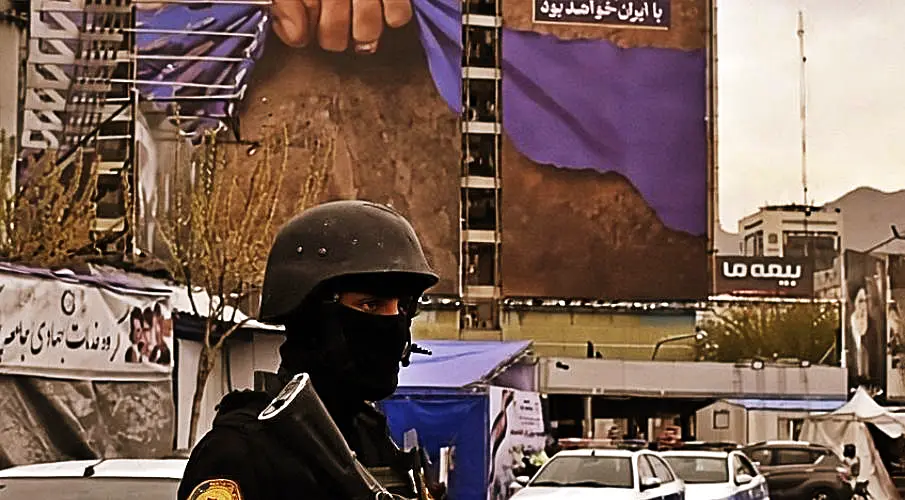
Tehran today: “The Strait of Hormuz belongs to Iran.”
A large banner in central Tehran declares sovereignty over the Strait of Hormuz. The action took place after peace talks between Iran and the United States in Islamabad, Pakistan, failed without agreement.
Iran responded to the blockade announcement with threats against all ports in the Persian Gulf and the Gulf of Oman. Ebrahim Rezaei, spokesperson for the National Security Commission of the Iranian parliament, called the American blockade threat “more bluff than reality.” If the situation escalates militarily, Iran is prepared. The blockade will further complicate Trump’s already difficult situation, further shake the market - and Iran could play cards that have not yet been shown. Brigadier General Esmail Qaani, commander of the powerful Quds Force, said the United States would leave the Middle East without any success - just as it had previously done in Yemen. He hinted that the Iran-backed Houthi rebels could again close the Bab el-Mandeb strait, as they did between 2023 and 2025. Ahmed Nagi, senior Yemen analyst at the International Crisis Group, confirmed this assessment: if Iran comes under pressure from the blockade, a Houthi escalation in Bab el-Mandeb is very likely - which would add another layer of pressure on global shipping.
Iran’s ambassador to India, Mohammad Fathali, said in New Delhi that Tehran is open to talks with the United States - if Washington does not make unlawful demands. The main points of contention in Islamabad were the nuclear program, war reparations, and sanctions relief. Asked about future negotiations, he said: “If they accept our conditions, it is possible.” Iran’s foreign minister Abbas Araghchi spoke on Monday by phone with Qatar’s foreign minister Sheikh Mohammed bin Abdulrahman Al Thani as well as with Saudi foreign minister Prince Faisal bin Farhan - both times discussing the failed talks in Islamabad.
Turkey’s foreign minister Hakan Fidan said the ceasefire could be extended by 45 to 60 days to allow negotiations. Both sides initially presented maximal positions in Islamabad. Iran will now review the American proposals and respond. Israel remains a factor that could disrupt the talks. If the nuclear issue becomes an all-or-nothing problem, a serious obstacle lies ahead.
Benjamin Netanyahu said on Monday that he had spoken with JD Vance after the talks in Islamabad - while Vance was still on the return flight. Israel supports Trump’s hard line and the naval blockade against Iran. Iran must remove all of its enriched nuclear material and refrain from any enrichment within the country for several decades. In a cabinet meeting, Netanyahu also said that fighting in Lebanon continues, particularly in the Bint Jbeil area. Israel is building a deeper security zone in southern Lebanon to keep short-range rockets and anti-tank missiles away from Israel’s border region. In Tyre, the office of the Lebanese Red Cross was hit by a drone on Monday. A wounded patient who was being transported died. Red Cross vehicles were damaged. The day before, a volunteer from the Lebanese Red Cross had already been killed in an Israeli strike in Beit Yahoun - his funeral took place on Monday.

Germany also spoke out. Chancellor Friedrich Merz said in Berlin that he was not surprised by the collapse of the talks in Islamabad. The negotiations had from the beginning not given the impression of solid preparation, he said - without specifying whom he meant. Germany is also reducing the energy tax on diesel and gasoline for two months - by about 17 cents per liter. Chancellor Friedrich Merz said the measure will quickly improve the situation for drivers and businesses across the country, especially for those who travel frequently, particularly for work.
That is the response of a country to a war it did not start and cannot stop - a discount at the pump while nuclear power plants are being evacuated elsewhere.

Spain’s defense minister Margarita Robles called the blockade threat “senseless.” Since the beginning of the war, everything has been senseless, she said on Spanish television. No one knows why this war began, a war that was supposed to be quick. This is just another episode in a downward spiral into which the world is being drawn. Spain had already at the beginning of the month closed its airspace to American aircraft used in the Iran war and excluded the United States from using jointly operated military bases in the south of the country.
France and the United Kingdom announced they would convene a conference with partners to contribute to a peaceful multinational mission to restore shipping in the Strait of Hormuz. Emmanuel Macron wrote that the mission is strictly defensive, separate from the warring parties, and would be deployed once circumstances allow. Fact: any attempt to shut down the strait - whether American or Iranian - violates the principle of freedom of the seas.

Meanwhile, the human costs of the blockade are already becoming visible before it has fully begun. Milind Kandalgaonkar, secretary general of India’s National Seafarers’ Union, wrote in a letter to India’s national shipping authority that nearly 20,000 Indian crew members are stranded in the region. Many suffer from acute shortages of food, drinking water, and basic medical supplies. He called on authorities to allow supply deliveries, protect the welfare of seafarers, and prepare evacuation plans.
Japan’s prime minister Sanae Takaichi spoke by phone with Pakistan’s prime minister Shehbaz Sharif and thanked him for mediation efforts in Islamabad. She emphasized that the most important thing is a rapid agreement and de-escalation to ensure safe passage through the Strait of Hormuz. Sharif said Pakistan hopes to work with Japan on this.
The oil price stands above 100 dollars. 20,000 seafarers are stranded. Russia is pulling its people out of a nuclear power plant. France and the United Kingdom are planning a conference. Merz says he is not surprised. And somewhere in the Strait of Hormuz, ships are waiting whose crews no longer know when they will return home.
Updates – Kaizen News Brief
All current curated daily updates can be found in the Kaizen News Brief.
To the Kaizen News Brief In English


Die Besatzungen der Schiffe, das ist grausam.
Jeder, der Hilfslieferungen zu den Schiffen verhindert, beteiligt sich an einem Massenmord.
Merz ist nicht überrascht, was für eine Aussage.
Wieder keine Kritik in Richtung Trump.
Benzin und Dieselsteuer werden um 17 Cent gesenkt.
Aber nur für 2 Monate.
Die Preise an den Tankstellen gingen daraufhin weiter hoch.
Die Märkte reagieren.
Trump verdient dabei.
Russland zieht die letzten Mitarbeiter aus dem Atomkraftwerk ab.
Trump und seine Entourage beleidigen die Iraner weiter.
Iran präsentiert sich „kompromissbereiter“.
Nicht wie Trump „wir bekommen alles, was wir wollen“.
Israel wird nicht einbezogen, was in meinen Augen ein Fehler ist.
So lange Israel den Libanon bombardiert, wird kein Friedensabkommen voran kommen.
Bedauerlicherweise zählt für die Meisten nur die Öffnung der Strasse von Hormus.
Keine Frage, es ist ein ganz enorme Weltwirtschaftsfrage.
Umso wichtiger ist eine Zusammenarbeit aller Anreiner und aller Kriegsparteien.
Nur den 3 Kriegsparteien steht ihr übergroßes Ego im Weg.
Und so sterben weiter Menschen. 😞
…auch dem ist nichts mehr hinzuzufügen, was aktuell in der welt passiert, erschütternd