
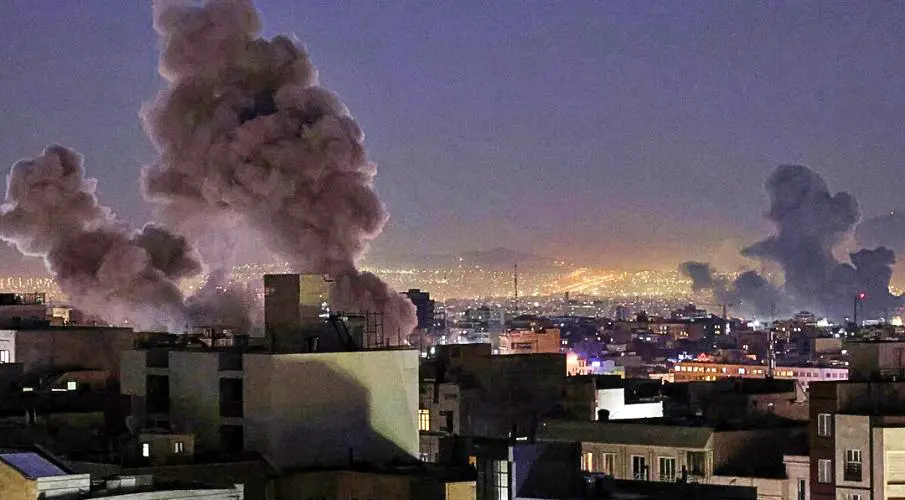
The White House calls it “major combat operations.” Congress nods. No one says “war,” even though bombs are falling and a head of state is dead. This is not just a question of wording. It is the dissolution of a constitution in the next room.
Lindsey Graham said it on Meet the Press: “I don’t know if this is technically a war.” What Lindsey Graham said he had already read somewhere before. The White House had distributed talking points to Republicans. Push back. “Major combat operations against Iran.” Not war. Markwayne Mullen pushed it into the absurd: “We have not declared war,” he said, two sentences after he said: “This is war.” A reporter pointed it out to him. “I was mistaken,” Mullen said.
NBC News’ Kristen Welker: “Are the United States at war with Iran?”
Senator Lindsey Graham (Republican, South Carolina): “I think the Ayatollah would say yes. I don’t know if this is technically a war, but - here is the headline for me this Sunday: The mothership of terrorism is sinking. The captain is dead. The largest state sponsor of terrorism, Iran, is close to collapsing. The leader of the largest state sponsor of terrorism and his inner team are dead. The mothership that fuels the proxy forces is - it is in sinking mode.”
But it is not only the Trump people who are playing with words. The Democrats are as well. Chuck Schumer speaks of attack operations that could “draw us into broader conflicts.” Hakeem Jeffries says the operation has brought us “to the edge of a possible war.” Mark Kelly, former Navy Captain, calls it “a large scale military operation.” All three formulas suggest the same thing: We are not yet at war. That raises a question that may be more important than the Iran question itself. What is war in 2026?

“Operation Epic Fury” - Washington names the goals of the Iran attack
The mission carries the name “Operation Epic Fury” and is officially described as “major combat operations” - large scale combat actions without using the word war. The document names four central objectives. First, Iran’s missile arsenal and the entire missile industry are to be destroyed. Second, the complete destruction of the Iranian navy is explicitly stated. Third, the goal is to prevent Iranian proxy groups from continuing to carry out attacks or fueling regional conflicts. Fourth, Washington declares that Iran is to be permanently prevented from ever developing a nuclear weapon.
According to the White House, dozens of leading figures of the Iranian state leadership have already been killed in the first strikes, including Supreme Leader Ali Khamenei. The operation has also destroyed central Iranian nuclear facilities. In the political message of the document, President Donald Trump is explicitly praised. For decades, it says, American presidents tried to stop the Iranian regime. Trump has now shown for the first time the necessary determination to implement this policy militarily.
At the same time the document answers a central question only indirectly. To the question of whether the United States is at war with Iran, it merely states that the president has ordered “large scale combat operations with clear objectives.” The word war does not appear in the official formulation.
The answer does not lie in legal definitions. It lies in how a country is allowed to describe its violence without having to ask about it. For twenty years American presidents have followed the same strategy: air campaigns, “kinetic military actions,” “operations other than war,” “discrete strikes.” Always the same game. Each time a different word for the same thing. Clinton did it. Bush did it. Obama perfected it. Trump uses it.
Speaker Mike Johnson: “We're not at war right now. We're four days in to a very specific, clear mission, an operation, Operation Epic Fury.”
The reason works. The public has been trained to recognize war as war only when tanks roll and soldiers march. Ground troops. The old image. As long as that does not happen, nothing is happening. Syria, Yemen, Somalia. Years of bombing. People do not notice it. The condition remains. The constant presence remains. The normal remains normal.
The other reason is older. The War Powers Resolution of 1973 was written for a different war. For a war with a beginning and an end. With troops you could see. With soldiers whose names appeared in the newspaper. Congress was supposed to control whether America was waging war. That was the idea. Only: It no longer works when war no longer looks like war.
The United States can now do something it could not do before. Kill a head of state. With air campaigns. With minimal risk for American soldiers. With minimal attention from the outside. This capability does not go away. It becomes normal. That is the real problem. Not that America wages a war and does not call it that. The problem is bigger. It is the problem of a machine that is always running and that no one can switch off anymore because no one sees that it is running. Bernie Sanders is right that people in this country do not want this. They want to earn good money. They want health insurance. They want their children to be able to go to school. They do not want war. But the war continues anyway.
As long as Congress cannot even admit that it is war, Congress cannot control whether there is war or not. That is the end of the separation of powers. Not with a bang. With the dissolution of words.
Updates – Kaizen News Brief
All current curated daily updates can be found in the Kaizen News Brief.
To the Kaizen News Brief In English


Das erinnert jetzt doch sehr an Putins Militäroperation, Krieg durfte die ja auch nicht genannt werden.
…da sind auf jeden fall klare parallelen zu erkennen
Hier mal eine sehr gute Doku zu den vielen Kriegen der Amerikaner.
Wie sich die US Einwanderer schändlich gegen die Ureinwohner benahmen und diese Rücksichtslosigkeit hat seitdem kein Ende gefunden!
Ich denke, wir haben von den moralischen Vorstellungen der USA ganz falsche Illusionen und Vorstellungen.
Amerika: Warum die USA fast immer im Krieg sind | Doku HD | ARTEhttps://www.arte.tv/de/videos/119270-000-A/amerikas-kriege/
Eigentlich dachte ich, dass es völkerrechtlich eine feste Definition von Krieg gibt.
Wenn ein Land ohne UN Mandat, ohne Zustimmung des eigenen Kongress ein anderes Land bombardiert, souveräne Landesgrenzen überschreitet/überfliegt und Staatschefs entführt oder tötet…. Dann ist das für mich Krieg!
Aber scheinbar ist es 2026 anders.
Krieg ist es erst, wenn man es offiziell als Diesen deklariert.
Bis dahin sind es Spezialoperationen (Russland lässt grüßen) mit heroischen Namen.
Auch der Iran wagt es nicht, die USA ganz offiziell als KRIEGSgegner zu benennen. Bzw den USA den Krieg zu erklären.
Krieg, das Wort verschwindet immer mehr.
Weil das Wort Krieg genau das beschreibt, was es ist.
Spezialoperationen klingen rechtlich sicher. Man befindet sich nicht im offiziellen Krieg.
Was für eine heuchlerische Augenwischerei.
„…Solange der Kongress nicht einmal zugeben kann, dass es Krieg ist, kann der Kongress auch nicht kontrollieren, ob es Krieg gibt oder nicht. Das ist das Ende der Gewaltenteilung.“
Und da liegt das ganz große Problem. Und der Hrund für die sehr verhaltene Kritik im Kongress, aber auch bei den US Amerikanern.
,…. ja 2025 und 2026 scheinen die jahre von regeländerungen zu sein. der verstoss gegen völkerrecht, egal ob wir die regierung im iran mögen oder nicht, ist klar erfüllt, möglicherweise bewegt man sich ebenfalls im bereich des kriegsverbrechen, dazu in der nacht mehr
Wenn es wie 💩 riecht, sich wie 💩 „anfühlt“, es wie 💩 aussieht, ja dann wird es wohl auch 💩💩💩 sein