
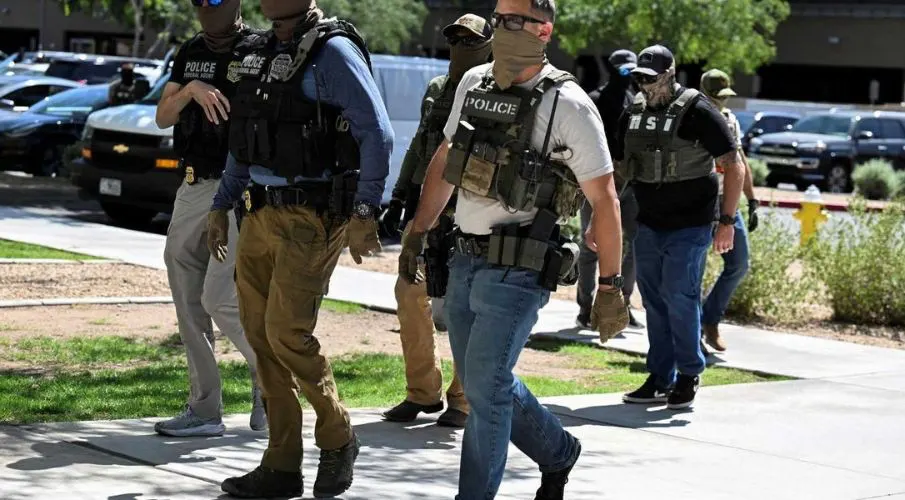
A government that cannot find fraud builds a hunt for it. A little more than two months before the midterm elections, hundreds of employees at the U.S. Department of Homeland Security are combing through state voter rolls under the internal name “Unlawful Voter Initiative,” looking for non-U.S. citizens. They are using personal data, birth dates and parts of Social Security numbers. On publicly accessible election websites, investigators are at times effectively posing as individual voters by entering their information. The state is slipping into the identity of its own citizens in order to question whether they belong. This could be checked without taking on the identity of the people being examined, yet reaching for their data is part of the intent. No proof, no reason, and still hundreds of officials are standing over the lists. The absence of a problem becomes a massive operation, and the agency meant to protect against threats is searching for the threat in its own voter records. An apparatus that cannot catch anyone fills its time by screening everyone.
The excuse sounds simple. The Department of Homeland Security says it wants to make sure that only U.S. citizens take part in elections. Evidence of widespread voting fraud by noncitizens is still missing. Critics accuse the administration of pulling employees away from cases involving human trafficking and terrorism for this search. Limited resources meant for fighting human trafficking and terrorism are being poured into the hunt for a phantom. Where the evidence fails to appear, suspicion takes its place, and suspicion needs no court, only a list. Security is the name of the department, suspicion is the tool, and now both are aimed inward.

The numbers expose the imbalance. Democratic Congressman James Walkinshaw said Trump is pulling Department of Homeland Security investigators away from human trafficking and terrorism cases to pursue “made-up voter fraud conspiracies.” Even data from the conservative Heritage Foundation show only around 100 cases since 2000 in which noncitizens voted. One hundred documented cases in a quarter century are not evidence of an epidemic, they are evidence of its absence. Of all places, a foundation close to the right provides the number that undercuts the entire effort. Hundreds of investigators for so few cases is not investigative effort, it is a declaration. Walkinshaw warns that Trump is laying the groundwork for interference in the November election. An operation that points to numbers and is disproved by its own numbers is looking for something other than the truth. The statistics are not there to prove anything, they are there to provide the excuse.
Privacy advocates are sounding the alarm as well. They warn that driver’s license data and birth dates could be used in a politically charged search, along with Social Security numbers, until lawful voters lose their eligibility. Privacy sounds technical, but what it means is the fear that your own name ends up in the wrong column. A civil rights organization has now sued the Department of Homeland Security and accuses the administration of deliberately targeting naturalized U.S. citizens. Naturalized citizens have gone through a process no citizen by birth ever had to go through, and that very process is now making them vulnerable. One data entry marked incorrectly turns a right into an application that has to be fought for all over again. The hunt for the foreigner ends up hitting the citizen. Suspicion knows no presumption of innocence when the agency keeps the list itself and reverses the burden of proof.
The method is what weighs most heavily. Officials type the information of real voters into public portals, the state wears the names of its citizens like a disguise. Every naturalized name comes under suspicion simply because it once came from somewhere else. A citizen whose papers are in order suddenly has to wonder whether that is enough. The bureaucracy calls it verification, those who experience it call it intimidation. The message reaches even those whose names never land on a list, because fear travels faster than any official notice. A check becomes a threat without a single case ever reaching a courtroom. Voting rights depend on the trust that your vote will count, and that trust is being worn down here one data entry at a time. Many people pull back when they fear being scrutinized, and fewer votes are exactly the result that can be planned for.
The value of this operation does not depend on what it finds. A hunt with no prey can still deliver exactly what it is meant to deliver, a paper trail for challenging an election result and doubt planted before the first ballot is cast. The doubt is the goal, not the fraudster. Election purity is the excuse, cleaning the rolls is the work. That is how an election can be won before it happens, by making its result contestable in advance. Democracies rarely die in a loud coup, more often in a quiet list deciding who still belongs. The election has not even been counted yet, and doubt about it is already being filed away. When the fight starts in November, the ammunition will already be there, sorted by birth date and number.
Updates – Kaizen News Brief
Alle aktuellen ausgesuchten Tagesmeldungen findet ihr in den Kaizen Kurznachrichten.
To the Kaizen News Brief In English


Und dazu steht niemand auf von den Richtern, Verfassungsschützern oder sonst zuständigen? Keine Gruppierung die dagegen Proteste organisiert bevor es zu spät ist. Armes Volk