
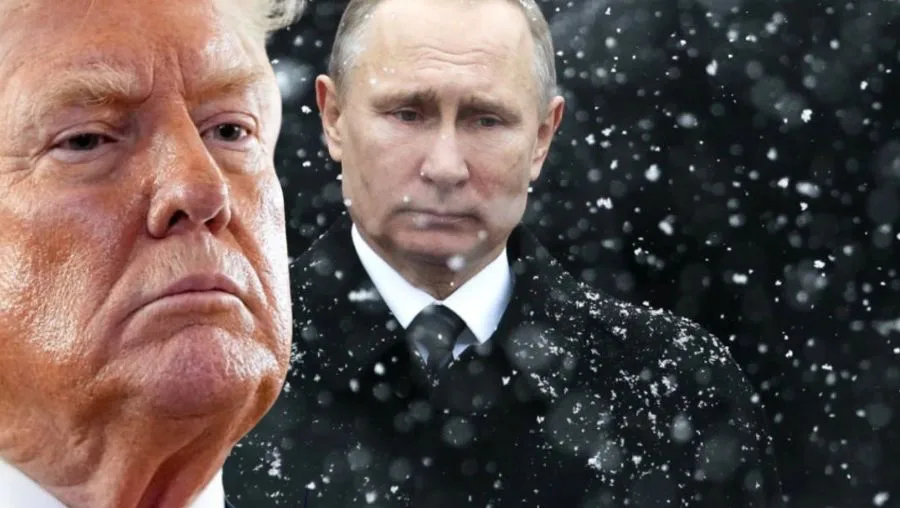
Germany is holding Russia responsible for an attempted drone attack on Leipzig/Halle Airport, and the European Union is talking about the hallmarks of state-backed terrorism. Two suspected participants have been identified, one with Russian roots and a Latvian passport, the other a Belarusian who also holds a Russian passport. At the very same time, Donald Trump is sitting in the White House saying he wants good relations with Russia. “Russia has got great land, very valuable land,” he says, and a lot of good things are happening. Germany is talking about sanctions and sabotage, Washington about good business. One sentence is aimed at the threat, the other at the one making the threat, and both are spoken on the same day. He does not just want good relations, he calls the attacker’s country valuable, as if what lay there were an opportunity and not a war.
“We want to have good relationships with Russia, Ukraine, with everybody. It would be great for business. Russia has got great land, very valuable land. A lot of good things are happening.”
The location was chosen carefully. Leipzig/Halle is far more than a small airport, it is a major civilian cargo hub that plays a role in NATO logistics and serves as a base for several large Ukrainian Antonov An-124 transport aircraft. In August, a drone carrying explosives and a detonator was discovered there. The German government considers the incident part of Russian hybrid warfare, while Russia denies any involvement. An explosive device at a hub for cargo and allies hits the supply arteries at the same time. The attack remained an attempt, its choice of target did not.

According to consistent reports, investigators have identified two men believed to be behind the attack. One was reportedly born in Russia, holds a Latvian passport and has ties to Russian intelligence services; he is said to have flown to Berlin in late July and driven a rental car toward Leipzig, then left the country by plane two days before the failed attack. The second is said to be from Belarus, also carries a Russian passport and entered the country on an Italian tourist visa issued in Minsk. A rental car and a tourist visa from Minsk, behind them the long arm of an intelligence service that leaves nothing to chance. The trail points to Russia.
Trump’s words landed directly in the middle of this situation. He said he wanted good relations with Russia and Ukraine, that it would be great for business, and that Russia’s land was very valuable; the words were spoken on September 2 U.S. time, when it was already September 3 in Germany. Not one word of solidarity with Germany, not one word of deterrence. The president appraises the attacker’s territory like a real estate broker while the attacker strikes an ally. Solidarity costs nothing, praising property costs trust, and he chose the praise. Countries under attack recognize their friends by what they say at the decisive moment, and Germany heard a real estate pitch.
The background makes the praise even darker. Vladimir Putin is now in the fifth year of a brutal war of aggression against Ukraine, Russian missiles and drones kill civilians and reduce cities to rubble, opponents of the regime are imprisoned or silenced. In Europe, Moscow is also repeatedly suspected of sabotage and espionage, and Germany is currently investigating two more suspected cases of sabotage at power facilities in North Rhine-Westphalia and Brandenburg. A country called valuable while its drones are flying becomes a commodity and the war a footnote. The ruler who uses death and destruction as instruments of state policy becomes a business partner as soon as the price is right.
The fact that Trump has treated Putin with striking friendliness for years is no secret. Democratic Congressman Jamie Raskin of Maryland, the ranking Democrat on the House Judiciary Committee, confronted him with it on September 2: The only communists left in the world today, he said, are Trump’s best friends and role models, Kim Jong Un, whom he writes love letters to, and Xi Jinping, whom he has publicly praised more than two dozen times; but when it comes to Putin, Trump follows him around like a little puppy, and Putin was once with the KGB. The problem with communism, Raskin said, is sitting on the other side of the aisle. He is wrong on one point: Putin was a KGB officer, never its chief. Correcting that fact does not make him one bit better, he bears responsibility for a war of aggression and massive repression. The closeness to Moscow is not a whim, it runs through this presidency as a consistent line.

That is why Germany should listen very carefully. But when Berlin is accusing Moscow of an attack on an airport important to NATO, suspects with possible ties to Russian services have been identified, and Europe is preparing new sanctions, it is not a minor detail that the American president is choosing this exact moment to rave about doing good business with Russia. An alliance depends on reliability, and reliability starts with naming the side that was attacked when things get serious. When the protector stays silent, the attacker grows bolder, and a single sentence can make alliance loyalty more expensive than any speech could ever make up for. Putin is likely happy to hear words like these. Germany should not ignore them.
Updates – Kaizen News Brief
Alle aktuellen ausgesuchten Tagesmeldungen findet ihr in den Kaizen Kurznachrichten.
To the Kaizen News Brief In English


