
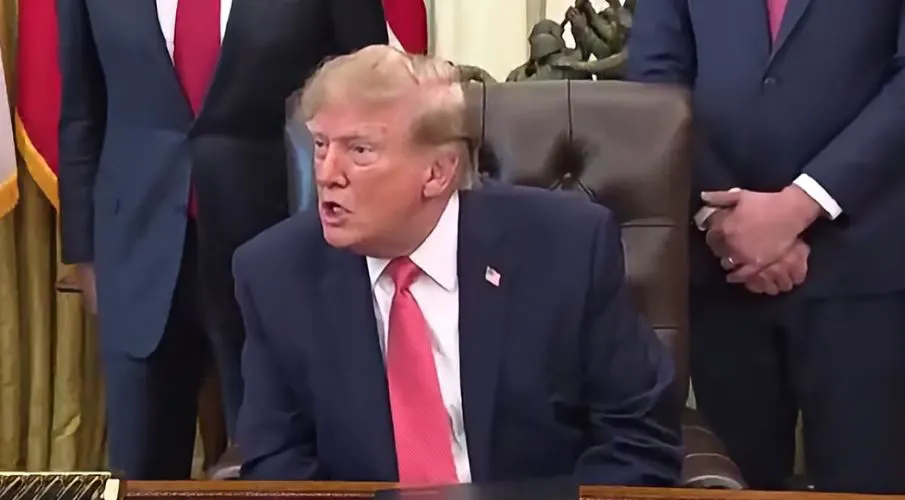
Donald Trump wants a third term. At least he talks about it as though the U.S. Constitution were a piece of paper he could fold and refold any way he pleases. On Tuesday, October 20, 2026, he's sitting in the Oval Office, declaring that the United States has never had a more secure border. That's been the case since the beginning of his second term, he claims. Then he corrects himself: "Or my third term, depending on how you want to define it." He'd like the third term, he adds, just without the results of the second. Behind that bizarre arithmetic is his old lie about the 2020 election supposedly being stolen from him. The 22nd Amendment to the Constitution allows a person to be elected president no more than twice. Trump keeps talking as though denying a defeat often enough could somehow erase it from history.
"So we have now a border that's as strong as we've ever had by far. It's been that way since the very beginning of my second term, or third term, depending on the way you want to define it, and I don't want the results of this; I'd like the third term but I don't want the results of the second term."
The occasion for these remarks is a new Justice Department initiative to combat fraud involving taxpayer money. Trump is putting up $25 million for it. Americans are supposed to be able to report suspected embezzlement through the website Fraud.gov. If someone uncovers $1 billion in fraud and can prove their tip was decisive, Trump promises a 1 percent reward. He explains that the same would apply to amounts of $10 billion or $200 billion. He even mentions $400 billion. Journalists could participate too, he jokes, provided their newspaper approves. Maybe they'd quit their jobs afterward because making money had suddenly become so easy. The considerable gap between a grand promise and a reward that can actually be paid out remains unexplained.
Shortly after Trump finishes speaking, his head drops. His eyes close and open again. As Vice President JD Vance speaks, the 80-year-old sits at the presidential desk and at times appears to have fallen asleep. What the footage clearly shows is his closed eyes and his head dropping; whether he was actually asleep cannot be established with certainty from the footage alone. For an administration whose leader had been talking about another term just minutes earlier, the images are pretty strange. Vance keeps talking. Trump sits behind the desk, his eyelids lowered. A government can tell the public just about any story it wants. Cameras have the inconvenient habit of simply keeping on recording.
Nick Shirley is also in the Oval Office. According to reporting, the conservative online video creator is receiving $10,000. He became famous for accusations against Somali-run daycare centers in Minnesota. During his visits, he interpreted locked doors and refusals to let him inside as evidence of fraudulently obtained government funding. The fact that an unknown man can't simply walk into rooms full of children should initially reassure any sensible daycare operator. The responsible agency in Minnesota later stated that at least 2 of the facilities shown had already been closed for years. Separately, there had indeed been fraud investigations in the state, even during the Biden administration. More than 90 people were charged, and at least 60 were convicted. Apparently, distinguishing between proven crimes and accusations spread publicly is less profitable than a sensational video.
Then the questions begin. A female reporter wants to ask something, and Trump loudly interrupts her: "Wait! Shh! No, no, no!" He repeats his demand and calls on a male colleague instead. Inside the president's own office, a female journalist is told to be quiet for trying to do her job. Nobody invited her there to applaud. A press conference would be a pretty pointless exercise if the president alone got to decide which answers he liked.
Andrew Feinberg, Washington correspondent for the British newspaper The Independent, asks about the rewards. Why would whistleblowers receive just 1 percent when, under the American law against false claims made to the government, they can receive between 10 and 25 percent under certain circumstances? The law dates back to 1863. The legal procedures are different; that's precisely why the question deserves an answer. Trump and Vance get irritated and demand to know who Feinberg works for. He names his newspaper. An explanation of the different compensation rates would have been possible right then. Apparently, information about the person asking is more interesting than information about the money.
"Hey! I don't know who the hell you are, but you better be careful!"
About 5 minutes later, Feinberg asks another question. Trump apparently doesn't recognize him, points a finger at him, and snaps: "I don't know who the hell you are, but you better be careful!" Feinberg later points out that he had introduced himself just minutes earlier. Those words come from the mouth of a president who wields the power of the state and publicly warns a journalist for asking questions. Just what consequences the man is supposed to fear goes unsaid. A pointed finger can sometimes carry more intimidation than a long speech. Still, Feinberg refuses to be driven away.
„Warten Sie, warten Sie! Ruhe. RUHE!!!! Was stimmt denn nicht mit Ihnen? Sind Sie KRANK?“
Bei einer weiteren Begegnung einige Minuten später wird Trump erneut laut. „Ruhe. Ruhe! Was stimmt denn mit Ihnen nicht? Sind Sie krank?“ Feinberg antwortet: „Nicht, dass ich wüsste, Sir.“ Trump setzt nach: „Ich glaube tatsächlich, dass mit Ihnen etwas nicht stimmt.“ Vom Unterschied zwischen ein Prozent und möglichen 25 Prozent ist man inzwischen weit entfernt. Der Präsident fragt öffentlich nach dem Gesundheitszustand des Journalisten, ohne dafür einen erkennbaren Anlass zu haben. Feinberg bleibt ruhig. Seine Stimme muss nicht lauter werden, damit die Zuschauer begreifen, wie sich die beiden Männer gerade verhalten.

Vance verbreitet den Wortwechsel anschließend im Internet und nennt Feinberg einen „schwachsinnigen Journalisten“. Der Reporter antwortet: „Herr Vizepräsident, wenn Sie mich schon beleidigen wollen, haben Sie wenigstens den Mut, mein Benutzerkonto zu markieren.“ Vance ist der 2. Mann im amerikanischen Staat. An diesem Nachmittag findet er Zeit, einen Journalisten öffentlich zu verhöhnen, dessen ursprüngliche Frage weiterhin eine nachvollziehbare Begründung verdient. Für die Regierungsinitiative entsteht daraus kein zusätzlicher Dollar. Zumindest hat die Öffentlichkeit erfahren, welchen Stellenwert sachliche Nachfragen beim Vizepräsidenten genießen.
Der polnische Journalist Jakub Wiech weist auf einen bitteren Widerspruch hin: Der amerikanische Präsident fahre einen Reporter an und nenne ihn wegen einer Frage krank; danach kämen Vertreter seiner Regierung nach Europa, um Vorträge über Meinungsfreiheit zu halten. Ein Präsident muss Journalisten weder schätzen noch ihre Fragen mögen. Das Amt verlangt allerdings mehr als die Fähigkeit, Menschen vor laufenden Kameras zurechtzuweisen. Wo Macht auf unbequeme Fragen mit persönlicher Einschüchterung reagiert, wird aus einem gewöhnlichen Pressetermin eine Warnung an alle, die künftig nachhaken möchten.
Und über diesem Nachmittag liegt Trumps beiläufige Bemerkung zur dritten Amtszeit. Sie fällt 2 Wochen vor den Kongresswahlen, während Bundesbehörden Wahlunterlagen und Maschinen beschlagnahmen und die Regierung Zugang zu Wählerverzeichnissen verlangt. Gegen demokratisch regierte Bundesstaaten werden Verfahren angestrengt; die Grundlage einzelner Vorwürfe ist umstritten. Ob Trump daraus tatsächlich einen Versuch ableiten will, die verfassungsrechtliche Grenze zu umgehen, ist offen. Seine wiederholte Behauptung über die Wahl 2020 bleibt falsch. Republikaner im Kongress haben ihn bislang nur selten wirksam begrenzt, während Gerichte wiederholt Vorhaben seiner Regierung stoppten. Dieser politische Hintergrund verleiht seinen Worten Gewicht, auch wenn er sie beiläufig ausspricht.
Ein Präsident, der von einer dritten Amtszeit spricht, während er einen Reporter bedroht und wenig später mit geschlossenen Augen an seinem Schreibtisch sitzt: All das geschieht während eines einzigen Termins. Der Anlass war die Bekämpfung von Betrug. Feinberg wollte verstehen, wie die versprochenen Zahlungen funktionieren. Trump hätte die Rechnung erklären können. Stattdessen bekam der Journalist einen bösen Blick und die Drohung, bloß aufzupassen. Vor ihm stand der Schreibtisch des Präsidenten der Vereinigten Staaten. Erbärmlich.
Updates – Kaizen News Brief
Alle aktuellen ausgesuchten Tagesmeldungen findet ihr in den Kaizen Kurznachrichten.
To the Kaizen News Brief In English


