
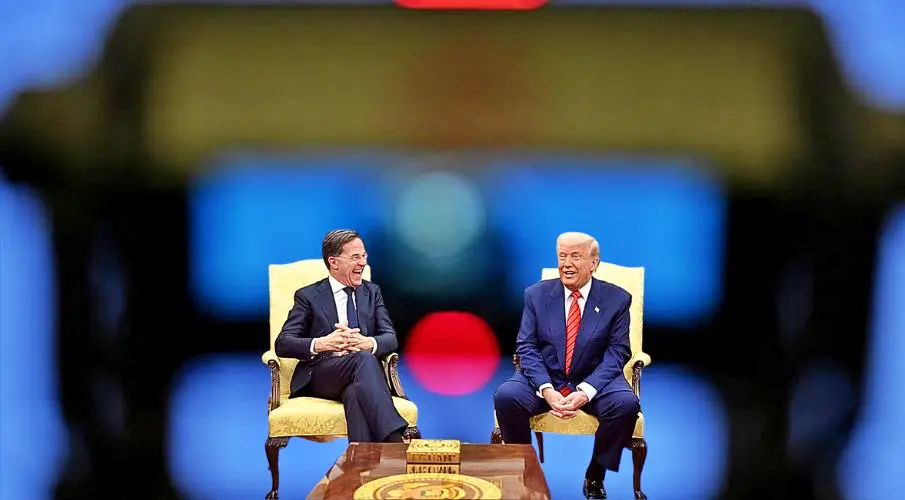
There is a kind of humiliation that goes so far it stops being personal and becomes a political category. Mark Rutte, Secretary General of NATO, has crossed that line - not once, not by accident, but systematically and with visible conviction.
Today, Rutte travels to the White House to calm Donald Trump two weeks before the NATO summit in Turkey. Trump has once again threatened to leave the 77 year old military alliance - this time arguing that European allies refused to help him reopen the Strait of Hormuz, which has remained closed since the Iran war. Defense Secretary Pete Hegseth escalated the pressure last week in Brussels and announced a six month Pentagon review of the American troop presence in Europe. He criticized the allies for refusing to make their bases in Europe available for strikes on Iran - even though NATO had not been consulted before the war began on February 28.
Read also our article: The Review That Is a Threat: Hegseth, Brussels’ Loudmouth Who Leaves Before Zelenskyy Arrives
Rutte's method in situations like this is well known. He flatters. He praises. He surrenders preemptively. On Fox News - the network Trump is known to consume daily - he appeared Tuesday evening and praised Trump as the real leader of NATO, declared that he stood "completely behind him" in the Iran conflict, and described criticism surrounding the base issue as "isolated cases." That is not the language of a man negotiating. It is the language of a man asking for permission.
But Rutte goes further. At last year's NATO summit, he called Trump "Daddy." He sent him private text messages written in Trump's peculiar style - with randomly capitalized WORDS - and wrote:
"Europe is going to pay in a BIG way - as they should - and it will be your win." Trump published that message on social media. In January, another followed that ended with the words: "Can't wait to see you. Yours, Mark."

Trump published that one as well.
You have to picture the scene: The Secretary General of the most powerful military alliance in the world sends private messages of submission to a U.S. president who publicly displays them like trophies. And Rutte allows it to happen. More than that: he repeats it. This is no longer diplomacy. It is self surrender as strategy.

Philosophical tradition knows this type. Hegel described the relationship between master and servant not as a stable hierarchy but as one that ultimately corrupts the servant and alienates the master from reality. What Rutte practices is a variation of that: He gives Trump a sense of superiority in the hope that Trump will not destroy the alliance. Whether that gamble works, nobody knows. What it costs is obvious.
NATO was founded in 1949 to counter the Soviet threat to European security. Its center is the collective defense clause - an attack on one is an attack on all. It has been invoked only once: in 2001 after the attacks on New York and Washington, when Europe stood with America. Today, an American president threatens to leave the alliance because European countries refused to provide bases for a war they had not even been informed about. And the Secretary General of that alliance responds with what read like love letters.
Trump also pressured European allies last year to raise defense spending to five percent of gross domestic product by 2035. Rutte thanked him for it. Trump threatened to annex Greenland - territory belonging to Danish allies. Rutte absorbed it. Trump has his defense secretary question the troop presence in Europe. Rutte travels to Washington and praises.
There is a charitable reading of this posture: Rutte is holding the alliance together by paying the price of personal dignity. Perhaps. But that reading assumes that an alliance held together only through the permanent humiliation of its Secretary General still functions as an alliance. Whether that is true will be shown at the summit in Turkey.
Until then, Mark Rutte writes messages. And Trump publishes them.
Updates – Kaizen News Brief
All current curated daily updates can be found in the Kaizen News Brief.
To the Kaizen News Brief In English


Rutte ist in meinen Augen eine absolute Fehlbesetzung.
Verfasst Mitteilungen im Namen der NATO im Alleingang, die er weder zusagen noch vereinbaren kann.
Keine Kritik an Trump.
Stattdessen Lobhudelei bis über die Schmerzgrenze hinaus.
Er steckt bis zu den Fußknöcheln im Rektum von Trump.
Das ist keine Diplomatie, das ist zu Kreuze kriechen.
Selbst bei den Republikanern ist ein NATO Austritt unpopulär und ohne Kongress kann Trump es bicht im Alleingang durchziehen.
Rutte sollte weniger schleimen und sich mal mit den Fakten beschäftigen.
Trump besänftigen… einen narzisstischrn Soziopathen besänftigt man genau so lange, wie man zu 100% nach seiner Pfeife tanzt.
Eine falsche Geste, ein falscher Blick, ein falsches Wort und der Narzisst geht zum Angriff über.
Ein Bündnis, dessen offizieller Vertreter derart in die Knie geht und komplett devot ist, ist nicht viel Wert.
Irgendwie ist Rutte der Infantino der NATO, nur mit weniger Geld/Gewinn.
Wenn Rutte so devot sein will, ich empfehle da eine Domina.
Privat.
Das richtet wenigstens keinen Schaden für die NATO an.
👍