
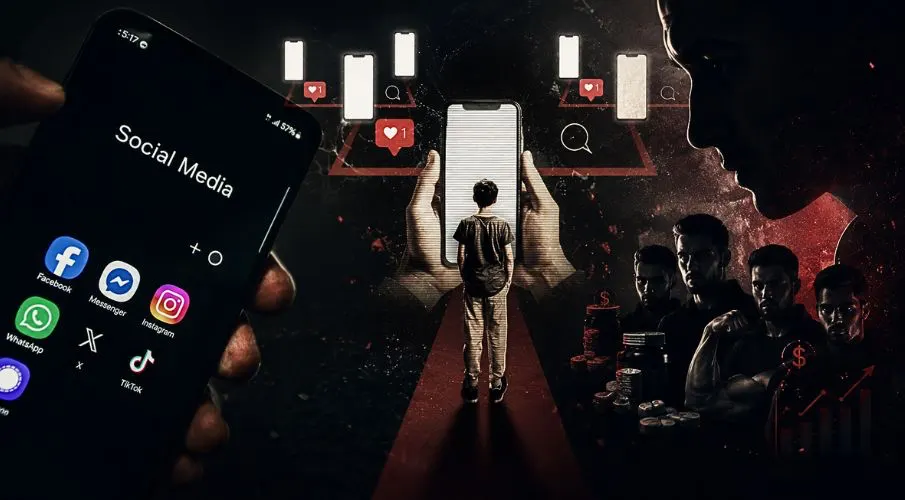
For years, one troubling question has been hanging over parents and teachers, newsrooms and the internet: What is going on with young men? Why are so many of them embracing harsh political views and talking about women with contempt? Risky crypto bets and online gambling pull them in, while at the same time they are becoming increasingly isolated and their symptoms of depression often go unnoticed. In the 2024 presidential election, young men broke for Trump after Republicans courted them with a loudly exaggerated image of masculinity. His second term has done little to change their anger, and their support for the president is now visibly crumbling.
The easiest explanation is that younger men have gathered online under the umbrella of the so-called manosphere, usually understood as an organically grown right-wing rebellion in today's culture wars. A new study reaches a different conclusion. The digital ecosystem producing so-called "red-pilled" men looks less like a political movement than a pyramid scheme.

In their report "The Grift Economy: How Young Men Are Being Sold Fake Belonging and Fake Wealth Online," researchers from the digital safety organization Reset Tech and the nonprofit Equimundo show how algorithms funnel men into paid communities, unregulated supplements, crypto schemes, and outrageously expensive coaching programs. Taken together, they amount to a multibillion-dollar industry. Masculinity, the authors of the 153-page report write, has become a commodity, created and cultivated online so money can be made from it.
It rarely starts with anything threatening. Someone looking for dating advice or investment tips, or simply trying to get fitter, comes across seemingly harmless self-improvement content. Only then do shady operators seize on that insecurity and offer a warped explanation built out of frustration and enemies, often through verified business accounts on X that use real economic data and twist it into the false claim that high youth unemployment affects men alone. Documented economic anxiety is turned into anger at clearly identified groups, at women and at people portrayed as immigrants or foreign workers.
Once men begin to feel that they belong to a community united by resentment and supposed betrayal, the same people start selling them the supposed cure. Sometimes it is a course or admission to an exclusive circle, sometimes a substance from the legal gray market. In the case of misogynistic influencer Andrew Tate, the researchers estimate that his paid "Real World" education platform alone generates $184 million in gross annual revenue; membership costs $99 a month. Reset Tech and Equimundo call systems like these fraud on a massive scale, built on recycled material and affiliate pyramids, deliberately difficult cancellation procedures and polished testimonials. Tate's attorney initially did not comment. Andrew Tate and his brother Tristan are fighting extradition to the United Kingdom, where they face allegations of rape and human trafficking for sexual exploitation; their attorney says they are innocent.
Leading livestreamers such as Adin Ross could, according to the report, make between $30,000 and $50,000 an hour; Ross also owns a stake in Kick, the platform where he streams. People like Joe Rogan can command more than $200,000 for an appearance. The most successful figures in this world can bring in between $1 million and $10 million a year through platform payouts, advertising, courses, memberships and speaking fees.

Gary Barker, founder and CEO of Equimundo, which advocates for gender equality and a healthy idea of masculinity, says the manosphere is easiest to understand by looking at how its biggest earners first fuel the frustration of young men and then turn it into money. Decades ago, a French thinker described a world of commodities in which things recede behind the signs of what they promise, and in which desire itself becomes a commodity, first created and then satisfied. What ultimately gets traded is the sense of belonging that buyers were first deprived of, packaged as fitness and wealth. "They're being duped," Barker says of the customers. They have a right to honest information about products that actually do what they promise instead of simply taking their money.
The platforms make money from it too. They take a cut of the revenue and reward creators for pushing increasingly extreme views because conflict and outrage hold people's attention. Reset Tech examined so-called looksmaxxing, the attempt to improve one's appearance through sometimes drastic methods, which this year has been heavily fueled by Kick streamer Braden Peters, known as Clavicular. The researchers tracked 216 influencers across TikTok, Instagram and Facebook; related content generated more than 14.6 billion views during the period studied. That reach, they found, followed the platforms' recommendation systems rather than developing on its own. The report draws a connection to content that fuels eating disorders among women. Platforms at least partially acted against that material after public pressure; there has so far been no equally determined response to content that convinces men their bodies are inadequate and then turns that insecurity into a business.

A civil lawsuit has been pending against Braden Peters, aka Clavicular, since April 2026. The then 18-year-old influencer Aleksandra Mendoza alleges that he had sex with her while she was still a minor and unable to consent because of alcohol. Peters is also accused of injecting an unapproved fat-dissolving substance into her face during a livestream that, according to the lawsuit, may have been laced with methamphetamine. Peters denies the allegations against him. Based on what is currently publicly known, the case remains unresolved.
Germany is hardly outside this business either. A study by the International Central Institute for Youth and Educational Television and the MaLisa Foundation shows how closely ideas about masculinity, political attitudes and the recommendation systems of social media have become connected. A representative sample of 705 teenagers was surveyed, and researchers also examined the content they encountered on the platforms. Around 26 percent of the boys stood out for a combination of right-wing views, traditional ideas of masculinity, rejection of sexual minorities and climate change denial. What happened with recommendations was particularly striking. Boys who initially showed an interest in seemingly apolitical subjects such as fitness or luxury cars were increasingly served content from the manosphere and far-right actors. In an analysis of 300 manosphere videos, researchers repeatedly found loneliness, failed relationships and insecurity serving as the entry point before distrust of women and blame followed.
Another study by Matthias Quent and Christian Stein involving 2,099 people between the ages of 16 and 27 found a positive correlation between intensive social media use and far-right attitudes. The researchers found no evidence, however, that TikTok alone should be described as an exceptional engine of radicalization compared with other platforms. The problem is bigger than any single app. Young people spend a significant part of their media lives inside systems that do not simply show them what they explicitly searched for, but decide what appears next on their screen based on their previous behavior.
Just how politically one-sided that can become was demonstrated by a Global Witness test ahead of Germany's 2025 federal election. The organization created new accounts and examined which political posts TikTok and X recommended to those users. On TikTok, 78 percent of the political content recommended from accounts the users did not follow was favorable to the AfD. That proves neither that TikTok turns a young man into an AfD voter nor that every road beginning with fitness and self-improvement eventually leads to the party. But taken together with the other studies, it produces a striking finding: Young men can start with fitness, appearance or money, encounter manosphere content and at the same time find themselves in a digital environment where right-wing political content is heavily represented. The AfD does not have to have created this grievance industry. But it meets young men there who have already been told by others that they are the losers of social change and that somebody must be responsible for it.

Graffiti as an expression of anger, political protest and the feeling of no longer being represented by existing social structures - it is precisely at these breaking points that the messages of the manosphere also find their way to young men.
Meta, TikTok and X did not respond to questions about their policies. YouTube said content that promotes self-harm and eating disorders or encourages other dangerous behavior is prohibited, and that stricter rules apply to material that can be monetized; Tate's channels were removed back in 2022. Kick said it responds to prohibited activity in livestreams with warnings and bans and, in some cases, by taking away monetization.
Clavicular shows just how directly outrage can be turned into money. In January 2026, during a livestream from a van in Miami, he listened to Kanye West's antisemitic song "Heil Hitler" alongside Andrew and Tristan Tate, Nick Fuentes and Sneako. Clips quickly escaped the original Kick audience and spread through aggregator accounts across the major platforms; the outrage was enormous. The already well-known Tate brothers saw almost no change in their audience afterward, while the numbers for the previously far less prominent Clavicular shot up. Two weeks later, his posts on X were averaging nearly 3 million views, compared with around 500,000 two weeks before the stream. More viewers meant more potential customers for his looksmaxxing academy, where the cheapest tier costs $49 while private coaching runs as high as $3,000.
Editorial note: We are showing this video solely for documentary and journalistic purposes in connection with this article. Our entire editorial team explicitly and unequivocally rejects the antisemitic content contained in it. It represents neither our position nor our views. We consider the content shown to be contemptuous of human dignity and despicable.
Barker points to a troubling gap. Younger children can at least partly be shielded by parents and organizations, and when necessary by protective regulations; people who have only just entered adulthood have almost none of that protection left. Yet 18-to-29-year-olds are precisely the group using these spaces most heavily. "Nobody's got their back," Barker says. They fall through the cracks because, as adults, they are expected to be able to figure out for themselves which sources online can be trusted. Focus groups conducted by Reset Tech after the 2024 election showed the opposite. Some participants knew remarkably little about where their news and beliefs actually came from; they regarded shows such as "The Joe Rogan Experience" as almost neutral sources. At the same time, they believed women were trapped in closed-off worlds of makeup and lifestyle content while they themselves were well-informed and getting reliable information.
A more critical approach is therefore essential, Barker says. Many young men genuinely do want to recognize when someone is feeding them bullshit, but algorithms have reduced their chances of encountering views that seriously challenge their own. As long as the platforms do not intervene more aggressively, much of the burden remains on users themselves. They have to understand that someone selling them peptides and dating tricks while promising quick riches may simply be exploiting their insecurity. Maybe one day a young commentator will become successful precisely by exposing the lies of this grievance industry. Barker does not expect an entire wave of young men to rise up tomorrow and announce that they are going to fight this online. But that, he says, is exactly where part of the pushback has to begin.
Updates – Kaizen News Brief
All current curated daily updates can be found in the Kaizen News Brief.
To the Kaizen News Brief


Medien haben schon immer, gerade junge, Menschen stark beeinflusst.
Ich denke da an den Magersuchtsboom durch Twiggy in den Hochglanzmagazinen 😞
Den Bodybuilderwahn mit Sterioden durch Arnold Schwarzenegger und Co.
Durch Social Media verbreiten sich Trends und eben auch gefährliche Ansichten viel schneller.
Man(n) steckt viel schneller in einer Bubble.
Ich sehe es bei meinem MAGA Bekannten.
Total unpolitisch. Hat zwar traditionell republikanisch gewält, aber das war es.
Das letzte Jahr von Trumps Amtszeit bemerkte ich die Veränderung. Nachplappern der Trump Narrative.
Ab der „gestohlenen Wahl“ driftete er vollends in die MAGA Bubble ab.
Ein gebildeter 75 jähriger Vietnam Veteran.
Ich bin gegen ein Sovial Media Verbot für Minderjährige.
Sie konsumieren dann mit 18 Jahren ohne social media Kompetenz.
Aber eines muss man klar sagen.
Jeder hat einen eigenen Willen und kann nein sagen.
Ja, kann man(n), wenn man(n) wollte.
Aber das Patriarchat ist so tief in der Gesellschaft verankert, dass gerade junge Männer auf diese Seiten und deren crude Ansichten reinfallen.
Frauen hingegen fallen eher auf Seiten mit (unerreichbaren?) Schönheitsidealen rein.
Dort wird das Geld mit Kosmetik, Botox, Diäten etc gemacht.
Bei den Männern hingegen entwickelt sich eine toxische Bubble.