
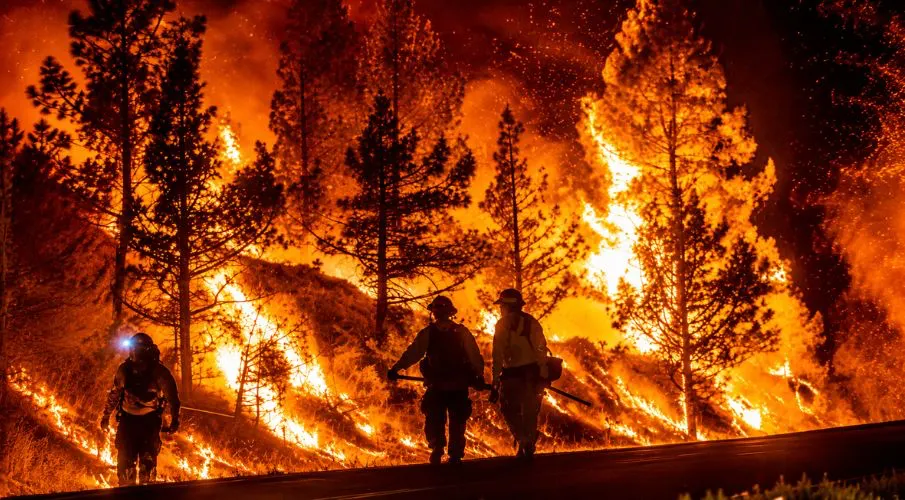
While the forests around Spokane were burning and 65,000 people were forced from their homes, the money that was supposed to help thin those forests was sitting in a federal government drawer. It wasn't sitting there by accident. The Trump administration had held it back until a state pledged obedience to its deportation policies and its campaign to end diversity programs. Washington pledged nothing. So the wildfire prevention money stayed put, and summer did the rest. On Saturday, 3 fires were raging at the same time, more than 900 buildings have been destroyed or damaged, more than 10,400 acres have burned, and as of Thursday the fires were about 10 percent contained. Smoke over the city, families in gymnasiums, and somewhere inside a federal agency, a form still waiting to be signed.
The Forest Service had awarded $15 million in September 2025 to two organizations in the Spokane area to fight exactly what is happening now. $9.3 million went to the Spokane Conservation District to reduce the growing wildfire risk in the county, and $5.5 million went to the Spokane Valley Fire Department. The district planned to thin forests and help residents clear brush from around their homes and make their properties more resistant to the flames; only recently did the state's Department of Natural Resources even send over a draft agreement. Both projects were supposed to serve the greater metro area and its 600,000 residents, many of whom live in forests that are getting drier year after year. The recipients waited month after month. The money never came.

Because in the meantime, the Agriculture Department had inserted a new condition. If you wanted federal money, you had to fall in line with the administration, with its massive deportation campaign and its elimination of diversity and equity programs, or DEI. The money was no longer tied to the forest or the weather, but to a position on immigration and minorities. Washington refused because the conditions conflicted with its laws, including a rule that keeps the state out of the hunt for immigrants. Put simply, helping Trump's deportation machine was being demanded as the price for money to fight fires. Twenty Democratic-led states sued over it as early as March 23, and on June 5 a federal judge temporarily blocked the conditions. Still, more weeks went by. Our research found that the wildfire funding agreements weren't signed until July. USDA and the Washington State Department of Natural Resources confirmed that timeline. When the fires broke out in early August, the organizations in Spokane were still waiting for the $15 million. That raises a second, even more uncomfortable question: Why didn't the money arrive in time even after the court ruling? A political blockade had long since turned into an administrative delay, and while Washington waited for the money, the forest didn't wait.
But a fire doesn't ask about ideology. It doesn't check papers and it knows nothing about loyalty, it takes whatever is dry as it moves up the hillside. Anyone who ties protection from fire to a pledge of allegiance has mistaken the enemy, and nature can only be mastered by obeying it, not by demanding that it obey you. The forest doesn't wait for a court. It burns by its own laws while people in government offices argue about diversity. Fire is the most honest opponent there is, it knows no party and no executive order, it takes whatever you leave in its path.
Of course, whether this money would have changed the course of these 3 fires remains an open question; even if it had arrived on time, the work would only just have been getting underway, according to Operations Director Cori Turntine. But that is exactly the scandal. The fact that nothing had started wasn't some quirk of the weather, it was a decision made in Washington. If you delay prevention yourself, you don't get to turn around afterward and say it wouldn't have made a difference yet anyway. That's the logic of someone who fills in the well and then complains there wasn't enough water. First you hold up prevention, then you point out that it hadn't had time to work yet, and in between, the country burns.

No one in Spokane disputes that prevention works. Reducing fuel changes how a fire behaves, says Lance Dahl of the fire department; thinning trees and removing dead vegetation that allows flames to climb from the ground into the canopy reduces the size and intensity of a fire. And Brett Anderson of the Spokane Valley Fire Department says this is exactly the kind of work that helps stop a fire as it moves out of the wildlands and toward homes. It only works when everyone works together, the county, state agencies, and private organizations. It doesn't help to treat your own 4,000 acres if the fire starts on the 100 acres next door.
The ugly part is that this money was never Trump's to hand out as a favor. It comes from the Community Wildfire Defense program, a $1 billion program created under Joe Biden in 2022 through a bipartisan infrastructure law passed in 2021; the Forest Service awards $200 million from it every year to the strongest applicants, and Spokane's $15 million was part of the third round. A tool created to fight fire, passed by both parties, became a tool against those who refused to fall in line. If you don't play along on deportation and DEI, the help you need in an emergency gets delayed, without anyone ever having to openly say no. That turns bipartisan disaster prevention into a bargaining chip that can be used to extract obedience, with the forests as the stakes.
And Spokane wasn't an isolated case. Washington is now also fighting the Department of Homeland Security and FEMA over conditions attached to billions of dollars in federal funding for security, emergency preparedness, and disaster protection. Once again, it's about political concessions. The state is supposed to cooperate with the administration's immigration enforcement policies, and according to the attorney general, the challenged conditions even include demands to hand voter data over to the Department of Homeland Security. That means this fight goes far beyond $15 million for a few forests around Spokane. It's about a method: Congress appropriates money for public safety, and the administration tries to tie its release to demands that have nothing to do with the actual purpose of the money. Wildfire prevention, disaster protection, and public safety are turned into leverage against states that refuse to obey politically.

Experts call it dangerous. Brittany Fallon of the environmental organization Western Resource Advocates says it is risky to make protection from catastrophe dependent on the shifting priorities of an administration. Athan Manuel of the Sierra Club calls it frustrating to impose ideological filters on things that aren't remotely ideological. These communities are taxpayers who fund these agencies, he says, and their money should come back to them in the form of wildfire protection without forcing them to jump through DEI hoops first. Behind all of this is the question of whether protection from fire is a right or a favor you earn through good behavior. In a country governed by the rule of law, it would be a right. Under this administration, it's a tip for submission.
The Agriculture Department stayed silent about its rule and whether the disaster had changed anything. It pointed to close cooperation with local and federal partners and said 242 of its personnel were working the fires. Trump ultimately also approved Washington's request for a federal emergency declaration, opening the way for immediate FEMA assistance. That is exactly what makes the contradiction complete. Once the fire was there, federal resources arrived; the money that was supposed to help reduce the danger beforehand had been stuck for months. Two hundred forty-two people are fighting the fires now, while the $15 million for wildfire prevention still hadn't reached the places where it should have been put to work long ago. No pledge of allegiance stops a flame, no executive order makes a hillside less steep. That is the record of an administration that tried to make political loyalty a condition even when protecting homes and lives was at stake. An administration that ties wildfire protection to ideology doesn't light the match, but it clears the way for the fire.
To be continued ...
Updates – Kaizen News Brief
All current curated daily updates can be found in the Kaizen News Brief.
To the Kaizen News Brief


Trump und seine Entourage sind 🤬🤮
Anders kann ich es nicht ausdrücken.
Die politische Gesinnung passt nicht, da werden zugesagte und zustehende Gelder zurück gehalten.
Das trifft viele ddmokratische Staaten zu verschiedenen Programmen.
Aber nach den vielen Waldbränden der letzten Jahre, hätte das doch Priorität.
Es betrifft ja nicht nur Spokane oder den Bundesstaat Washinton. Es betrifft die angrenzenden Staaten, Kanada und das Weltklima.
Trump, der sich noch über den Rauch aus Kanada aufgeregt hat, lässt die Menschen in und um Spokane im Stich.
Fanilien haben alles verloren, Verletzte, soweit ich weiß auch Tote (bei den First respondern), tote Tiere…..
Alles wegen Trumps Anti-DEI Kurs.
Wäre das Geld sofort geflossen, hätte es bicht so ausufernd gebrannt.
Trump hält so viel Geld zurück, als Waffe gegen demokratische Staaten.
Vielleicht sollten die demokratischen Staaten Bundessteuern zurück halten, bis zu den Summen aus den zugesagten Mitteln.