
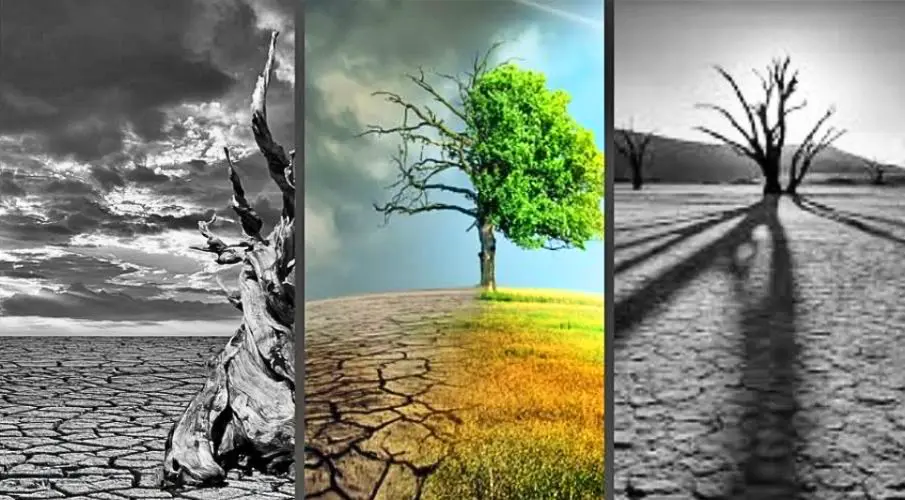
A new study shows that Earth’s freshwater cycle has long since crossed a planetary boundary, driven by climate change and the human use of land and water. Dry and wet extremes now occur twice as often as they did a hundred years ago, and no one seems to be in a hurry.
There are boundaries whose crossing comes without noise. A new study published in Nature Communications concludes that Earth’s freshwater cycle has already moved beyond one of them, the planetary boundary within which the world’s water remains in a stable and reliable state. Climate change and the large scale human use of land and water are pushing the cycle ever farther from that state, and the finding that the boundary has been crossed reflects a long trend that threatens freshwater’s ability to sustain the climate and ecological processes of the Earth system.
The researchers analyzed data from 1901 to 2019 using an ensemble of global hydrological models and measured changes in two kinds of water. So called blue water, the water in rivers and lakes as well as groundwater, and green water, the moisture stored in soils. They separated what humans directly cause through land and water use from what humans indirectly cause through climate change. The result is sobering. Dry and wet extremes now occur about twice as often as they did at the beginning of the twentieth century, in both blue and green water.

How to read the graphic:
At the top are rivers and lakes, at the bottom soil moisture. On the left are regions that have become unusually dry, on the right regions that have become unusually wet.(a) Where rivers now carry less water more often than in the past.
(b) Where rivers now carry more water more often than before, with a higher risk of flooding and extreme rainfall.
(c) Where soils dry out more frequently, harming agriculture and ecosystems.
(d) Where soils become excessively wet more often, leading to waterlogging and flooding.The more orange and red a region appears, the farther it has moved from its earlier state. The graphic shows one thing above all: water is not simply redistributing itself, the swings toward dry and wet are becoming more extreme across the world.
The changes in the freshwater cycle have accelerated in recent decades, says Vili Virkki of the University of Eastern Finland, and the calculations suggest that this trend will continue to intensify. If the cycle changes faster than the environment can adapt, the risks of harmful consequences grow. The real danger lies in that sentence, not in change itself, but in its speed. Adaptation takes time. It is the slow work of roots and river systems, and water that shifts faster than that work can unfold leaves life behind.
Where this happens differs from place to place. In many tropical and subtropical regions, increasing dryness dominates, while in the northern boreal zone wet extremes are becoming more frequent, through floods and prolonged large scale rainfall events. Looking only at blue water is not enough, says co author Sofie te Wierik of the Dutch Environmental Assessment Agency, to fully understand changes in the water cycle and their possible consequences. These changes vary greatly from region to region and over time, depending on which part of the cycle one examines. This is more than guidance for specialists. A society that watches only rivers and lakes sees the flood but overlooks the slow drying of soils, the green water no one notices and without which nothing grows.

The main driver behind these changes, and behind the crossing of the boundary itself, is climate change. Wet extremes are primarily linked to climate effects, while direct human pressure through land and water use intensifies dry deviations in particular. In some regions, including parts of India and Central Asia, climate change may even slightly increase the amount of water available throughout the year, but that gain is consumed again through land and water use, leaving the landscape drier.
Returning the cycle to within safe boundaries, says Dieter Gerten of the Potsdam Institute for Climate Impact Research, will only be possible if climate change and land and water use are understood as connected causes, and if we gain a better understanding of how planetary boundaries interact with one another, a task researchers now intend to pursue. That identifies the uncomfortable point. The world treats these causes separately, climate over here, land and water over there, dividing up a process that is in reality one and the same.
How a society responds to a finding like this says more about it than the finding itself. A crossed planetary boundary appears as a number in a scientific journal, not as a siren. It does not announce itself on a single day but across a century, and a century is longer than attention spans, longer than an election cycle. It is longer than the time horizons in which decisions are calculated and votes are cast. Water becomes background noise, noticed only when it enters homes as a flood or burns fields as drought, and between those loud moments people forget that the cycle carrying everything has already slipped out of balance.
Water is the oldest measure of life, older than any order humanity has built, and now humanity is bending that ancient flow faster than life can follow. The study demonstrated this with one hundred and eighteen years of data and with models, using the sober language of thresholds, and that is exactly what makes it unsettling: that a civilization is capable of measuring its own loss so precisely and still does not stop. A boundary has been crossed quietly, without the path back appearing on its own. Perhaps the most honest question of these days is not whether we know, because we do know, but why that knowledge carries so little weight when what is at stake does not move to the rhythm of our urgency.
Updates – Kaizen News Brief
All current curated daily updates can be found in the Kaizen News Brief.
To the Kaizen News Brief In English


Es kann einen Angst und Bange werden wenn man an die nächsten Generationen denkt .