
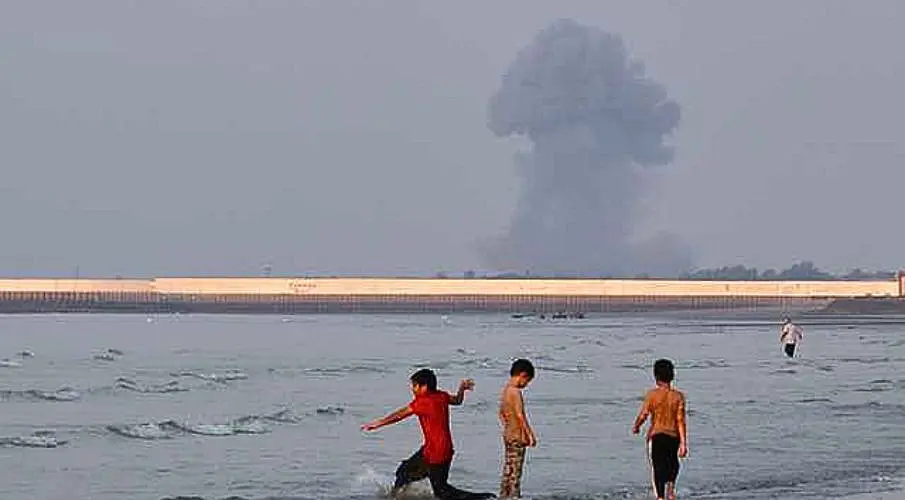
Iran had a quiet night. Those four words from a spokesman for Iran's Health Ministry capture just how fragile this moment really is, because in the fifth month of a war, a quiet night has become news in itself. After nearly two weeks of American warplanes striking targets across Iran night after night, the skies finally fell silent. U.S. Central Command confirmed no new attacks and declined to comment when asked. At the same time, diplomatic efforts moved to the forefront in an attempt to keep the conflict from sliding back into open warfare. This coming Tuesday marks five months since the conflict began on February 28.
Whether this marks a turning point or simply the pause between two blows, no one can say, least of all the president, who seems determined to argue both at once. Donald Trump said Friday that America was locked and loaded while insisting serious negotiations were taking place at the same time. He brushed aside concerns that soaring gasoline prices caused by the war could hurt Republicans in November's midterm elections. It is the posture of a man holding the door open with one hand while keeping the other clenched into a fist, hoping his opponent will decide what it means.
"We can take it to a much higher level if we want to. We're prepared to that. We're locked and loaded and ready to go."
One person viewing the situation without much emotion is Michael Singh, formerly the Middle East director on George W. Bush's National Security Council and now a senior fellow at a Washington institute specializing in Middle East policy. If this pause stretches over several days, he said, that would be significant. Whether it represents an operational pause or simply space for behind the scenes diplomacy remains difficult to determine. Israel, which entered the war alongside the United States on February 28, has noticeably stayed out of the latest round of attacks. Singh believes that absence itself may be intended as a signal to Tehran that Washington wants to keep the conflict from expanding. On Tuesday, however, Trump is scheduled to meet Israeli Prime Minister Benjamin Netanyahu for the first time since February, only weeks before the war began.
This is where the brutal mechanics of every war reveal themselves. The side with the advantage is usually the one willing to take one more step than the other, which means ending a war often falls to the side that fears looking weaker first. That is exactly why wars are easier to begin than they are to end. A ceasefire is not peace. It is only the narrow space where both sides wait to see who blinks first.
June already showed how quickly that narrow opening can disappear. A temporary agreement and a brief ceasefire were followed almost immediately by fighting over the Strait of Hormuz, the narrow waterway through which roughly 20 percent of the world's traded oil normally passes, pushing the region back to the edge of a much broader conflict. American forces gradually expanded their target list, striking naval facilities, coastal defenses around Bandar Abbas, bridges, highways, and infrastructure deep inside Iran, reaching areas on the outskirts of Tehran. According to investigators, six bridges and one tunnel around Bandar Abbas alone were damaged, communications towers were destroyed, and transportation links to nearby islands were temporarily severed.

The current wave of attacks has not reached the intensity seen at the beginning of the war. During the first one hundred hours, the United States and Israel struck hundreds of military targets and eliminated much of Iran's leadership, including Supreme Leader Ali Khamenei. Iran's Health Ministry says 3,434 people have been killed since the conflict began, including 55 during the latest escalation. Airstrikes temporarily crippled transportation, communications, and parts of the country's water supply. One strike on a desalination plant in Jask reportedly destroyed pumping stations serving about 10,000 residents. That attack followed an Iranian strike against U.S. bases in Jordan that killed three American soldiers. At a border crossing into Iraq, where religious pilgrims had gathered, two more people were killed. For every Iranian attack targeting the Strait of Hormuz, Trump warned, another power plant or bridge would fall.
A second front has now settled over the waters farther south. The Iranian backed Houthis launched missiles and drones at Saudi Arabia, targeting Aramco facilities in Yanbu and Jizan in retaliation for Saudi strikes against the port city of Hodeidah. They have also threatened to close the Bab el Mandeb Strait to Saudi shipping, a chokepoint through which roughly 12 percent of global trade passes. At the same time, Tehran accused Ukraine of attacking an Iranian commercial vessel in the Caspian Sea, killing one crew member and injuring another. Kyiv responded by saying it had achieved significant results against vessels transporting military supplies from Iran.
The toll hanging over every discussion about ending this war has long since spread beyond any single battlefield. More than 7,000 people have now been killed, including over 3,400 in Iran, 18 American service members, 24 civilians in Israel, and more than 4,000 people in Lebanon, where Hezbollah began attacking Israel just two days after the war started. Against those numbers, one quiet night carries very little weight. It is only the first word of a sentence that neither side is yet willing to finish, and no one knows whether that sentence will end with a period or another burst of fire.
Updates – Kaizen News Brief
All current curated daily updates can be found in the Kaizen News Brief.
To the Kaizen News Brief In English


Solange ein demented Präsident, ein iranfeindlicher Israeli und die iranischen Hardliner bestimmen, sehe ich keinen echten Frieden.
Eine Feuerpause hier und da.
Dann wieder Drohungen und Angriffe.
Hegseth liebt den Krueg.
Trump hält sich für den Dealmaker der gesamten Welt.
Netanyahu will an der Macht bleiben, da ihm juristisches Ungemach droht.
Die Mullah wollen ihre Macht und Kontrolle nicht aufgeben.
Und in der Zwischenzeit sterben Menschen, leidet die Wrltwirtschaft und mit ihr die Weltbevölkerung.