
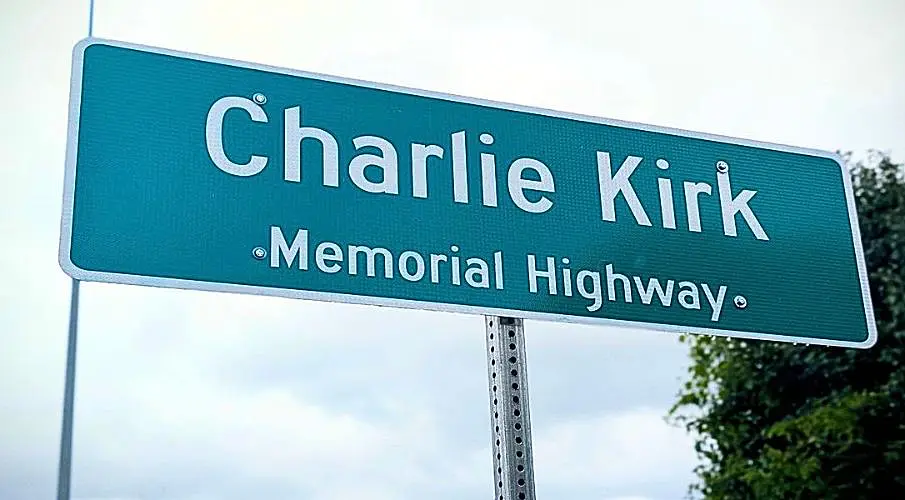
One morning, Vietnam veterans in Sumner County, just north of Nashville, woke up to find that the road that had belonged to their own fallen for more than four decades suddenly carried someone else's name. Last month, they discovered new signs along State Route 386 reading Charlie Kirk Memorial Highway. That very stretch has officially been known as Vietnam Veterans Boulevard since 1987, and it is more than just the name of a road. It is a roadside memorial. Twenty five men from the county who died in Vietnam are honored there, each with an individual sign bearing his name and military branch. Tennessee lawmakers have now placed one name over those twenty five without ever asking the people who built that memorial.

David Black is 78 years old, a Vietnam Marine veteran and now a professor at Vanderbilt University. He describes it with the phrase no soldier likes to hear - blindsided. Hit from the side. No one from the state legislature ever contacted them. The fact that Black himself once appeared on Charlie Kirk's podcast actually makes the situation even more striking. It shows this was never about hostility toward Kirk. It was about taking something away from the living. Barry Rice, 80, an Army veteran and president of the Tennessee State Council of Vietnam Veterans of America, puts it more politely, which somehow makes it even more powerful. Many veterans, he says, have absolutely no objection to a memorial honoring Charlie Kirk somewhere. Just not on their boulevard.
The man responsible is Johnny Garrett, the Republican state representative for Sumner County, who introduced the memorial designation back in March. According to Garrett, several constituents approached him asking for a way to honor Kirk for defending free speech and inspiring an entire generation of young people to stand up for the freedoms and Christian values on which America was founded. He chose that location, he said, because it is the main gateway into Sumner County from Nashville. When you choose a memorial site, you choose visibility, and Garrett wanted the most visible entrance available, the one every traveler passes. There is an old observation that nothing eventually becomes more invisible than a monument. People drive past it thousands of times. Their eyes stop noticing it. The sign quietly becomes part of the landscape, and that quiet familiarity is exactly where its dignity lives. A new name changes that. It forces people to look at the sign again. The cruelty of this decision is that from now on they are looking at the wrong name. That is exactly what David Black fears, and he says it in words that hardly require any commentary. Young people driving this road know the name Charlie Kirk because they recognize it. They know almost nothing about Vietnam or about what those veterans endured. Before long, he says, this road will simply become Charlie Kirk Memorial Highway because that is the name future generations will remember.

In that single thought lies the entire politics of memory now playing out in Tennessee. A society does not simply decide who it honors. It also decides who slowly disappears from public memory, and forgetting is often the more deliberate act. Twenty five men who died in a war their country lost and spent years trying to forget had finally been brought back into public view. Now an activist takes their place, a man whose fame is fresh, whose name is still spreading across social media, and the legislature's calculation is obvious. The younger, newly martyred public figure pushes aside the older dead because his name carries more noise than their silence ever could. The way Charlie Kirk is now being presented as a martyr for free speech deserves the closest scrutiny. He did not build his fortune or his influence by defending everyone's right to speak. He built it by ridiculing people who disagreed with him, by turning provocation into a career where conflict itself became the product. To place him beside men who gave their lives for their country, carrying a rifle instead of a microphone, shifts the meaning of sacrifice in a way Garrett unintentionally captures himself when he says he wants to honor both the men who fought for America's freedoms and the man who died while exercising them. As though hosting a podcast were somehow equivalent to fighting through a jungle. As though a political commentator shot during a speech belonged in the same place as a soldier killed in combat.
Once the backlash grew louder, Representative Garrett suddenly discovered concerns he had apparently never heard during the weeks before. He now says he acted immediately to find another location that would properly honor both Charlie Kirk and the Vietnam veterans. The only problem is that no such location exists yet, while the signs remain exactly where they are. As of Wednesday they were still standing. David Black and Barry Rice have both been told the signs will eventually be moved, but nobody can say when. Most likely, it will require a second vote in the Tennessee legislature, exactly the legislative process that veterans themselves were never given before the signs first appeared.
Meanwhile, the Tennessee Department of Transportation has wrapped itself in bureaucratic innocence. A department spokeswoman says no order to remove the signs has been received. The legislature approves memorial highway designations, the department simply manufactures and installs the signs, and it will follow whatever instructions lawmakers eventually provide. Responsibility dissolves into procedure. The lawmakers wanted it. The agency installed it. The signs stand there as though they had somehow planted themselves. Even Turning Point USA, the organization Charlie Kirk founded, has quietly begun stepping back. A spokesman said he appreciated the desire to honor Charlie Kirk but suggested another highway might ultimately be more appropriate, adding that he trusted lawmakers and veterans' organizations to reach a solution that honors both. It is the language people use when they are unwilling to admit a mistake but would not mind if somebody else quietly fixed it for them.
David Black reduces the entire controversy to something as simple as the metal signs themselves. He says they just want them taken down as quickly as possible. Nothing more. And frankly, no state should owe its fallen anything less than that. Because a road may officially carry two names, but only one will survive in people's memories. The twenty five men honored there do not have a podcast to keep speaking for them.
Updates – Kaizen News Brief
All current curated daily updates can be found in the Kaizen News Brief.
To the Kaizen News Brief In English


Vietnam Veteranen, so oft vom Volk und Politik beschimpft und vergessen.
Die Traumata derer, die dort gedient haben, sind präsent.
18 jährige, die zwangsweise in einen Krieg geschickt wurden, den sie nicht wollten.
Lebend, aber verwundet (psychisch oder physisch), zurück gekehrt.
Vernachläsdigt in der Gesundheitsversorgung, im gesamten zivilen Leben.
Und nun beschließt ein Abgeordneter, ohne die Zustimmung des Landeskongresses, das der Veteranen Highway einfach Charlie Kirk Highway heißt.
Die Schilder sind schne ab und die neuen schnell aufgebaut.
Man sagt zu, es zu ändern.
Nur wann sagt Keiner. Es bleubt jetzt wie es ist.
Die Veteranen wrrden wahrscheinlich in den nächsten Jahren versterben.
Dann erinnert nichts und Niemand an sue.
Stattdessen huldigt man dem Faschisten Kirk.
In Tennessee kein Wunder.