
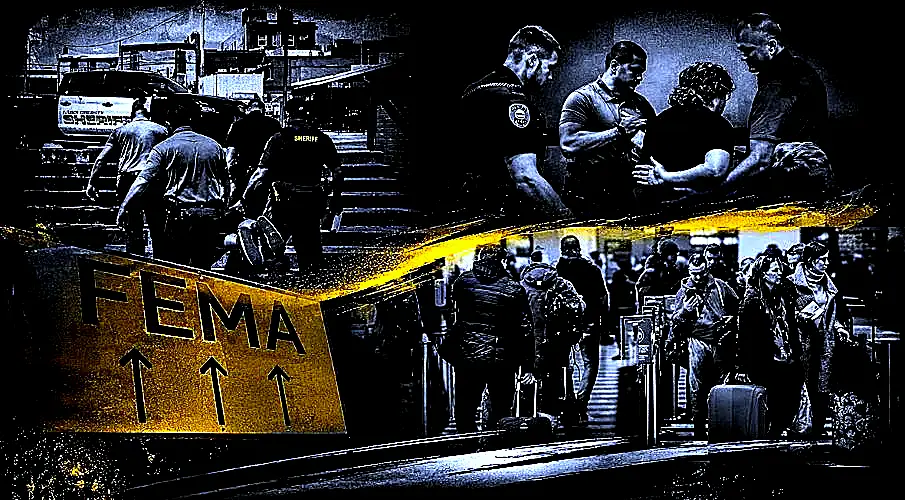
It starts with a knock. The sheriff's cruiser is sitting in the driveway, and the man at the door isn't there because of a crime, because no crime exists. He read a post, wrote one late at night, said one word too many about the government, capitalism, or the border. Somewhere, inside a center he'll never see, a trained analyst recognized a sign in it, the possibility of a crime that never happened and may never happen. From that moment on, a file exists. And inside that file, you exist as the person you might one day become. Until recently, no sheriff would have had either the authority or the funding for something like that. Now they have both.
Read also our article: Investigations reveal: Bounty list - How ICE pays local police for arrests, even involving children

Both come from an internal document issued by FEMA, the Federal Emergency Management Agency. We are in possession of the complete document. It is a paper about grant funding, yet it turns the oldest principle of the rule of law upside down, the principle on which every free Western society has long rested, that punishment follows the crime and never the other way around.
What the Government Wants to Buy
For years, FEMA was criticized for failing during wildfires, floods, hurricanes, and tornadoes. Now it has a new mission. Domestic terrorism. Directive No. 566, dated July 9, 2026, signed by the Acting Deputy Administrator for Grant Programs and now in our possession, instructs states and local governments to make domestic terrorism their top priority when applying for federal grants. The title cites the implementation of National Security Presidential Memorandum No. 7. Its contents embrace Trump's demand to identify suspected domestic terrorists before they ever strike.

The document that sets everything in motion. Dated July 9, 2026 and signed by an acting federal official, it instructs states to make domestic terrorism their central priority.
The document, which we possess in its entirety, is remarkably candid about what the states are expected to purchase. Training programs to identify warning signs on social media. Analysts tasked with monitoring online behavior and digital footprints. Teams assigned to deal with persons of interest whose conduct allegedly suggests a possible path toward terrorism.

The core message in brief. The document establishes the new priority, reminds recipients of the mandatory funding quota, and opens the door for local law enforcement to satisfy it.

Here FEMA ties federal grant money directly to the President's memorandum. What qualifies as terrorism is left to a definition broad enough to be stretched whenever necessary.
Across its eight pages, variations of the word "indicator" appear ten times. It is the favorite word of the security bureaucracy because it conceals what is really happening. An indicator is something a person said or did that a trained official is expected to interpret as the warning sign of a future crime. Where evidence once stood at the beginning of every investigation, prediction now takes its place. It is policing by intuition, fortune-telling dressed up in the language of national security. What was originally designed to combat organizations like al-Qaeda and the Islamic State is now being turned against the country's own citizens.
How deeply this preventive mindset has taken hold becomes clear in the initiatives the directive encourages. Officials are instructed to learn the latest tactics used by domestic terrorists so they can recognize indicators before an attack occurs. Communities are to be trained to report threatening or suspicious behavior. They are to practice surveillance and countersurveillance to uncover pre-operational reconnaissance of domestic targets. The only activities excluded are those unrelated to terrorism prevention. Social work, public health programs, anything that helps rather than suspects people, is explicitly excluded.
The list of eligible projects reads like the blueprint for an expanding security apparatus. It funds behavioral threat assessment teams that classify persons of interest and formally document their case management. It funds liaison officers who connect patrol officers, tactical units, and fusion centers while focusing specifically on indicators. It funds reporting systems connected to a centralized federal database, along with overtime for intelligence analysts during periods of heightened threat so surveillance never has to stop. Even the equipment is carefully spelled out, including specialized optics for the early detection of suspicious activity at crowded locations, churches, schools, government buildings, transportation hubs, polling places, and large public gatherings.

What FEMA and the Department consider especially valuable. The examples are explicitly non-exclusive, leaving the scope intentionally open.
The Coercion Hidden in the Fine Print
Why would a local government step into such a politically sensitive field? A second document we also obtained provides the answer - a grant solicitation issued by the Department of Homeland Security itself. It is effectively a shopping list worth $1 billion, and it comes with a catch. Thirty-five percent of the funding must be spent on counterterrorism, with additional mandatory shares devoted to five departmental priorities, including election security at a minimum of 3 percent and border security at a minimum of 10 percent. The language is blunt. Any recipient that fails to meet those requirements will have the affected funds withheld until the violation is corrected. This is not a request. It is the threat of turning off the money.

Pay up or pay the price. Jurisdictions that fail to meet the quotas lose the funding. And the border security requirement leads directly to the 287(g) program, where local police are paid to hunt down migrants.
The thresholds are flexible, and they move in only one direction - upward. The 2002 law requires that at least 25 percent of certain grant funding be devoted to law enforcement counterterrorism activities. For Fiscal Year 2026, the Department raised that threshold to 35 percent through its own administrative directive. What Congress established as the minimum has been pushed higher by executive decree. And what actually qualifies as terrorism is defined so broadly that it can be stretched whenever needed. The directive points to a definition covering any act that endangers human life, violates criminal law, and is intended to intimidate a civilian population or influence government policy. Whoever decides what constitutes intimidation also determines the reach of suspicion. And that person sits in Washington.

The administration turns Congress's minimum requirement of 25 percent into 35 percent through its own directive. What lawmakers established as the floor, the Department raises at will.
The priorities mirror the President's obsessions as faithfully as a shadow follows the man. Just this month, Trump claimed during prime time television that China manipulated the 2020 election, and now election security appears on the mandatory funding list. The border crisis requirement pushes states directly into the 287(g) program, which turns local police into bounty hunters by paying them to enforce immigration law based on the number of people they arrest. The Department states it openly in its funding table - at least 10 percent must go toward cooperation between local agencies and Homeland Security investigators to apprehend and remove individuals considered threats. Another priority funds the new federal-state task forces Trump created by executive order on his very first day back in office. And the final priority, protecting crowded places, carries its own ghost.

Read also our article: Our Investigation and Confidential Documents Show: How Under Secretary Rogers First Declared Germany, Then Half of Europe, the Enemy
A Murder as the Beginning
That ghost has a name. Charlie Kirk, the conservative activist who was shot to death last September in front of a crowd during a university event. Everything that followed grew out of that murder. Three days after declaring Antifa a domestic terrorist organization by executive order, Trump signed National Security Presidential Memorandum No. 7 on September 25, 2025. It opens by referencing Kirk's death, then establishes a program intended to prevent the next such killing by searching for its cause where it is easiest to find - in people's beliefs.

Click here to access our Charlie Kirk Dossier
Because the memorandum claims political violence in America does not arise on its own. It argues that it is the product of sophisticated, organized campaigns. And it identifies what it considers indicators of terrorism. The list has to be read in full to grasp just how sweeping it is. Anti-Americanism. Anti-capitalism. Anti-Christianity. Support for overthrowing the government. Strong positions on immigration, race, and gender. Finally, hostility toward those who continue to embrace traditional ideas of family, religion, and morality.
Related articles:
A man clapped exactly once during the public comment period at a hearing over the construction of a data center in Emporia, Kansas.
He was arrested
Here the mask comes off. No crime is required anymore. A belief is enough. This catalog does not describe bomb makers. It describes a worldview and places it under surveillance. We have already shown where that leads in our investigation Our investigation reveals: Anti-capitalism. Anti-Christian. Anti-American. The FBI is now compiling lists. and in its follow-up, The FBI Is Keeping Lists Now - Part 2: Charged Over a Password - Trump’s Justice Department Turns Encryption Into a Crime. Frankly, we expected far more public pushback. Instead, the consequences of these policies enjoy broad support across much of the population, and nothing is more dangerous to freedom than the applause of those who believe it will only ever happen to someone else.
The Neighbors Become the Reporting System
The program reaches its furthest point where it turns ordinary citizens into participants. The directive explicitly encourages campaigns that train communities to report threatening or suspicious behavior and teach the public to recognize and pass along indicators. The old slogan, "If you see something, say something," is turned inward and aimed at the beliefs of your neighbor. A society that monitors itself eventually needs the fewest government agents because it has turned every individual into one. It is the quietest form of control because it does not come from above. It moves through living rooms. And where distrust becomes a civic duty, the trust that holds a society together dies. What remains is a neighborhood where everyone watches everyone else through the eyes of the government.
All the way down to the county sheriff
For a long time, the memorandum was aimed primarily at the federal bureaucracy, federal law enforcement, and the IRS. But one short section at the end reaches all the way down to the county sheriff. It instructs the Secretary of Homeland Security to establish grant programs that pay local police to pursue domestic terrorism. The FEMA directive is the implementation of that order. It turns the fusion centers, the information hubs created after the September 11 attacks where local police, federal agents, and intelligence analysts pool their data, into tools directed against domestic threats. It funds the teams that classify persons of interest. And it pays for monitoring digital footprints that are supposed to indicate future mobilization.
How extensive this system of conditioning has become is reflected in the training requirements. Courses on the history of terrorism and the conditions that allegedly foster it are specifically required to cover domestic extremism and organized political violence. Tabletop exercises and full-scale drills are designed to test whether reports flow properly and suspicious behavior is recognized. Other exercises rehearse responses to cyberattacks carried out by domestic actors. Everything ultimately feeds into a centralized federal reporting system so that information gathered in a single county becomes available nationwide. Piece by piece, a national nervous system is taking shape, one that reaches into even the smallest sheriff's office and whose trigger is no longer an actual crime, but merely suspicion.
A Government Agency That Was Allowed to Bleed Out
Washington has known for years where this leads. FEMA was created in 1979 as an independent agency. After the September 11 attacks, however, it was folded into the newly created Department of Homeland Security in 2003, and many of its disaster preparedness responsibilities were broken apart and distributed throughout the Department. That very September, the senior official responsible warned then-Homeland Security Secretary Tom Ridge in a seven-page memorandum that the restructuring would cripple America's ability to respond to disasters. His warning was ignored. Two years later, Hurricane Katrina struck.

The origin of it all. Here, the White House orders domestic terrorism to become a national priority and instructs that local law enforcement be paid to pursue it.
The fusion centers have their own record as well. In October 2012, a bipartisan congressional investigation found that the Department of Homeland Security could not even say how much money had been spent on them. Internal estimates ranged anywhere from $289 million to $1.4 billion. The Senate concluded that the intelligence they produced varied widely in quality, was often weak, rarely timely, and at times threatened civil liberties. During the thirteen months examined, investigators found nothing that had uncovered a genuine threat or prevented an active terrorist attack. Of the 610 intelligence reports reviewed, 188 were never published, many because they contained nothing of value or raised civil liberties concerns. Among the reports criticized were a Muslim community group's recommended reading list, a parenting guide, and a motorcycle club flyer advising its members to remain polite during traffic stops. Fourteen years later, that very same machinery is being tasked with searching digital footprints for indicators of un-American beliefs.
What FEMA and the Department consider especially valuable. The examples are explicitly non-exclusive, leaving the scope intentionally open.
And while it is being handed this new mission, its backbone is being broken. Since January 2025, FEMA has lost roughly 14 percent of its workforce while still managing more than 300,000 projects across over 600 active disaster declarations. What that means was demonstrated only recently. A tornado tore through Wisconsin's Fox Valley, prompting the National Weather Service to issue the kind of warning it reserves for only the most catastrophic events. Entire homes were ripped open, their interiors simply gone. The people who lost everything can at least take comfort in knowing they have been protected from domestic terrorism.

The bureaucratic trick that ties everything together. Agencies that pursue domestic terrorism simultaneously satisfy their mandatory funding quota.
Why This Matters to Every Traveler

Anyone who reads this document in isolation misses the larger picture. At the same time these new grant programs were rolled out, investigative structures expanded and border controls became more aggressive. At the same time, cases emerged in which even tourists and American citizens were detained without any transparent justification. The alarming part is not the wording of this document by itself, but the political environment in which it appears. What looks like an ordinary administrative directive becomes a window into the direction an entire government is taking.
That leads us to a warning we do not make lightly. Anyone traveling to the United States today should understand that an apparatus is taking shape that interprets digital footprints, social media posts, and personal beliefs as indicators. A critical opinion about capitalism, the government, or border policy, a sentence that would have been harmless yesterday, can be enough to make someone a person of interest. The border has already become the place where those decisions are made because phones are searched, online accounts are examined, and nothing you have written can ever truly be taken back. We have already documented that encrypting your own phone has been treated as the basis for a criminal prosecution. You are traveling to a country whose hospitality now comes with conditions. And that condition is your worldview.
The Price of Suspicion
In the end, one question remains, and it reaches far beyond any budget line. A system that holds people accountable for what they have done still regards them as free to choose what is right. A system that targets people for what they might one day become has already abandoned that freedom because it treats thought as though it were action and possibility as though it were a crime. The presumption of innocence was never just a legal technicality. It was a promise that the government would regard every citizen as free until given a reason to believe otherwise. A program built around searching for indicators turns that promise upside down. It sees every citizen as a potential criminal and waits for them to prove otherwise. Once suspicion alone becomes enough, everyone eventually becomes suspect. And anyone who believes they are safe has simply failed to notice that the list from which their name is absent can be expanded at any moment. A climate change denying government obsessed with domestic terrorism is creating a disaster of its own. And a Congress that does nothing watches it happen as though the storm already gathering over America's living rooms has nothing to do with them.
The FEMA document is not an isolated case. Whether in Washington, Berlin, or Brussels, security agencies are receiving more funding, more data, and broader powers. Migration, extremism, and domestic security dominate the political agenda, and while the tools differ from country to country, the direction does not. Faced with crises, governments respond not with less surveillance but with more, with tighter integration between agencies and ever greater authority to intervene.
The most dangerous part is not any single law but the gradual acceptance that comes with it. Each individual power sounds reasonable when viewed in isolation. Only together do they create a picture that cannot easily be undone. Those who identify it early, who examine it, document it, and sometimes investigate it at considerable personal risk, often stand alone. Not because everyone else is indifferent, but because the full consequences are difficult to grasp in everyday life. They rarely reveal themselves in one dramatic moment. They accumulate through countless small ones. That is precisely why investigations like these are necessary. They look closely before the accumulation becomes a new reality, one in which merely looking too closely has itself become suspicious.
Updates – Kaizen News Brief
All current curated daily updates can be found in the Kaizen News Brief.
To the Kaizen News Brief In English


Das erinnert mich an die Stasi oder oder Nordkorea usw.
Es ist erschreckend wie weit der Wahnsinn schon ist.
Nur dass man heute durch die Digitalisierung viel schneller und effizienter ist 😖
… da haben sie recht
… das kommt der Sache mittlerweile sehr nahe, leider
Erinnert mich irgendwie an „Minority Report“! 😥
…ein sehr guter Vergleich
Diesen Bericht musste ich mehrfach lesen.
Das, was jetzt gefördert wird ist die totale Überwachung und Elimination eventueller (!) Kritiker.
Wie soll da Widerstand wachsen?
Ohne Hilfe von Außen, hat es quasi keine Resistance geschafft das zu beenden.
Jedenfalls nicht in der Neuzeit.
Das ganze ist eine Mischung aus 1984, Minority Report, Person of Interest, die Hexenverbrennungen, die Blockwarte zur Nazi Zeit und die informellen Stasi Informanten in der DDR.
Nachbar gegen Nachbar. Mensch gegen Mensch.
Ich mag Jemanden nicht, also wird er angeschwärzt. Ob die Behauptung stimmt ider nicht, die Maschinerie setzt sich in Gang.
NIEMAND ist sicher.
Das muss einfach klar sein.
Es ist mehr wie dringend, dass es eine Reisewarnung für die USA gibt.
Oder müssen auch erst Touristen (Mehrzahl, sonst ist es nur ein bedauerlicher Einzelfall) sterben?
Je mehr die USA in den autokratischen Faschismus abdriften,desto mehr ploppen bei FB profile auf, von Menschen die in die USA ausgewandert sind.
Wie sicher es ist.
Wieviel freier man lebt
Wie freundlich Alle sind.
Welch hervorragende Gesundheitsversorgung man hat und dafür viel weniger zahlt als in Deutschland.
Blablabla.
Ihre Wohnsitze haben sie seltsamerweise in Ohio, Oklahoma, Florida… in all den roten Staaten.
Die „es ist so toll in den USA“ Kommentare klungen auch sehr ähnlich.
Sie reden Alle nieder, die etwas Kritik üben, mit der Behauptung, man muss in einem Land leben um sich eine echte Meinung bilden zu können.
Und es wird viel zu negativ und mit Fake news berichtet.
Ich bin mir sicher, dass die meisten Profile bicht echt sind.
Einige schon, es gibt auch unter Auswanderern MAGA .
Das Gleiche auch mit deutschsprachigen USA Reiseseiten.
USA wird hoch gelobt. Kritik nicht geduldet.
Würde mich, im Hinblick auf Eure Recherche, nicht wundern, wenn genau solch Seiten dazu dienen, kritische Menschen zu erfassen.
Eben nicht nur in den USA.