
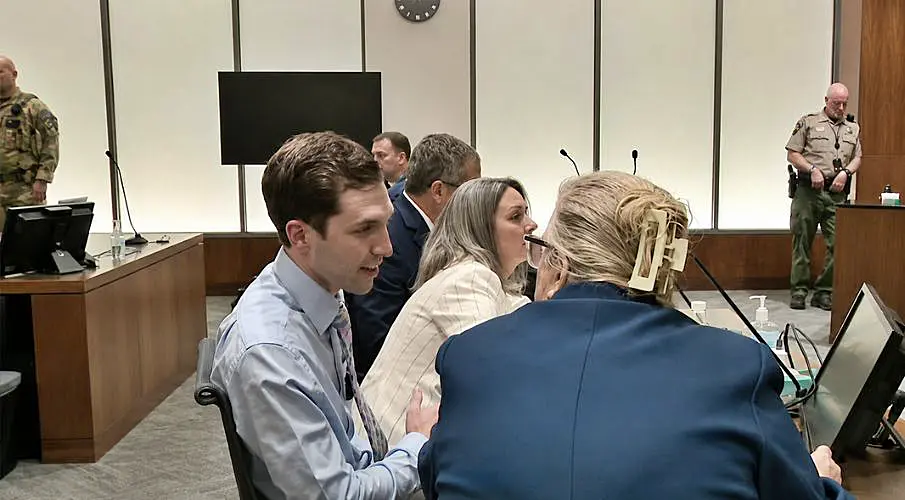
Provo, Utah (KB) - Outside the Fourth District Courthouse in Provo on Wednesday, police officers led a dog past people competing for the few public seats available. Inside, laptops, cell phones, and smartwatches are prohibited, and anyone wishing to report on the proceedings must rely on memory alone. It is the second day of the week-long preliminary hearing in which Judge Tony Graf must decide whether the evidence is sufficient to send Tyler Robinson to trial for aggravated murder. Ten criminal counts are at issue, all stemming from the death of Charlie Kirk, who was shot on September 10 on the campus of Utah Valley University. Robinson has not entered a plea to the charges, nor have his attorneys addressed the question of guilt, and their attempts to have the death penalty removed from the case have so far failed.

The day begins with audio problems and a projection screen that the judge has moved so everyone in the courtroom can see the digital evidence, explicitly in the interest of openness. At first, the attorneys' monitors display nothing. Then they do. Graf reminds everyone that electronic devices have no place in the courtroom and that all spectators are expected to conduct themselves quietly, respectfully, and in an orderly manner. Prosecutor Ryan McBride raises a question concerning the admission of several exhibits, his colleague Gurmander announces the next witness, and defense attorney Michael Burt informs the court that he intends to call two witnesses from the Bureau of Alcohol, Tobacco, Firearms and Explosives.
Jeremy Bentham, the utilitarian philosopher, called publicity the very soul of justice. The same man also designed the panopticon, the circular prison in which one individual is exposed to every eye. In Provo, both inventions of the same mind collide. The world wants to see, while the defendant has the right not to be judged before a jury has even been empaneled.
The afternoon witness is Brian Davis of Utah's state law enforcement agency, a veteran investigator whose career includes more than sixty homicide cases and responsibility for a cold case unit. Together with investigator Dave Hull, he is leading the Kirk investigation. His agency serves as the lead investigative authority, he says. Also involved are the FBI, the ATF, several state and local agencies, the university police, the Orem Police Department, and the sheriff's offices of Utah County, Washington County, and St. George.

On September 11, 2025, Davis recounts, he spent the day at the command center. At about 8:30 that evening, he received a call instructing him to drive to St. George because someone wanted to surrender in connection with Kirk's killing. At the Washington County Sheriff's Office, officials discussed how to handle a person turning himself in. The suspect had arrived with his parents and a family friend. It was Tyler Robinson. Officers spoke with his mother, his father, and Mike Mitchell, the close family friend who had helped arrange Robinson's surrender to law enforcement. Davis himself interviewed Robinson's mother. At approximately four o'clock on the morning of September 12, Robinson was formally taken into custody at the sheriff's office, and Davis was the officer who processed him. Robinson's cell phone had already been secured before his arrival in St. George. After the arrest, officers collected his clothing, swabbed him for DNA, and took his fingerprints. Later that same day, September 12, search warrants were executed for both Robinson's apartment and his parents' home. Davis was not present during those searches. Robinson had been living with another person.
Read also our investigations:
The boy who had everything and still lost his future - An investigative reconstruction
The Distorted Truths About Tyler Robinson and Messages From Hell
Then a video is played, and what it shows reflects the narrow confines of these proceedings. It is a shortened version, presented without audio by agreement of both sides. Robinson enters a room inside the sheriff's office wearing a red shirt and a baseball cap. He pauses at the doorway. Then the screen goes black. Whether he was questioned there remains unknown. It is a rare glimpse of a man at the moment he surrendered himself, and no one hears his voice.
Mike Mitchell gave a second statement on March 31, 2026, handwritten, a process that took him about an hour. The prosecution introduces it as an exhibit but wants neither the spectators nor the cameras to have access to it. It cannot be read on the courtroom screen. The proceedings simply move on without anyone outside the courthouse learning what it contains. At the crime scene, Davis says, investigators found a live cartridge on the roof of the computer science building at the far eastern edge of the campus. The building stood east of the auditorium where Kirk had been seated, and from the location of that cartridge there was no line of sight to Kirk's tent. It is a detail that proves nothing and suggests everything, depending on who is interpreting it.
Then Lance Twiggs enters the picture, Robinson's roommate and romantic partner. He was interviewed twice, on September 12 and again on April 20, 2026. Investigators collected a buccal swab from him and seized his cell phone. Twiggs received limited immunity for his testimony, meaning that his statements cannot be used against him, while offering no protection from prosecution on any other grounds.

The recorded interview of Lance Twiggs becomes the focus of the entire remainder of the day, and this dispute is the real trial. Prosecutor Hunt wants the audio to be played while limiting the video to the courtroom so the cameras cannot broadcast it online. A day and a half earlier, the defense had submitted eleven pages of proposed redactions to a twenty-one-page transcript. Defense attorney Richard Novak argues that portions of the interview are irrelevant and inadmissible, and that in any event they must not be broadcast. Twiggs discusses matters that have never before been mentioned during the hearing, including text messages and a group chat, and he repeats statements Robinson is alleged to have made.
The attorney representing the media organizations and journalists objects. Closing the courtroom, he argues, is out of the question. The public has the right to know what is taking place, and everything upon which the State bases its case belongs before the public's eyes. Under Utah law, material of central importance is to be made public, and just how central this recording is can be seen from the intensity with which both sides are fighting over it. If it is withheld, the inevitable impression will be that it contains something someone does not want the public to see.
Novak requests a brief closed proceeding. A discussion at the bench would not be enough, he says, because transcripts of bench conferences can later be obtained, and the judge remarks that it is not his role to tell the parties how to try their case. Graf visibly takes offense at Novak's suggestion that he should intervene. At 2:40 p.m., the court recesses for what is announced as fifteen minutes. It turns into an hour. The judge reviews the video himself and examines the proposed redactions. He rejects some of them and accepts others.
At 3:43 p.m., Graf states that pages nineteen and twenty of the transcript contain material of no relevance, and that he is not yet prepared to rule on them. Two minutes later, it is decided that the portion running from 32 minutes and 55 seconds to 35 minutes and 48 seconds will not be released publicly. Novak says the prosecution will argue that Robinson confessed to Twiggs. He himself refuses to call it a confession, and argues that allowing something the State may later characterize as a confession to circulate beyond the walls of this courtroom would violate his client's constitutional rights at this very moment. The prosecutor again requests that the audio be played while withholding the video, and the argument continues, technical and exhausting, circling around the same issue.
Late in the afternoon, Graf adds that the segment running from 6 minutes and 56 seconds to 20 minutes and 27 seconds will also remain sealed from public release. It will, however, be admitted so that he himself may consider it. Jeffrey Neiman, attorney for the Kirk family, steps forward. If evidence is admitted, he argues, then the world should be allowed to see it in its entirety. Without openness, doubt and mistrust toward the justice system inevitably arise. Novak responds that he respects the family, but publishing what the State calls a confession would jeopardize Robinson's right to a fair trial. Then the ruling is handed down. Both segments remain closed to the public. Graf says he recognizes the importance of transparency while equally recognizing the weight of the defendant's constitutional rights. It is, he says, a narrow line to walk. Much of what is being withheld concerns discussion of text messages, and those messages will likely be introduced separately.
Remember that sentence. It is not the content that disappears, only its voice. The country will be allowed to read what was written, but it will not be allowed to hear the way it was told. Bentham would have admired that distinction, and he would have been horrified by it.
The prosecutor announces that she will edit the video and present the admissible portions on Thursday, then asks to adjourn for the day. The defense agrees and identifies another exhibit it wants redacted, five screenshots taken from Twiggs' cell phone. Judge Graf asks Novak to submit a short written brief so that he can fully consider the defense's argument. The prosecution says it will do the same. Proceedings will resume at 9:00 a.m. on Thursday, and the judge indicates that he intends to admit the edited audio recording of the interview.
The prosecution has already hinted at what the recording contains. Robinson allegedly texted Twiggs that he had targeted Kirk because he was tired of his hatred. In another message left for him, Robinson allegedly wrote that he had the opportunity to eliminate Charlie Kirk, and that he intended to take it.
DNA evidence was also fiercely contested. The defense disputes that the forensic testing connects Robinson to the alleged murder weapon. Michael Burt questioned an FBI analyst about the procedures used to associate Robinson with a towel wrapped around a rifle that was found in a wooded area near the crime scene together with the bolt action rifle and a spent cartridge. Burt emphasized that she could not directly associate Robinson with the specific samples in question. Lawrence Quarino, professor and director of the forensic science program at Cedar Crest College in Pennsylvania, described the methods as highly reliable and called DNA analysis the gold standard of forensic science. Analyst Amanda Bakker testified that after Twiggs provided a reference sample, she repeated her testing and was able to attribute all of the biological material to two individuals. Jennifer Faumuina of Utah's state crime laboratory testified that DNA from two people was found on the towel, one being Twiggs and the other, with a very high degree of probability, Robinson.
Investigators say Robinson climbed onto a rooftop near the stage and shot Kirk through the neck while he was answering questions before an audience of several thousand people. Kirk was pronounced dead at the hospital. Prosecutors argue that the fact the shooting endangered numerous other people constitutes an aggravating circumstance that makes the offense death penalty eligible under Utah law. They also seek an additional sentencing enhancement because Robinson allegedly selected Kirk on the basis of his political beliefs. That is precisely what the defense is fighting, and Novak attempted to exclude from the proceedings a statement describing the traditional Christian values of Turning Point USA.
At the end of this day, no one has heard a single word from Lance Twiggs, and the cameras remained still. A proceeding that may ultimately determine life or death spent an entire afternoon arguing not about the killing itself, but about who is allowed to watch. Publicity is the soul of justice, and in Provo, it was sitting in the hallway.
Updates – Kaizen News Brief
All current curated daily updates can be found in the Kaizen News Brief.
To the Kaizen News Brief In English


Wirklich spannend, was da im Gerichtssaal abging
… sehr viel uneinigkeit auf jeden fall …