
Provo, Utha (KB) – At 6:30 in the morning they were already standing outside the Fourth District Courthouse in Provo, waiting for the wristbands that would secure them a seat inside the courtroom. The first people had been there since eleven o'clock the previous evening, others since one in the morning. One woman took the day off from work, arrived at five, and still did not get a seat. Drones hovered above the courthouse, and security personnel stood watch on the roof.

It is the fourth day of the preliminary hearing, which Judge Tony Graf intends to conclude on Friday at five o'clock in the afternoon, when he will decide whether there is sufficient evidence to send the case to trial. Tyler Robinson, twenty three, from St. George, is charged with aggravated murder, discharge of a firearm causing serious bodily injury, obstruction of justice, two counts of witness tampering, and committing a violent offense in the presence of a child. Prosecutors are seeking the death penalty. Robinson has never entered a plea. Graf ordered that neither cameras nor photographers may show the victim's family. Whenever the courtroom feed pans toward the ceiling, Erika Kirk is usually walking through the courtroom. At 9:30 the judge takes the bench and greets the widow. Overnight, her attorney Jeffrey Neiman filed a motion arguing that everyone inside the courtroom should be allowed to see whatever the judge permits. Utah's Victims' Rights Amendment, adopted by voters in 1994, grants victims' families the right to attend major court proceedings. That right, he argued, becomes hollow if they are prevented from seeing the evidence the judge is considering. Where transparency is absent, speculation and conspiracy theories flourish.

The attorney representing media organizations and journalists argues that the public should be allowed to see as much as possible. Graf's obligation to maintain public access, he replies, exists alongside the rights of the victim and the defendant's constitutional right to a fair trial. Not every piece of evidence will be shown because limiting access preserves the integrity of the proceedings. For every exhibit, he chooses between three levels: for the judge only, visible inside the courtroom, or also shown in the public livestream.
Hegel distinguished revenge from punishment by arguing that revenge remains an act of the injured will and merely creates new injury, whereas punishment becomes justice only when imposed by a third party who has nothing to avenge. Graf demands precisely that kind of detachment from himself, while to the family that same detachment appears heartless. A court that gave the family everything it understandably desires would no longer be a court. It would become their instrument.

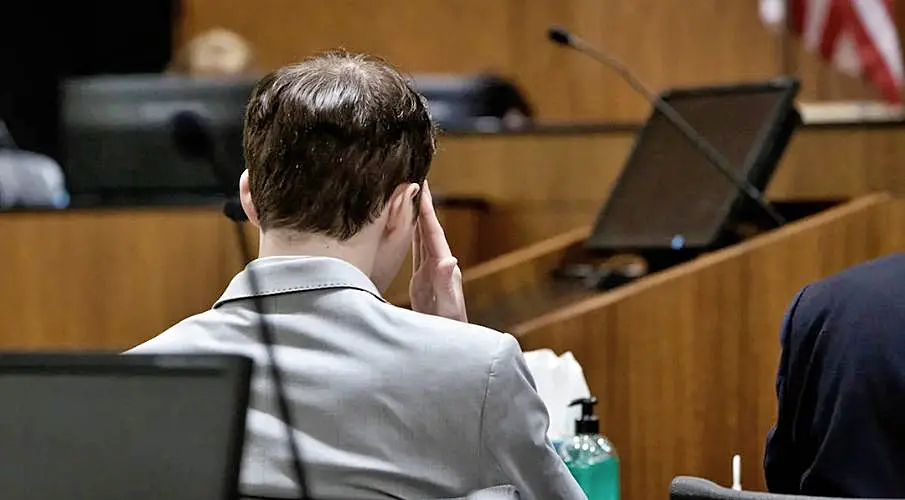
The man accused of fatally shooting Charlie Kirk, Tyler Robinson, left, sits during the fourth day of the preliminary hearing at the Fourth District Courthouse in Provo, Utah, while Judge Tony Graf confers with the attorneys about the further course of the proceedings.
The morning belongs to the video. Everything showing anyone other than Deputy Utah County Attorney Ryan McBride and witness Lance Twiggs must be redacted, Graf orders, along with eight seconds at one point and seven seconds at another. Defense attorney Richard Novak notes that he never requested the first redaction. He considers the second passage irrelevant. Graf allows the first section, maintains his refusal regarding the second, and admits the exhibit into evidence without allowing the complete recording to be shown.
Twiggs testified that Robinson told him he "wished he hadn't done it." "I just asked him in person if what he said the night before was true, and he said it was... He started crying a little bit and said he wished he hadn't done it..."
"Eventually Robinson said he would talk to his parents or turn himself in."
Neiman rises once again. The family has waited ten months and wants to understand what the judge is reviewing. What is the purpose of being present if they cannot see it? They deserve to know what happened to Charlie. The prosecution asks that the video be shown inside the courtroom but not included in the public livestream. Of the eighteen pages containing text messages, five and a half pages are public. The ruling ultimately goes further than prosecutors requested. Graf allows the interview, the text messages, the handwritten note, and the chat log to be shown in the livestream as well, with only limited exceptions.
Late in the morning the video is played. The blacked out portions, prosecutor Lauren Hunt explains, are the court ordered redactions. The recording shows Twiggs in a video interview with McBride, conducted in April at the Utah County Attorney's Office. In exchange for his testimony, Twiggs received immunity from prosecution. He said he met Robinson in 2023 when they became roommates through the same group of friends. Two or three months after moving in together, they became a couple while continuing to occupy separate bedrooms in an apartment complex in St. George. Twiggs worked as a bathroom installer, while Robinson worked for an electrical company and was training to become an electrician. Robinson spent the night leading into September 10 at the apartment and left for work around four in the morning. The evening before, he had asked about the engraving tool because he wanted to go hunting with his family and engrave phrases onto ammunition. He had been talking about hunting for months. Twiggs got up around noon. Robinson posted only once that day in a group chat and did not contact him again until about eleven that night. Around that time, Twiggs found a note underneath his computer keyboard, read it, took a photograph of it, and placed it back where he had found it.
The two saw each other again on the morning of September 11. Robinson paced nervously around the apartment and said there were probably police officers outside. Twiggs asked whether what Robinson had said the previous evening was true. It was, Robinson replied. He cried a little and said he wished he had not done it. Afterward, he tried to keep himself occupied to distract himself. Twiggs said goodbye and drove to his parents' house. At eight that evening, Robinson wrote a message in the group's weekly role playing game chat. Later that same night, he surrendered to authorities.
Twiggs learned about the shooting after a friend sent him a link on social media. Because of the quality of the image, he told McBride he could not be completely certain the suspect shown was Robinson, but the shoes and sunglasses looked like his. Robinson usually wore a hat. The bottom two photographs, however, were definitely him. Twiggs said he himself did not use social media. The two of them mostly played multiplayer games, including shooting games after school. Robinson was generally the one who talked about politics, discussing what he had heard on the radio, President Trump, and current events. Twiggs said he could not remember Robinson ever mentioning Charlie Kirk. Some people knew him by the name Luna. There was also an engraving tool inside the apartment.
Read also our earlier investigations: The Distorted Truths About Tyler Robinson and Messages From Hell
Investigator Brian Davis, who was present during the interview, confirms Twiggs' account and reads aloud the text messages recovered from Twiggs' phone using a forensic extraction device. Robinson was saved in the contacts as Tyler, and the phone number matched.

"Leave everything where it is," Robinson wrote. "Look underneath your keyboard." Twiggs replied with question marks, asking whether this was some kind of joke. "Damn, I meant to delete that," Robinson answered. He added that he was okay and was still stuck in Orem, my love. "It was you, wasn't it?" Twiggs asked. "It was," Robinson replied. "I'm sorry." Twiggs asked how long he had been planning it. "A little over a week, I think," Robinson answered.

Luna,
If you are reading this letter because of my message, then I am very sorry. I left the house this morning on a mission and wrote a will. I am probably dead or facing a long prison sentence. I had the opportunity to take Charlie Kirk out, and I took it. I do not know whether I succeeded, but I had hoped to make it back home to you.
I wish we could have lived in... (Tyler Robinson's handwritten note to Lance Twiggs, "Luna")
He then wrote that he wanted to retrieve the rifle, but the roads had been blocked off. Twiggs asked whether the police had found it, why Robinson had left it behind, and whether it had a serial number. Robinson replied that he did not know. What worried him were the fingerprints. He had been forced to leave the rifle in the bushes where he changed clothes, and a tracking dog might eventually find it. It was an old rifle, he added. He had wanted to use it for hunting, and judging by today's events, it had worked quite well.

Robinson's final message instructed Twiggs that if police questioned him, he should ask for a lawyer and remain silent. His attorney, Robinson wrote, should be Doug Terry. Investigators recovered the photograph of the handwritten note from the extracted data on Twiggs' phone. Davis identified the defendant in the courtroom, wearing a gray sport coat. The defense declined to cross examine him.
During the afternoon, prosecutors called their final witness, Sergeant Jennifer Faumuina, who had been dispatched to the university campus at approximately 1:30 p.m. on September 10. She processed the courtyard where Kirk was killed, the Fulton Library, the wooded area, and another nearby building. On the roof investigators found a screwdriver, a shooting rest, disturbances in the gravel, and smear marks along the parapet. The distance from the shooting rest to Kirk's tent measured one hundred twenty six meters. The drop from the roof to the ground measured twenty one meters. Investigators recovered latent prints and a palm print from a window beneath the roof. In the courtyard they documented personal belongings scattered in the grass, along with a tent, banners, and crowd control barriers.

Because surveillance footage showed the suspect running from the roof into the wooded area, investigators searched the area and recovered a rifle wrapped in a dark towel. They seized one spent cartridge casing and three unfired cartridges, all of them engraved. The chambered casing contained the words "Notices bulge," "owo what's," and "this?" The cartridges bore the inscriptions "Hey Fascist," followed by "fang," together with arrows pointing up, right, and twice downward. Another cartridge read "O bella ciao, ciao, ciao." The third contained a mocking message directed at whoever read it. Inside Robinson's bedroom investigators found clothing, a box of ammunition, and bullets, one of them engraved with the words "Test shot." They did not recover a matching firearm there, but they did find perforated shooting targets and an engraving tool inside the closet.
They recovered one spent cartridge casing and three unfired cartridges, all of them engraved. The chambered casing bore the words "Notices bulge," "owo what's," and "this?" The cartridges were engraved with "Hey Fascist," followed by "fang," together with arrows pointing upward, to the right, and twice downward. Another cartridge read "O bella ciao, ciao, ciao." The third contained a mocking inscription directed at the reader. In Robinson's bedroom investigators found clothing, a box of ammunition, and additional bullets, one engraved with the words "Test shot." They did not recover a matching firearm there, but they did find perforated shooting targets and an engraving tool inside the closet.

Inside the kitchen trash can investigators discovered a burned note, charred and upside down, with barely a single word still legible. It was turned over to the FBI. Alongside it appeared the photograph of the handwritten note recovered from Twiggs' phone, which the courtroom cameras were not permitted to show but briefly displayed by mistake. Faumuina also recovered Robinson's gray Dodge Challenger from his parents' home. An otherwise unreadable laboratory report stated that it was highly likely the DNA recovered from several components of the rifle belonged to Robinson. The same conclusion applied to DNA found on the engraving tool, on a container holding its attachments, and on the cartridges. Investigators concluded that the cartridge casings had been engraved with such a device, while the bullet fragments recovered from Kirk's body could not be excluded as having been fired from that rifle.
Ten seconds of surveillance footage remained. The defense argued the clip was irrelevant. Prosecutors responded that it showed the suspect placing his hands on the same window where investigators later recovered fingerprints. From a great distance, the recording shows a figure running across a parking structure before jumping down. Faumuina testified that the individual never touched the window. During cross examination, she identified the backpack, jacket, and gloves recovered from the crime scene. She acknowledged halting one laboratory report concerning the clothing, but said it was not because the items were unrelated to the case. Asked whether Robinson had received or sent anything significant while in jail, she answered no. The prosecution then rested its case. The courtroom cameras shifted to the official court seal, and the audio feed fell silent.
Neiman again argued that the family should also be allowed to see the evidence withheld from the cameras, explaining that it would later become relevant during jury selection. The prosecution did not object, provided the material remained inside the courtroom. Defense attorney Michael Burt urged the court to stay focused on the purpose of the preliminary hearing. Erika Kirk, he argued, discusses evidence at press conferences and refers to the prosecutors as her attorneys. She could simply tell the world what the cameras had not shown. That is not true, Neiman replied. A husband and father had been murdered, and seeing additional evidence would help the family understand what had happened. Graf declined to change his ruling.
The defense then called Samantha Carner, a firearms and toolmark examiner with the Bureau of Forensic Services. Her forty six page report was admitted over the prosecution's objection. Carner acknowledged one inconsistency. Investigators had recovered seven bullet fragments, yet only four had been provided to her, something she learned only months later. She displayed the cleaned jacket fragments, their petals folded backward. The bullets could have been fired from different .30 caliber firearms. She also found dust inside the barrel whose origin could not be determined. Most importantly, she testified that she could not conclusively state the fragments had been fired from Robinson's rifle. Several findings, she said, remained inconclusive.
Burt questioned her about the theory behind firearm identification and the criticism surrounding it. He asked about the only study measuring its accuracy, conducted in 2023, and about the review of her own work, for which no results had been produced. He then asked whether science functions best behind closed doors. The judge sustained an objection, calling the question argumentative. Twice Graf warned that the defense had drifted beyond the purpose of a probable cause hearing. Burt, he remarked, had traveled one hundred sixty kilometers beyond the point where probable cause ends, even though that point lies only one and a half kilometers away.
On cross examination, McBride brought the focus back to her qualifications. Carner testified that she had spent six years with the agency, having previously worked as a latent print technician and crime scene investigator. She now serves as an instructor in a developing forensic discipline. She explained that she conducts her test firings into a water tank in order to preserve the bullets. Her work, she said, is not reviewed through traditional peer review but through a formal verification process. Asked whether her discipline is recognized within the scientific community, she answered yes.

Defense attorney Richard G. Novak, who represents Tyler Robinson. Robinson's defense team also includes Kathryn Nester, Staci Visser, and Michael N. Burt.
The discussion then turned to scheduling. Prosecutors requested six weeks to file their written brief. The defense requested additional time to respond, and Robinson formally waived his right to a speedy proceeding. Under the schedule approved by the court, the prosecution's brief will be due on July 28, the defense response on August 11, the prosecution's reply on August 18, and oral argument will take place on September 1 at 10:00 a.m. The family expressed its wish for the trial to move forward as quickly as possible but took no position on the requested deadlines. Finally, Graf ruled on the unedited recording. It would be shown inside the courtroom but not included in the public livestream. On Friday he will decide whether the enlarged surveillance video, which he declined to show earlier in the week, will be admitted. At 5:30 p.m. he adjourned the hearing until 9:00 a.m.
Michelle Jeffs, a legal scholar at Weber State University who previously served seven years as a prosecutor, explained that a defendant's rights generally take precedence over those of the victim. The defendant is presumed innocent and has the constitutional right to require the government to prove its case. Utah, she said, gives victims' families greater insight through its public preliminary hearings than states that conduct such proceedings behind closed doors. Over the past fifty years, victims' rights have steadily expanded. As a result, judges today must balance far more competing interests, and in the end, someone is usually left dissatisfied.
Read also our articles:
Charlie Kirk Murder Trial: Day 3 - Provo, Where the Public Waits Outside
The boy who had everything and still lost his future - An investigative reconstruction
A family that waited ten months sits in the front row facing a black screen. The President's son sat inside the courtroom this week, and many people regard the victim as one of the reasons for Donald Trump's election victory. Yet the discipline with which the court preserves its detachment, even here, is not an insult to the grieving family. It is the only thing preventing their grief from turning into revenge. Hegel argued that justice can be restored only when it does not belong to the person who suffered the wrong.
The hearing resumes Friday at 9:00 a.m., and Judge Graf intends to conclude it at 5:00 p.m. The question to be decided is not what happened, but whether enough evidence exists to place that question before a jury. Anyone who has ever waited knows that time inside a courtroom does not pass the way it does elsewhere. It is allocated, divided into deadlines, and measured out among the people involved. For some, it is a delay. For others, it is the final form of hope.
Updates – Kaizen News Brief
All current curated daily updates can be found in the Kaizen News Brief.
To the Kaizen News Brief In English


Das ist wie im Krimi…
…stimmt, und er ist noch lange nicht beendet