
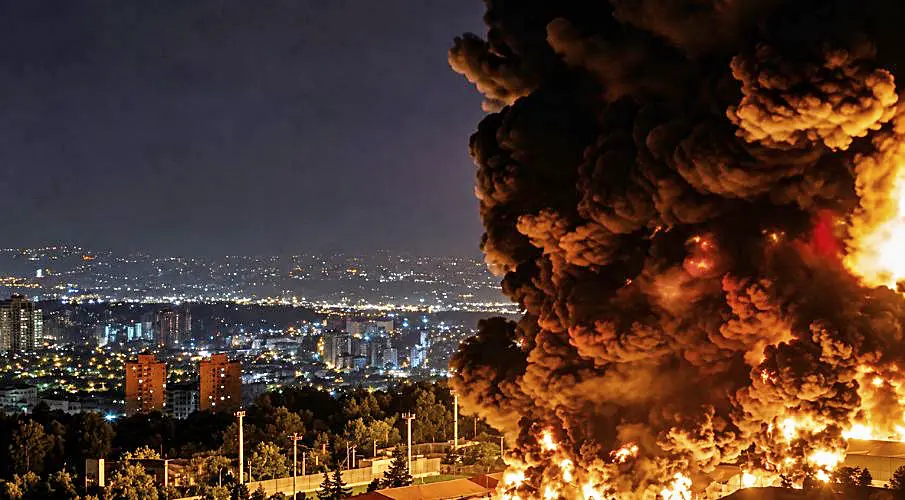
The U.S. military launched another wave of airstrikes against Iran during the night into Thursday, only hours after the president declared the three-week-old ceasefire effectively over. According to U.S. Central Command, approximately ninety military targets were struck, including air defense positions, drone and missile storage sites, and logistical facilities along the coast. The stated objective was to deprive Iran of the ability to threaten commercial shipping in the Strait of Hormuz. Iranian state media reported explosions in at least three port cities along the country's southeastern coastline. Shortly afterward, in the early hours of Thursday local time, Kuwait's military announced that it was intercepting drones and missiles, while Bahrain's Interior Ministry reported air raid sirens without saying what had triggered them. Both countries had already come under fire on Wednesday morning after Iran announced that it had attacked American military bases there.
The president described the new strikes as retaliation - retaliation for Iranian attacks on commercial shipping. If it happened again, he wrote on social media, the consequences would be far worse. Earlier, at the NATO summit in Turkey, he had been asked about the ceasefire. He said he believed it was over, but added that he remained open to negotiations and did not expect a full-scale war.
One could describe this night in measurable terms: Covenants without the sword are but words and have no strength to secure any man at all. The ceasefire reached last month was precisely such a covenant, while both sides kept their swords firmly in hand the entire time. From the moment it was signed, it appeared fragile, with each side accusing the other of violating it. The conflict has now shifted to the Strait of Hormuz, the narrow waterway through which a substantial share of the world's energy supplies passes. Iran claims that the agreement grants it authority over the passage and insists that ships follow routes designated by Tehran. The United States accuses Iran of repeatedly attacking commercial vessels, although Tehran has not claimed responsibility for any of the attacks over the past several weeks. The strikes that began shortly before midnight Tehran time were the second within two days that Washington justified by citing attacks on three commercial ships earlier this week. On Tuesday, it also revoked the sanctions waiver for Iran's oil industry, a waiver that had explicitly been part of the ceasefire agreement.

Traffic through the strait has once again come to a halt. The ceasefire was meant to reopen it and bring the fighting to an end, but it left the most difficult questions, above all Iran's nuclear program, to a sixty-day negotiating period. On Wednesday, Iranian media outlets closely aligned with the military declared in editorials that the agreement was officially over. On an account belonging to Supreme Leader Mojtaba Khamenei, an edited image appeared showing Trump's signature beneath the ceasefire agreement transforming into a snake.

Mohammad Bagher Ghalibaf, Iran's chief negotiator, accused the United States of blackmail and of breaking its commitments. To put it plainly, he wrote, whoever strikes will be struck. The Strait of Hormuz would reopen only according to Iran's terms, not under American threats. Mohsen Rezaee, a senior military adviser to the Supreme Leader, declared early that morning that the attacking enemy and its accomplices would be severely punished.

Shortly afterward, on the flight home, the president claimed that Iran had reached out. "They called recently," he said. "They desperately want to make a deal." Tehran has said nothing about any new negotiations. Notice the order of those statements. First, ninety targets destroyed. Then the claim that the other side is begging for talks. It is the oldest trick in politics, presenting one's clenched fist as an outstretched hand.
The aircraft that carried him home is remarkable in itself. Trump left Turkey on Wednesday evening not aboard the new Boeing gifted by Qatar, but aboard the older presidential aircraft, reportedly as a precaution because of the renewed hostilities, according to people familiar with the matter. His security detail is said to have insisted on the change. That decision deepens doubts about whether the new aircraft, whose rapid completion the president himself had pushed, was adequately modified with protective systems over the past year. Members of Congress and government officials are asking whether the accelerated schedule left sufficient time to install an advanced missile defense system and the other protective measures required for a presidential aircraft.
White House Communications Director Steven Cheung stated that the new aircraft is equipped with state of the art security systems and the highest level of protective measures. As the president himself recently said, America has many enemies who have him in their sights, and every available means is being used to counter those threats, including deception and misdirection. Anyone who turns deception itself into part of the security strategy should not be surprised when no one believes the opposite anymore. Individuals familiar with the capabilities of the new aircraft, who spoke on condition of anonymity because of the sensitive nature of the security issues involved, say it does not possess all of the features of the older presidential plane. The switch, they say, was made on the recommendation of the presidential security detail, even though there was no specific threat. On Monday evening, Trump had flown to the summit aboard the new aircraft, admiring its luxurious interior. After his arrival, the conflict with Iran erupted once again, and the United States launched its strikes while the president and NATO leaders were meeting sixteen hundred kilometers away in Ankara.
On Wednesday, Trump denied that security concerns had been behind the change of aircraft. The new plane, he said, had been scheduled to depart earlier in order to visit military bases and greet American troops because it was magnificent. Yet when journalists in Ankara pressed him on the matter, he repeatedly pointed out that he himself was Iran's primary target and at one point mentioned that he had either seen or been briefed on a list of Tehran's targets. One can say both things, but one cannot mean both at the same time. Either the change of aircraft was a demonstration, or it was an escape.
The cost of the war, meanwhile, can already be measured. Oil prices, which had fallen to nearly prewar levels after the agreement, climbed five percent to roughly seventy eight dollars per barrel, placing them above the approximately seventy two dollars seen before the war, though still below the peak reached during the heaviest fighting. The recovery of commercial shipping through the strait now risks collapsing once again, and on Wednesday the head of the International Maritime Organization urged shipping companies not to send their vessels through the Strait of Hormuz.
Talks between the United States and Iran had been suspended during the mourning ceremonies for Ayatollah Ali Khamenei, the Supreme Leader who was killed on the first day of the war. What remains of diplomacy since then has taken the form of announcements that end on social media. And so the story ends with a president sitting aboard an old aircraft insisting that it was the magnificence of the new one that prompted him to switch, while ninety targets burn and two Gulf states sound their air raid sirens. Hobbes would have found nothing mysterious about this ceasefire. Where no sword stands above agreements, agreements are merely paper, and anyone who signs them without laying down the weapon has already planned for their collapse. The snake in the fabricated image is a lie and yet a truthful portrait, because it crawls out of a signature that was never truly one from the beginning.
Updates – Kaizen News Brief
All current curated daily updates can be found in the Kaizen News Brief.
To the Kaizen News Brief In English


dieser Artikel „.. aus der Unterschrift kriecht eine Schlange“ hat literarischen Gehalt, ist pointiert, verständlich (uff) und informativ. Danke.
Danke für diesen hervorragenden Bericht.