
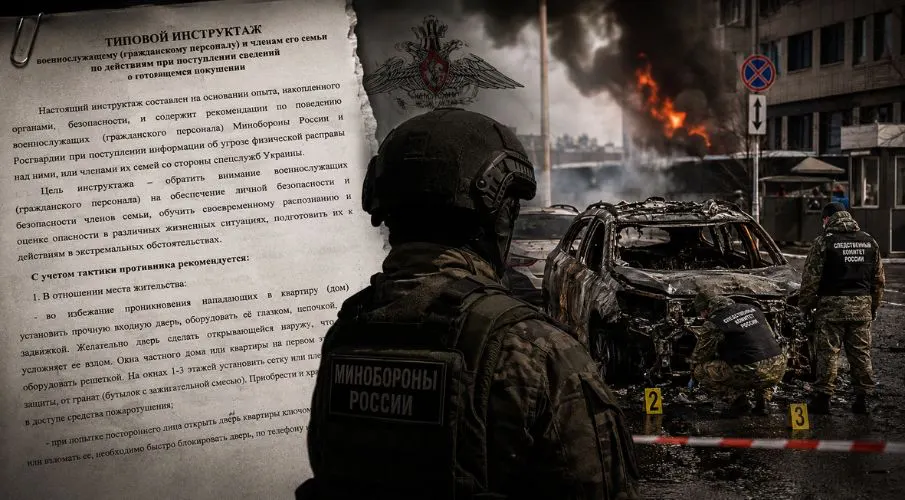
Before the officer drives to work in the morning, he crouches down and shines a flashlight underneath his own car. Wheel wells and undercarriage, the places where an explosive charge could be attached. It is not the idea of a fearful man. It is official procedure. Russia's Ministry of Defense is distributing a document to soldiers and civilian employees for the event of a possible assassination attempt. The document is titled Standard Instructions for Employees and Their Family Members on Conduct When There Are Indications of a Planned Assassination Attempt, based on the experience of the security services. It is intended for anyone working for the Ministry of Defense or the National Guard who has received a death threat from Ukrainian intelligence services.

According to the document, the enemy collects names from open sources and messaging services, memorizes where people live and how they move through their daily routines, and then chooses a method of attack. The employee, therefore, is supposed to disappear without changing locations. No trace on social media anymore, a new number, a new phone, and only answer calls from known numbers. Take a different route every day, and get rid of everything that reveals your location, right down to your smartwatch and step counter. Anyone who crosses your path twice or photographs you and your vehicle is considered suspicious. Even your face is supposed to become a different one. Glasses and a beard, a different hairstyle and different clothes, so that the general looking into the mirror becomes someone else.

The document warns Russian soldiers and their families about targeted assassination attempts by Ukrainian intelligence services and recommends extensive security measures. These include frequently changing driving and work routes, avoiding fixed routines, checking homes and vehicles for explosives, exercising caution with packages and delivery services, and giving up location services and social media. It also advises removing personal information, changing one's physical appearance, accepting calls only from known numbers, and preparing family members for the possibility of an attack.
A separate section is devoted to the car, the favorite coffin of this war. The best option is not to drive one at all. If that is not possible, park far from home, preferably under surveillance cameras, and inspect it before every trip. The document explains where a bomb is likely to be placed and when it is likely to detonate, whether when the engine is started, when the door handle is touched, by timer, or by remote control. Then comes the small choreography of fear. No delivery services, no packages from strangers, do not get into an elevator with unknown people, reinforce the front door, install bars on ground-floor windows. Employees are advised to carry pepper spray or a stun gun. Even a weapon with limited stopping power is mentioned. They are instructed to rehearse emergency situations with their families, make sure every family member knows the document, and establish contact with the security services in advance so that someone can be notified immediately if the worst happens.

The instructions focus on protecting the home, the vehicle, and personal behavior. Among the recommendations are reinforced doors and windows, regular inspections of vehicles and the surrounding area for explosives or signs of tampering, avoiding predictable routines, and constantly changing parking locations and travel routes. Soldiers are also advised to avoid unknown packages and delivery services, remain alert to suspicious individuals, and prepare both practically and psychologically for possible assassination attempts.
It is worth pausing for a moment. A state was once built on the promise of freeing people from the fear of a violent death, that one great terror exchanged for obedience. Now that same state is handing its officers a manual explaining how to survive exactly that fear. The men who send death to others are now being told how to hide from it. Political scientist Yekaterina Schulmann remarked dryly that the document fits poorly with those generals who continue celebrating in restaurants despite the warnings.
And the dead are not few. On the evening of August 1, 2026, an explosion tore through Moscow's Balzi Rossi restaurant, where Commander of the Aerospace Forces Alexander Chaiko was celebrating his birthday. Whether he was actually there or whether he was the intended target has never been officially confirmed. Several guests were killed, and more than 20 people were injured. In June 2026, a car bomb in Balashikha killed General Damir Davydov, the officer responsible for supplying ammunition to the Russian military. In February 2026, several bullets struck GRU Deputy Chief Vladimir Alexeyev. He survived. Fanil Sarvarov from the General Staff's training directorate was killed in December 2025 by a bomb placed underneath his car. In May 2025, an explosion in Stavropol tore apart Saur Gurziyev, who had participated in the capture of Mariupol and most recently served as deputy head of the Stavropol city administration. A car bomb in Balashikha killed Yaroslav Moskalik of the Main Operational Directorate in April 2025. Igor Kirillov, commander of Russia's Nuclear, Biological, and Chemical Defense Forces, was blown apart outside his Moscow apartment building in December 2024. In November 2024, Navy Captain Valery Trankovsky, chief of staff of a Black Sea Fleet missile boat brigade, was killed in Sevastopol. In October 2024, unidentified gunmen shot Colonel Nikita Klenkov near Moscow shortly after he had returned from the war.

Going further back, the trail hardly fades. In September 2024, Ukrainian military intelligence reported that drone commander Alexey Kolomeytsev had been killed, but Moscow never confirmed the report, while the pro-Kremlin war project WarGonzo claimed he was alive and retired. In July 2024, the intended target was reportedly GRU officer Andrei Torgashov, but a namesake was hit instead, and Torgashov himself later said he had never been the target. At the beginning of it all, in July 2023, former submarine commander Stanislav Rzhitsky was shot while out for his morning run in Krasnodar, where he was serving as deputy head of the city's mobilization department. A Russian-Ukrainian dual citizen, Sergey Denisenko, was later convicted.
The handbook reads as though the front line has shifted inward, right beneath one's own car. The very people who order death are now being advised by their own ministry to grow a beard and take a different route every morning.
Updates – Kaizen News Brief
All current curated daily updates can be found in the Kaizen News Brief.
To the Kaizen News Brief


„Wer Wind säat, wird Sturm ernten“.
Russland attackiert seit 4 1/2 Jahren die Ukraine völkerrechtswidrig.
Nun kommt der Krieg inden russischen Alltag.
Angst schüren kommt einer Diktatur gelegen, so kann man das Feindbild hoch galten.
So kommt es auch, dass Anschläge kontrolliert durch das Eingreufen des SEB geschehen.
Damals war es der KGB um dem „Westen“ die Schuld zu geben.
Heute ist es der FSB, der der Ukraine die Schuld gibt.
Die Angst vor Anschlägen ist berechtigt.
Aber sie ist auch hausgemacht.
Den Preis zahlen leider zumeist unschuldige Menschen.