
It starts with a piece of paper, and paper has never arrested anyone. On September 16, the U.S. Justice Department reminded the public that anyone operating in the country under the direction or control of a foreign government or a foreign principal must register and disclose that activity under FARA or 18 U.S.C. § 951. If that disclosure is not made, civil and criminal consequences can follow, including up to 5 years in prison. Citizens are invited to supply the initial suspicion themselves and report suspected covert control to the FBI or a federal prosecutor's office. A state that asks its people to keep an eye on one another has already torn down the first wall, right through the middle of the neighborhood.
The same piece of paper says the opposite, politely. The Department says it protects the rights guaranteed by the First Amendment, and that no political belief should influence a decision. Two paragraphs later, it lists what may now fall under suspicion: public activity, explicitly including demonstrations, if they serve the goals or propaganda of a foreign power. The government itself watches over that condition, the same government people are protesting against. A freedom whose boundary is drawn by the very person it is being used against is a freedom that can be revoked.

The public square is a place where journalists work and citizens raise their voices. That is exactly where this document lays down the threshold of suspicion. Whether a conversation is called reporting or the first entry in a file is no longer decided by the substance, it is decided by the watching eye. The White House has long since shifted its tone into authoritarian territory. Three major newsrooms were barred from its grounds after Trump accused them of “fiction and lies” and declared their reporting a threat to national security. He offered no evidence for that, as usual: All three went to court and won, at least provisionally for 14 days. The sequence turns the burden of proof upside down. First the critic is treated as the enemy, then he gets to fight in court for the right to walk back through the door. An accusation without evidence is enough, because it keeps working for as long as the case drags on.
How close this gets to individual people can be seen in the case of Georgia Fort. The journalist reported on January 18 about a protest inside a church in Minnesota, and the reporting turned into a criminal prosecution; an indictment. The Justice Department, in its now familiar fashion, discovered serious federal charges against her and other members of the press, one of them in the area of hate crimes. Amnesty International calls the cases an attempt to intimidate journalists and silence them. A camera inside a church is now enough to land you in the defendant's chair.
Independent journalist Georgia Fort is free again after being arrested in the morning. She was reporting in Minnesota on a protest against ICE inside a church and was taken into police custody while doing her job as a journalist. After her release, Fort asked a simple, uncomfortable question: Whether this country still has a Constitution, she said, is the question that matters. A journalist gets taken away because she documents what is happening. By now, that has happened to many.
The law still requires a connection to a foreign principal, real or invented, and the White House will now decide that. On paper, the conditions are strict. Only paper does not investigate anyone by itself. Prosecutors do, and they decide whom to summon and which old acquaintance suddenly looks suspicious to them. In the hands of a government that already throws critical outlets out the door and declares reporting a matter of national security, such a broadly framed warning is no longer an explanation of the law. It is a loaded weapon, and the finger rests on the trigger of a single agency.

In China, the Communist Party directly runs the major newsrooms and tells them every day what gets published. Anything that gets in the way is deleted or blocked. Independent journalists are watched and arrested. Charges like “subversion” or “picking quarrels” can land them in court, and more than 100 are currently behind bars. Beijing hardly needs outright bans anymore, it controls the entire information space.
Russia has known this tool for years, and there the road has reached its end. The state brands people and organizations as “foreign agents” as soon as it considers them controlled from abroad, and foreign money is not even required. According to the Russian Justice Ministry, only 4 percent of those branded that way in 2025 had ever received foreign funding. 215 were added to the list that year, and another 197 followed between July 2025 and July 2026, many of them journalists and entire newsrooms. A disclosure requirement has become a brand, and none of those affected can name the day when the word turned against them. North Korea shows the end beyond the end. Unauthorized phones and receiving devices are banned, and distributing prohibited foreign media can carry the death penalty. People disappear over a few South Korean television shows. Where the state owns the information space completely, the screen itself becomes a confession.
American laws are different, and so are American courts, and that difference is real. It only reassures those who overlook the sequence. First a newsroom loses access. Then the subpoena arrives. Later people argue over whether a piece of reporting was already suspicious enough. None of these stages looks like a dictatorship, and that is exactly where their power lies. Freedom does not fall in a single day, it is stripped away regulation by regulation until nobody can say when the house lost its roof. Moscow and Pyongyang had the same beginning, a word that sounded like order. Washington still writes different laws today. Even so, reporters are already sitting in the defendant's chair, and newsrooms are being left outside the door. Reporting itself is now being treated as a security issue.
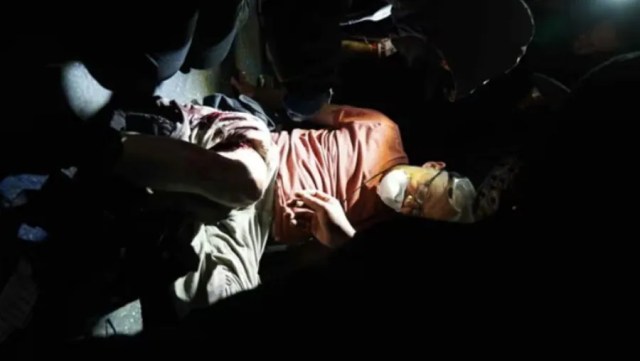
Nick Stern: At around 8:50 PM on June 6, 2025, he was standing about 45 meters from the police line, his press credential clearly visible, his professional camera in his hand. Around him, people were peacefully waving flags. Then, without warning, “I felt this excruciating pain in my right thigh. Instinctively, I reached down and felt something solid sticking out of my leg. “A flash-bang canister had buried itself deep in his flesh. Protesters carried the half-conscious photographer to the side of the road, where a volunteer medic cut open his pants and tried to stop the bleeding. Stern spent 3 nights in the hospital, and surgery was needed to remove the 7.5-centimeter-long plastic projectile.
Censorship is most dangerous when the censor waves it through. Freedom of the press does not die only when printing presses are seized, it becomes too expensive to afford long before that. The journalist calls his lawyer before he calls the source. The newsroom factors in the danger before it publishes. In the end, nobody has to ban a word anymore, people cross it out themselves, and that is the victory every power dreams of. Investigative journalism fights against that too.
By now, we work almost like we are underground. It brings to mind the story of The Man in the High Castle. Very few people can imagine the conditions under which something like that develops, because they are sitting on the other side of the screen. And that is a good thing. Resistance grows underground, that has always been its place. The fact that reporting and investigations are now moving there says enough about the times we are living in.
Updates – Kaizen News Brief
Alle aktuellen ausgesuchten Tagesmeldungen findet ihr in den Kaizen Kurznachrichten.
To the Kaizen News Brief In English


