
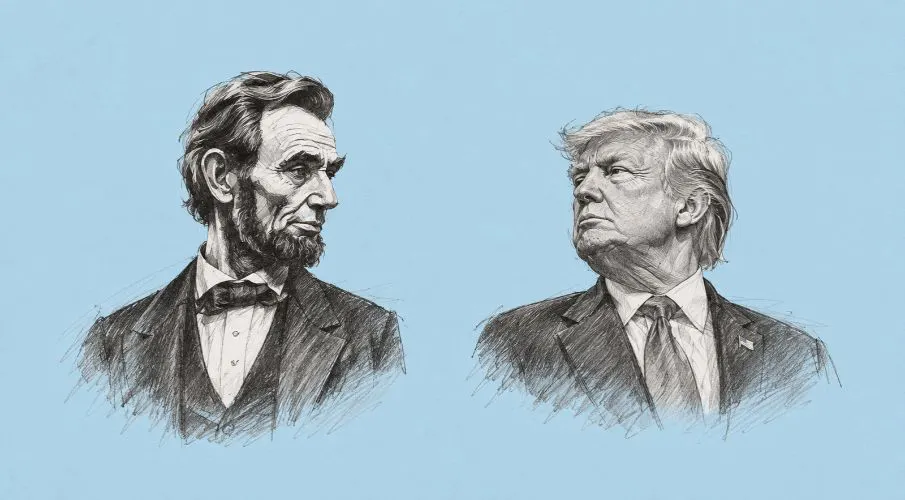
Dead presidents make the most agreeable rivals. They lose every contest you put them in and never file a complaint. That makes them ideal benchmarks for a man who would rather measure himself against marble monuments than actual voters. On November 12, 2026, Donald Trump brought two of them into the White House, barely after the living had delivered their verdict.
Republicans had suffered heavy defeats in the midterm elections and lost control of Congress. The president was mainly interested in finding fault with everyone else. Sitting across from him was Stephen A. Smith, who put a number on the table that rarely gets a warm welcome in that building. "Your approval rating is lower than the Democrats." Trump didn't have to look far for an answer. Abraham Lincoln had gotten 8 percent, Ronald Reagan 14 percent. He put himself at roughly 56 percent. "So I think my approval rating is good."
The numbers came from a poll that had asked an entirely different question. Among Republicans surveyed, 53 percent named Trump as the Republican president they admired most. Reagan got 18 percent, Lincoln 8 percent. Inside the White House, the president gained three points, Reagan lost four, and Lincoln got to keep his eight. Trump was feeling generous toward the man who had led the country through the Civil War. The question was about historical admiration within his own party. It said nothing about how Americans rated Trump's performance in office. Admiration is how you rank monuments. Approval is what happens when people look at the price of gas.
A recent nationwide poll put his approval rating at 32 percent. During the conversation, Trump also threw in a claim of 99 percent approval among Republicans. With loyalty like that, losing a congressional majority starts to look like reality made a math error. In this White House, numbers obey the mood of whoever happens to be saying them. Asked what had caused the defeat, Trump had no trouble finding answers elsewhere. In Alaska, voters had supposedly confused two candidates with the same name. Then there was the war with Iran. Maybe the war had been unpopular less because of its military objectives than because gas and oil prices had gone up. He had thought Americans could handle the added burden. Apparently, a war is perfectly bearable as long as nobody has to fill up their tank. Voters had already done their own math at the ballot box and decided just how much they could take.
Smith wasn't letting it go. During the campaign, Trump had explicitly urged Americans to vote as if he himself were on the ballot. After the defeat, he explained that he hadn't actually been running. Apparently, a name can be on the ballot as long as you're winning, then disappear the moment the votes are counted. Smith pushed back: "But Mr. President, you told people to put you on the ballot, and now you're saying they didn't." His supporters had spent years following his instructions, Smith pointed out. Maybe, Trump suggested, voters simply hadn't liked the Republican candidates. Had he liked them himself, Smith wanted to know. Some more than others, came the answer. Politically, though, he had considered every single one of them better than the Democrats. He had backed them. Yet somehow, someone else was responsible for their defeats, and that someone was never the man sitting across from Smith.
Lincoln fought slavery and led the Union through the Civil War. Reagan helped shape the politics of the Cold War. Trump needed their names to explain an electoral disaster in which neither man had been on the ballot. They served as witnesses who could never be cross-examined. The dead couldn't argue back. The living voters had already given their answer.
Updates – Kaizen News Brief
Alle aktuellen ausgesuchten Tagesmeldungen findet ihr in den Kaizen Kurznachrichten.
To the Kaizen News Brief In English


