
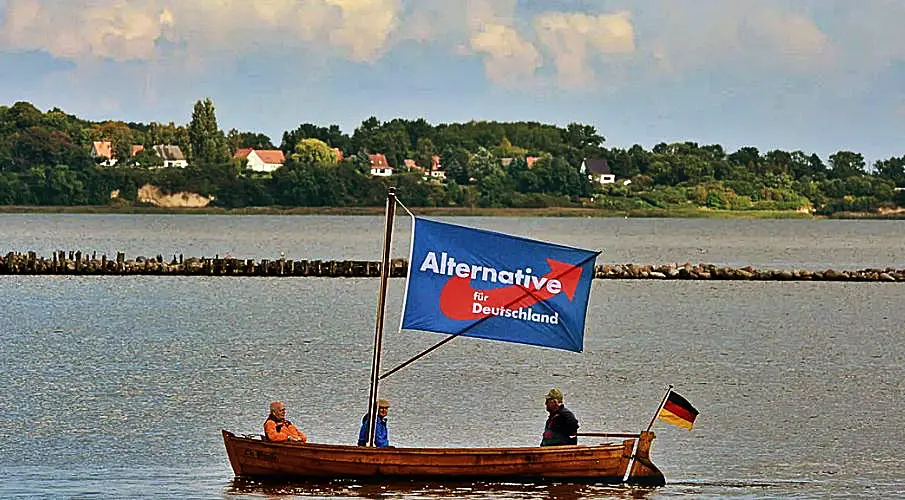
They do not call it an election program. They call it a governing program. That is no coincidence, it is an outrage. The AfD in Mecklenburg-Western Pomerania is no longer rehearsing opposition, it is rehearsing power. 94 pages, titled "Ready for the Blue Turn," distributed to members, scheduled to be adopted at a party conference in Grimmen at the end of May. Anyone who reads it is not holding an ordinary draft in their hands. They are holding a blueprint for the transformation of an entire state.
At the center stands migration. Not as an administrative issue. Not as a social issue. As an enemy image. The AfD wants to build a state-run "repatriation police force." It wants to establish a "task force against foreign criminals." It wants to create its own deportation detention structures and, as a last resort, enforce an intake freeze. For asylum seekers, the "bed-bread-soap principle" is supposed to apply: material benefits, large collective accommodations, control instead of integration. The state the AfD describes is not a state that examines protection claims. It is a state that treats people first and foremost as a risk.
And this is exactly where it stops being just another political paper. This is exactly where it becomes personal. Brutally personal.


We stood in tear gas for months. Not in front of a television, not in a newsroom, but out on the streets, in front of ICE buildings, in front of detention centers, with mothers standing beside us who did not know where their sons were. We represented hundreds of people who were arrested despite being innocent, picked up at work, picked up outside their children's schools, picked up in doctors' waiting rooms, taken away like cattle, without explanation, without a lawyer, without dignity. We accompanied families whose father left the house in the morning and never came back. We kept records on men who died in ICE custody because their pain was ignored, because nobody came, because their lives no longer had any value within the logic of that agency. We saw children who woke up at strangers' homes after their parents had been deported. We know what an agency does when it has only one mission: to remove people from the country.


And this is exactly what the AfD is now promising for Mecklenburg-Western Pomerania
"Repatriation police force" is not an administrative term. It is the German translation of ICE. An agency whose sole reason for existing is to remove people from this country. An agency that at some point no longer asks about the law, but about quotas. Not about individual fates, but about success reports. Not about dignity, but about images for the next election campaign. And "task force against foreign criminals" is not a police term, it is an equation. Foreigners equal criminals. Anyone who chooses such a name has already built in the presumption of guilt before the first door is kicked in. We have seen where this logic leads. We have it in our files.

Anyone who wants to build a "repatriation police force" in Germany wants to import the American nightmare. Anyone who promises a "task force against foreign criminals" is not reforming the rule of law, they are dismantling it. We witnessed for months how quickly "repatriation" turns into an arrest, arrest into abuse, abuse into a dead body. We know it because we took those calls in the middle of the night. Because we drove to detention centers where people officially were not even supposed to exist. Because we stood in courtrooms where judges understood more clearly than any politician that this machinery no longer produces justice, only damage. And this is exactly the machinery the AfD is now promising for Mecklenburg-Western Pomerania. Not in Texas, not in Florida, not in Arizona, but in Schwerin, in Rostock, in Stralsund.

In addition, there is something the AfD deliberately leaves out of its entire narrative because it tears apart its worldview. The numbers. In 2025, a total of 103,901 crimes were recorded in Mecklenburg-Western Pomerania according to the Police Crime Statistics. No general share of "crimes committed by foreigners" was published for the statewide statistics because the data are organized by suspects, not by crimes committed by specific population groups. Available police data from large regions of the state do, however, show the scale. In the area covered by the Neubrandenburg Police Headquarters, 1,191 out of 6,721 suspects were non-German nationals, which is around 17.7 percent. At the same time, the share of foreign nationals within the population of Mecklenburg-Western Pomerania is approximately nine to ten percent. At first glance, this appears to support the AfD narrative. At second glance, that narrative falls apart. The statistics count suspects, not people who have been legally convicted. The numbers include immigration-related offenses, meaning violations that a German citizen cannot even commit because they only exist for people without German citizenship. The numbers include age structure, social conditions, mobility, regional concentration in larger cities, all of the factors that any honest criminologist immediately considers before interpreting a statistic. Out of this complex reality, the AfD constructs one single brutal message: foreigners are the problem. This simplification is not truth, it is election campaigning. Anyone who broadly equates an entire population group with crime is using statistics to lie instead of using statistics to explain.
And then there is the second lie, bigger than anything else in the paper. The skilled labor shortage.
Mecklenburg-Western Pomerania is facing a demographic gap that economically throws every single sentence of this governing program into the trash. Projections estimate a decline of around 110,000 people of working age by 2030. 110,000. That is more than the combined population of Stralsund and Greifswald. An entire section of society simply disappearing because the population is aging, because young people are leaving, because fewer children are being born, because earlier waves of migration after reunification are still having effects today. And into that gap, the AfD seriously wants to push people out of the country. Already today, there are not enough hands in nursing care to wash, dress, and feed elderly people. Childcare lacks educators without whom no mother and no father can go to work. Social work lacks people who speak with young people before they lose their footing. Electrical engineering lacks skilled workers for the energy transition that the AfD does not even want. Skilled workers are missing from the trades, the people who repair roofs, fix heating systems, and install water pipes. Logistics lacks personnel, without whom nothing moves anymore in a large territorial state. Healthcare professions lack doctors, nurses, and paramedics, especially in rural areas where medical practices are closing one after another because no one is left to take them over. At the same time, Mecklenburg-Western Pomerania continues to have relatively high unemployment because available jobs and existing qualifications often do not match. The problem is not that there is no work. The problem is that the people who can do that work are missing. Anyone who wants to build a repatriation police force under such circumstances is not only destroying lives. They are destroying the economic future of their own state. Anyone who drives out nurses will eventually have no one left to wash their own mother. Anyone who drives out educators will eventually have no daycare center left for their own grandchildren. Anyone who drives out doctors will eventually have no medical practice left in the village. Anyone who drives out tradespeople will eventually sit in their own house without electricity, without water, without heating. The AfD's logic does not work economically at a single point. It is self-destruction with advance notice. But none of this matters to the party because the program was never designed economically. It was always designed ideologically. And ideology does not ask for numbers. It asks for enemies.

One might come to the conclusion that the AfD is being deliberately manipulated or that Mr. Abel is doing some rather strange things there. We will simply let that sink in and recommend that AfD voters start thinking.
The direction becomes especially clear in the language. The party claims that the state government of Manuela Schwesig is working toward replacing a "German-shaped society" with a multicultural one. This is not harmless polemics. This is madness. This is compatibility with the narrative of the alleged "Great Replacement," which has been circulating in the far right for years. Mecklenburg-Western Pomerania has a foreign population share of less than ten percent. Many people with foreign passports come from Ukraine and Poland. Despite that, the AfD builds its program on the image of a threatened state that supposedly needs to be defended against people who are barely present. One really has to ask whether AfD voters in Mecklenburg-Western Pomerania no longer have eyes in their heads or whether they knowingly follow along, according to the motto: "Who is the fool? The fool himself, or those who follow the fool?" And while we are talking about blindness:
Mecklenburg-Western Pomerania in 2025 with +1.4% one of the highest rates of economic growth in Germany
"Remigration" also appears openly in the document. What circulated for a long time in the party's most radical circles is now appearing in the governing draft of a state chapter polling at 35 to 37 percent. Specifically, the AfD wants to prepare the "remigration" of Syrians. The word is thereby being normalized even though it has long meant far more than voluntary return. It stands for the idea that people who have lived here for years, worked here, and sent their children to school here should one day disappear again.
On domestic policy, the AfD is relying on toughness. The age of criminal responsibility is supposed to be lowered to twelve years. Schools are supposed to be able to expel students more quickly for violent offenses and drug-related incidents. To where? The AfD does not explain that. The police are supposed to receive more powers and better equipment. For what? Everything follows the same logic: more control, more order, less social explanation. Problems are not solved, they are labeled, punished, and pushed outward.
In education policy, the document becomes openly reactionary. The AfD attacks "gender mainstreaming," speaks of ideological pedagogy, and wants to once again reshape the school system more sharply toward selection. Children with insufficient German language skills are supposed to be placed in preparatory classes. Preschool is supposed to become more mandatory. The transition to high school is supposed to become more difficult. High school is not supposed to be a "mass institution." Inclusion is explicitly criticized, and special education schools are supposed to remain permanently. Behind the language of performance and order stands a view of society that once again turns separation into a virtue.
One can only describe this as kindergarten behavior, and that is exactly where the AfD's true level reveals itself.
Cultural policy in the document is equally clear. The AfD wants to protect "German and European-Western culture," promote German and Low German "folk art," and enforce an "architectural homeland style" in public construction projects. Only German flags are supposed to fly in front of public buildings, no longer the EU flag. Gender asterisks and other forms of writing are supposed to disappear from official language. War and fallen soldiers' memorials are supposed to receive special preservation. This is not cultural preservation. This is an attempt to officially cement a narrow national self-image.
A central attack is directed at public broadcasting. The AfD wants to terminate the NDR State Treaty and the Media State Treaty, abolish the broadcasting fee, and cut back programming to a "lean basic broadcasting service." Anything no longer needed should be transferred into a liquidation fund. In practice, much of this would be legally difficult and hardly immediately implementable. The NDR State Treaty could be terminated no earlier than August 31, 2031, and the broadcasting fee is collected based on a ruling of the Federal Constitutional Court. Politically, however, the message remains clear. A party that has attacked independent media for years wants to weaken the structures that can contradict it if it enters government. Whoever weakens media weakens oversight. Whoever weakens oversight weakens democracy. That is how simple this Orwellian calculation is.
Economically, the party presents itself as market-liberal while simultaneously combining this with an energy policy course back into old dependencies. Nord Stream is supposed to be repaired and put back into operation. Reentry into nuclear power is supposed to be prepared, if necessary with a focus on locations and technologies within the state. The AfD wants to stop the expansion of wind energy. While Europe has been struggling since Russia's war of aggression to free itself from dependence on Moscow, the AfD is once again betting in Mecklenburg-Western Pomerania on the pipeline that has long become a political symbol of German naivety toward the Kremlin. This is not energy policy. This is a gesture toward Moscow. This circus troupe has learned absolutely nothing from the Iran war.

The party is equally misguided on the issue of nuclear energy. Anyone selling nuclear power as the solution has slept through the last twenty years. Nuclear electricity today costs two to six times more than electricity from renewable energy sources. That is not an opinion, that is market reality. On top of that, construction timelines for new reactors regularly spiral out of control. The French nuclear plant Flamanville was supposed to go online in 2012. Final completion was postponed again and again, costs exploded from 3.3 billion to more than 13 billion euros, and the reactor ultimately did not actually go online until December 21, 2024. Twelve years of delay, nearly four times the originally projected costs. This is not future-oriented energy policy, this is an economic nightmare the AfD wants to drag Mecklenburg-Western Pomerania into. And this is only the beginning.
Beyond the enormous costs, the environmental compatibility of nuclear energy is repeatedly sugarcoated. Reality looks different. There is not a single functioning permanent repository for highly radioactive waste anywhere in the world. The Asse mine in Germany and Fukushima in Japan show how problematic even temporary storage can be when politicians believe the problem can simply be pushed into the future. The risk of accidents remains real even in highly developed technological countries. Harrisburg, Chernobyl, Fukushima - these are not statistics, they are warnings. And with climate change, another vulnerability is growing. Heat waves and periods of drought cause rivers to become too warm to cool reactors. Nuclear power plants are shut down during hot summers because they run out of water or because the discharged cooling water would thermally damage the river. An energy source that fails precisely when electricity demand for air conditioning is highest is not energy security, it is a risk.
And then there is water consumption, the issue the AfD has hidden most carefully of all. Nuclear power plants require gigantic amounts of cooling water. A large German nuclear power plant has a thermal output of around 3,000 megawatts and an electrical output of around 1,200 megawatts. The difference, around 1,800 megawatts, must be dissipated as waste heat, almost always through water. Using the simple physical formula Q equals m times c times Delta T, where Q is the heat energy that must be removed, m is the mass of the water, c is the specific heat capacity of water at approximately 4.186 joules per gram and degree Celsius, and Delta T is the temperature difference, a cooling water demand of several hundred million liters per day and per reactor is quickly reached with an assumed cooling water temperature increase of 10 degrees. Germany most recently had three active nuclear power plants, Neckarwestheim 2, Emsland, and Isar 2, until the final nuclear phaseout in 2023. Before that, there had still been six. If a single large nuclear plant requires 500 to 800 million liters of water every day, then multiple reactors quickly reach around 2.7 billion liters of cooling water per day. 2.7 billion liters. Every day. In a world where water scarcity, drought, and dried-up rivers have long become reality. The AfD completely ignores these numbers even though they cannot be denied physically. Anyone who sells nuclear power as a clean and safe option is either lying or has never done the math.
Alongside this runs a development that security authorities have documented soberly for years. Right-wing crimes continue to represent the largest category of politically motivated crime in the state. Propaganda offenses, digital hate posts, right-wing violence, antisemitic and anti-LGBTQ offenses - all at a high level. Anyone presenting a governing program under such conditions that exclusively describes threats from the outside is lying to themselves and everyone else. Anyone serious about security must look at the entire picture, not just the section that fits neatly into a campaign brochure.
What is also striking is what is missing. There is practically nothing about relations with churches and labor unions. Europe and the EU remain largely undefined. Relations with countries in the Baltic region barely play a role even though Mecklenburg-Western Pomerania is geographically and economically located precisely there. The Baltic Sea itself barely appears. Instead, migration, broadcasting, gender, police, Nord Stream, and national culture dominate. That says more about what truly occupies this party than any program point.
Of course, it remains open whether the AfD can govern at all. In polls, it is leading, clearly ahead of the SPD. But so far no other party wants to form a coalition with it. Lead candidate Leif-Erik Holm says cooperation with the CDU would be possible, while the CDU rejects it. Many proposals would be legally vulnerable or would not even fall within the authority of a state government. That does not make the document any less alarming. It shows where the party wants to go as soon as it gains room to maneuver.

In many political debates, Mecklenburg-Western Pomerania often appears to be a state defined almost exclusively by problems. The numbers, however, paint a much more complex picture. The state's economy recently grew by 1.4 percent, Greifswald was recognized nationwide as Energy Municipality of the Year, and tourism in individual cities is also showing clear growth: Wismar recorded an increase of 11.3 percent, Rostock 3.9 percent, and Schwerin 3.6 percent in overnight stays. Nevertheless, an image frequently emerges of permanent decline, as if hardly anything in the state were moving forward. Anyone who speaks only about crisis, decay, and stagnation ultimately is not telling the whole story and is misleading their voters.
This program is the written plan for an authoritarian, nationalist, and socially backward transformation. The AfD is not promising Mecklenburg-Western Pomerania renewal, but control. Not security, but isolation. Not freedom, but a state that reshapes culture, language, schools, media, and migration according to a narrow political worldview. That is exactly why this document must be taken seriously. Not because everything could immediately be implemented, but because it shows what this party considers normal as soon as it feels close enough to power. And we, who fought against ICE for months, who saw the injured, the victims, and the dead, we know where such a path leads. We have been through it once before.
Updates – Kaizen News Brief
All current curated daily updates can be found in the Kaizen News Brief.
To the Kaizen News Brief In English


Danke für diesen Artikel, der direkt aus dem Herzen geschrieben scheint. Danke für die inbrünstige Warnung, danke für die Aufklärung, ja Bloßstellung einer Partei und ihrer absurden, verbrecherischen Handlungs- und Denkweise.
Bezeichnend auch, dass das frühere Argument „die Ausländer nehmen uns unsere Jobs weg“, überhaupt keine Rolle mehr spielt, denn diese Jobs wollen sie nicht, oder können sie nicht. In die prekären Jobs werden die verachteten „Sozialschmarotzer“ gezwungen (ja, liebe AfD-Wahler, ihr werdet ein bitteres Erwachen haben), die qualifizierten Leute interessieren eh nicht, da müsste man ja einen Plan haben, Deutschland voran zu bringen, Versorgungslücken zu schließen, oder Deutschland zukunftsfähig zu machen.
Aber(!), es wird Jobs geben, die einzigen, die sie mit Freude erledigen werden: Ausländer jagen! Hochoffiziell, in martialischer Ausrüstung und stolz geschwellter Brust „verteidigen sie ihr Vaterland“. Die gleichen Leute, die die Schuhe jedes ausländischen, mächtigen Angreifers lecken würden, denn, warum sollte ich mein Land mit meinem Leben verteidigen, wenn ich auch einfach „ja, passt schon“ sagen kann, diese Leute sind heiß darauf, Krieg im eigenen Land zu führen. Ohne Risiko, aber in dem Bewusstsein „seht her, ich bin wer, ICH habe den Knüppel in der Hand“.
Wenn die Unionsparteien nicht endlich die Kurve kriegen und diese vor Gewalt- und Herrschaftsphantasien strotzende Neonazi-Partei endlich verbieten werden sie verantwortlich sein, für alles was kommt. Wenn das Verbot nicht kommt, heißt das für mich:
Es ist der Union scheißegal!
Unsere Geschichte: scheißegal!
Die Hälfte des Volkes, die nicht Union oder AfD wählt: scheißegal!
Europa: scheißegal!
Es ist dringend an der Zeit das ein AfD Verbot kommt.
Die „schönen“ Worte, dass eine Demokratie das alleine bewältigen kann sind Blödsinn.
Es wäre schön, wenn es so wäre.
Aber die Geschichte vom Nazi Deutschland lehrt uns, dass es eben nicht so funktioniert.
AfD darf keine Regierungsmacht bekommen.
Je mehr Stimmen, desto mehr können sie demokratische Schritte blockieren und aushebeln.
Wer AfD wählt, sollte sich die Dokumentationen über das Nazi Deutschland ansehen.
Ebenso Dokumentationen über MAGA USA (und zwar nicht die schöngefärbten)
Wer so leben will, dem ist nicht mehr zu helfen.
Die erreicht man nicht.
Hoffentlich erreicht man die Anderen.
Die „Protestwähler“ noch.