
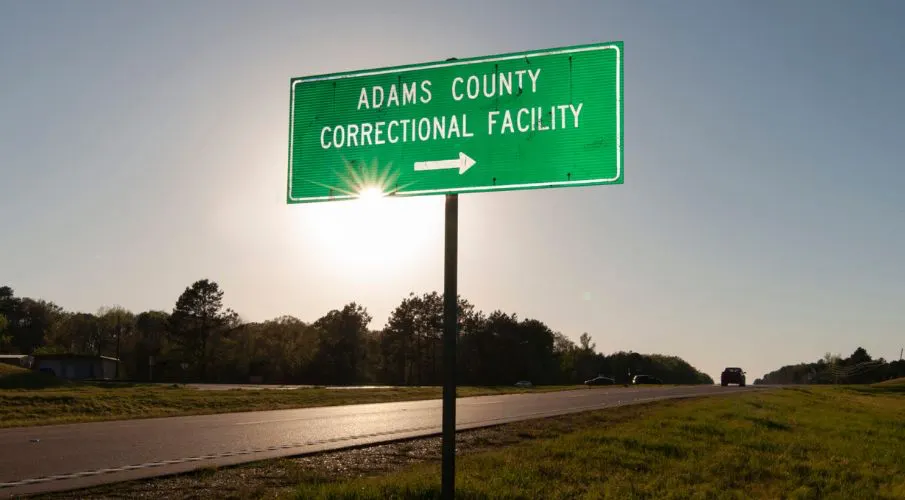
On Saturday, August 8, gas leaked at a deportation detention center in Mississippi, and the men who inhaled it reportedly still have not received any clear explanation. At the Adams County Correctional Facility, operated by CoreCivic on behalf of U.S. Immigration and Customs Enforcement, detainees complained of headaches and other symptoms. Before that, they had been taken outside into the afternoon heat for hours because something was wrong inside. When they returned, it reportedly still smelled like gas, as if nothing had happened at all.
The American wife of one detainee, whose name is being withheld out of fear of retaliation, described what happened through family members; her husband spoke anonymously out of concern for his own safety. The men had reportedly been taken outside for hours, the smell had lingered inside, and some later complained of having inhaled gas. They were never told where the leak came from or whether it had ever been completely sealed. They were told almost nothing as the number of sick men grew and the uncertainty remained. At the center of the allegations is the claim that sick men received no treatment. The men who complained of headaches after inhaling the gas were reportedly left alone with their symptoms while illnesses spread through the facility. An institution that locks people up owes them care for their bodies; it is the only place left that can still call a doctor for them. According to this account, it did not, and the sick men waited.

The heat came from a power outage that began on Monday, August 10. By Tuesday, electricity was running only partially, enough for lighting and the most basic operations; the air conditioning did not come back on until late Wednesday, August 12. For 2 days, detainees were left with a choice between cramped cells in stifling heat and hours outside in temperatures of around 100 degrees Fahrenheit, with no shade. Where neither option was available, they were simply locked in their cells, with no trip to dinner or breakfast.
It was not a real choice. Outside, the sun beat down on men with no roof over their heads; inside, the air stood still in rooms too small for the people packed into them. The body pays for hours like that with every breath, and no one outside was watching. When you are locked up, the first thing you lose is control over where you can move your own body. Even the walk from the burning yard back into the cell was decided by someone else. Heat inside a place like this is not an accident of the weather. An air conditioner that stays off for 2 days and a population beyond what the facility was designed to hold are the result of decisions made long before any storm arrives. Too few staff for too many people adds to it. The outage hit a facility that was already operating at the edge of what it could handle.
As the heat rose, so did the tension. In the understaffed facility, arguments and physical fights among detainees increased to the point that the source feared for his own safety. Illnesses were piling up, and the crowding was getting worse instead of better. Three people were now reportedly being put into a cell built for two detainees. More bodies in the room meant more heat and less air for each person. At the same time, there was reportedly an effort to keep the news inside the facility. During those days, detainees were allegedly denied their tablets so they could not contact their families. Anyone who appeared to be organizing something was sent to solitary confinement. That is how an emergency stays invisible to the outside world as long as no message gets out and management itself controls who is allowed to speak at all.
CoreCivic of course rejected the accounts and said in response to questions that false information was circulating. Several detainees may have believed they smelled something that could have been related to a natural gas leak, but no staff member detected anything of the kind, said Ryan Gustin, the company's senior director of public affairs. Out of an abundance of caution, an on-duty technician came in, checked the rooms for possible leaks, and found nothing. The power outage was caused by a storm, the air conditioning did not fail, and medical treatment was never denied at any point.
A company's name hangs over the facility. ICE has contracted the confinement of human beings to CoreCivic, and anyone who gets sick there is dependent on the word of the same company that is responsible for the conditions. The agency remains responsible and yet stays far away, while the company runs the cells and at the same time provides the account of what happens inside them.
So two versions now stand side by side, the account from the family member and the calm word of the company. The smell that many people noticed, the incident documented by many, appears in no report. A body reports danger before an agency confirms it, and the headaches came without permission. Between what men smell inside a cell and what an inspection report records lies the space where responsibility disappears. We are currently trying to get doctors into the facility, and lawyers are involved as well.
9 Percent
The facility in Mississippi is one of the largest deportation detention centers in the country. In March, more than 2,000 people were being held there on roughly 14 acres, and only 9 percent of them had any criminal record at all. The rest filled the cells without any criminal record, held solely because of their immigration status. The failed air conditioning therefore hit mostly people who had never been convicted by any court, and who were still sweating behind bars.
The conditions there do not stand alone. Poor hygiene and illness have also been documented elsewhere, at the family detention center in Dilley, Texas, and at Delaney Hall in New Jersey, where the 3rd detainee recently died. One broken facility becomes part of a series whose victims can no longer be talked away. At Delaney Hall, the dead are already being counted, and every one of them stood for a place that confined human beings while denying their suffering at the same time.
To be continued ...
Updates – Kaizen News Brief
All current curated daily updates can be found in the Kaizen News Brief.
To the Kaizen News Brief


Bei den Eingängen fehlen nur noch Schilder wo drauf steht „Arbeit macht frei“.
Ich bin zu tiefst erschüttert