
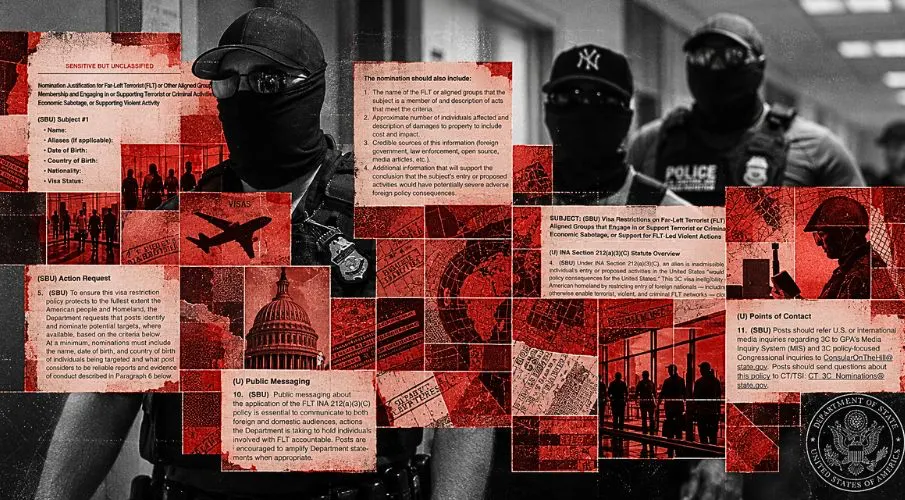
A European flying to the United States with the wrong views on capitalism, the police, or American foreign policy could now be turned away at the border or lose a valid visa. No crime is required. That's what a confidential directive from the U.S. State Department, signed by Secretary Marco Rubio, says. The document was leaked to us, and we have it in our possession. It instructs embassies and consulates around the world to keep certain leftists, meaning anyone deemed undesirable, out of the country.

One day after Rubio signed the document, he stood in Greece with the Acropolis behind him and celebrated "free debate, the contest of mind against mind." He praised Socrates, whom Athens executed for "impiety" and "corrupting the youth." During the same appearance, he accused schools of having "taught children to be ashamed of the countries they would one day inherit." He honors the dead thinker while shutting out the living one.
The directive implements an order from Donald Trump, known as NSPM-7. According to the directive, it identifies "anti-Americanism, anti-capitalism, and anti-Christianity" as supposed warning signs of political violence. Attitudes toward immigration and race are also included, along with views on gender and traditional morality. Rubio is now bringing this ideological screening into the visa process. The border becomes a filter for opinions.

The U.S. State Department describes a new visa policy under Section 212(a)(3)(C) targeting members of so-called "Far-Left Terrorist" groups and organizations associated with them. Diplomatic missions are instructed to report potential targets and send documents to Washington for review.
The legal basis is a provision of immigration law known within the department simply as "3C." Under that provision, a foreign national is inadmissible if the Secretary determines that their entry would have "serious adverse foreign policy consequences." The policy was announced on July 16. It targets people displaying an "overriding hostility toward the legal, economic, and political orders" of the United States, particularly those who consider the country "fundamentally illegitimate and oppressive." An opinion about the country you're visiting is enough.
The document is no mere statement of intent. It lays out how Washington plans to operate from now on. It orders diplomatic missions to immediately provide names, along with an estimated number of people affected and a description of the damage they supposedly caused. Every embassy becomes an informant, from Minsk to Kabul. Suspicion doesn't begin in Washington. It begins at the desk of a consul who has read a newspaper. What was announced as a political policy has been operating as a daily procedure since this week.

The final section of the internal directive shows just how centrally controlled the new visa policy is. Press inquiries must be directed to the State Department's Media Inquiry System, while congressional inquiries go to a separate contact office. Questions about potential candidates for a 3C ban are routed through a dedicated State Department email address. The document is signed "RUBIO" and was distributed to numerous U.S. diplomatic missions.
Embassies are instructed to "identify and name" individuals. The targets include anyone who has committed, supported, or incited terrorism, backed acts of violence, or engaged in "economic sabotage." What exactly counts as "support" and where an "affiliated" relationship begins remain undefined. The groups don't even have to be officially designated as terrorist organizations. It's enough to connect them to that supposed organization called "Antifa," which doesn't even exist as a single formal organization. Being on no watchlist at all no longer protects you.

The attached nomination form shows what personal information is supposed to be collected on potential targets: names, possible aliases, dates of birth, countries of birth, nationalities, and visa status. Diplomatic missions are also instructed to review existing consular records and, when necessary, add further individuals along with brief biographies.
Wie weit der Begriff greift, zeigt eine Zeile über die anvisierten Gruppen. Gemeint seien solche, die mit „Einschüchterung und Zwang“ die Politik von Regierung und Parteien beeinflussen wollten, dazu die Entscheidungen von Firmen und einzelnen Bürgern. So rückt vieles, was sonst Protest oder Druck heißt, in die Nähe des Terrors. Zwischen der lauten Kundgebung und der verbotenen Einschüchterung zieht das Papier keine saubere Linie.
Just how far the definition reaches becomes clear in one line describing the targeted groups. It refers to groups seeking to influence government and party policies through "intimidation and coercion," as well as the decisions of companies and individual citizens. That brings a great deal of what would ordinarily be called protest or pressure dangerously close to terrorism. The document draws no clear line between a loud demonstration and prohibited intimidation.
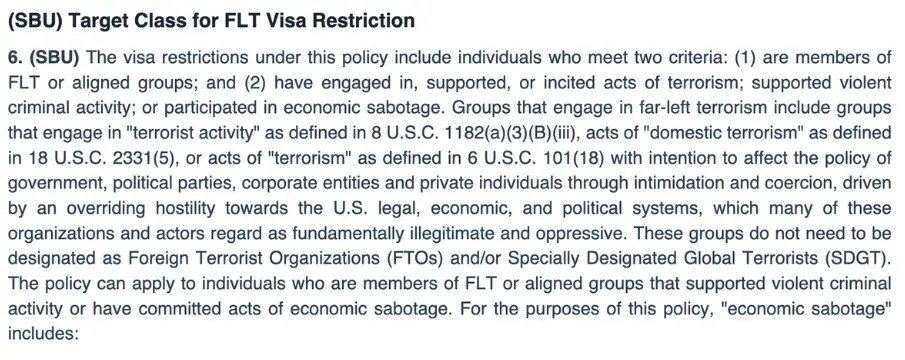
Here, the State Department defines who can fall under the new visa policy. It is intended to cover members of so-called "Far-Left Terrorist" groups or affiliated organizations accused of terrorism, supporting violent crime, or engaging in economic sabotage. Those groups do not have to be officially designated as terrorist organizations.
The embassies report. Washington decides. Headquarters reviews the nominations, enters flags into the consular screening system, and revokes valid visas. A report requires only basic personal information, a name and birth details, along with whatever an embassy considers credible evidence. Nowhere does the form require a criminal conviction. It lists foreign governments and authorities as sources, along with "media articles." The document names no individuals, and because visa records are confidential, no names of affected people may be publicly disclosed. Those affected may not even discover the flag on their record until they reach the counter and the visa stamp never comes.
We are where,
it hurts
Investigative reporting costs money. Looking away would be cheaper. If we're going to keep going where things get uncomfortable, we need support.
Make Kaizen possible About our work →What this means for ordinary travelers is easy to imagine. A student planning an exchange program who once marched against deportation policies. A researcher invited by an American university who has written harsh essays about the police. A grandmother who wants to visit her grandchildren and once called Trump a fascist online. None of them has committed a crime, yet any one of them could end up in an embassy report without ever finding out.
It's precisely that invisibility that makes it effective. Because there's no list and no warning, cautious travelers are left with only one option: keep quiet before their trip and delete their own posts. That's exactly where the administration wins. A border that screens people's thoughts doesn't even have to turn everyone away. It's enough to make everyone wonder whether their opinions will cost them their flight.

The directive doesn't need actual terrorism to be dangerous. As it acknowledges itself, terrorists are already covered by existing prohibitions against terrorism and crime. The new provision comes on top of those rules and reaches into places where the old ones find nothing. What it adds isn't the violent offender already covered by law. What it adds is the politically undesirable person who has never committed a crime. It openly states its purpose. It aims to disrupt networks "before they escalate into criminal acts." The government no longer waits for an act to be committed. It targets the attitude from which an act might someday emerge. That's the oldest dream of every security apparatus and the surest way to make thinking itself suspicious. Where personal convictions are declared a danger, suspicion takes the place of crime.
Every gap in this document is a door deliberately left open. What constitutes a serious foreign policy consequence is decided by a single secretary, and what counts as a threat today can be called something else tomorrow. Whether someone is "affiliated" or merely "supports" a group is judged by the same hand that can also take away their visa. A net capable of catching everyone will, above all, catch the people those in power want to catch.
The press is hit particularly hard. The very things journalism does, naming names and publishing information, serve as sources of evidence under the directive and can also be classified as sabotage. The pen reporting on those in power provides them with material and can itself become the next target. That's how power protects itself from the news, by turning the messengers into suspects.

Excerpt from the State Department's internal directive on implementing the new 3C visa policy: Press inquiries must be centrally referred, public statements about affected individuals generally cannot disclose names because visa information is confidential, and such statements must be coordinated in advance.
For Europe, this means something deeply uncomfortable. Even someone who loves America and merely criticizes its policies is no longer safe from a red flag in the system. A traveler with the wrong views about capitalism or the police, a name appearing at a demonstration, and suddenly a flag can be attached to their record. For a long time, America was the place people fled to when their opinions were made into crimes back home. Now, at its own gates, it asks the very question they once ran away from: what does this person think, and is that thinking permitted?
Controversial speech only ever seems self-evidently acceptable in hindsight. In its own time, it appears dangerous, and that's precisely why it needs protection. Comfortable opinions don't need protection. They get by just fine on their own. Even Stalin supported speech he liked. A state that sorts people's minds at its doorstep no longer trusts its own citizens to listen and make up their own minds.
In Athens, Rubio complained that too many people longed for "a world of perfect safety, a world without risk and failure," and that because of this, "we are building downward." This directive is that downward construction, put on paper. The man who quoted Socrates in front of the Acropolis had signed, just one day earlier, the order that would have kept Socrates out of the country.
Updates – Kaizen News Brief
Alle aktuellen ausgesuchten Tagesmeldungen findet ihr in den Kaizen Kurznachrichten.
To the Kaizen News Brief In English


Es geht in Richtung Staaten, in denen niemand mehr den Mund aufmachen darf. So wird eine Diktatur geschaffen in der nur die oberste Elite zu entscheiden hat.
Es wird immer gefährlicher für Menschen mit Rückgrad.
…das stimmt leider, deswegen muss man den mund noch weiter aufmachen ….
Es wird höchste Zeit, die Olympischen Spiele woanders stattfinden zu lassen, das wird sonst eine noch größere Farce als die Fußball WM.
Nachdem Trump sich jetzt auch noch mit Putin verbündet des Geldes wegen, soölte auch eigentlich der Letzte begreifen, wohin der Weg führt.
…zu 100% haben sie recht