
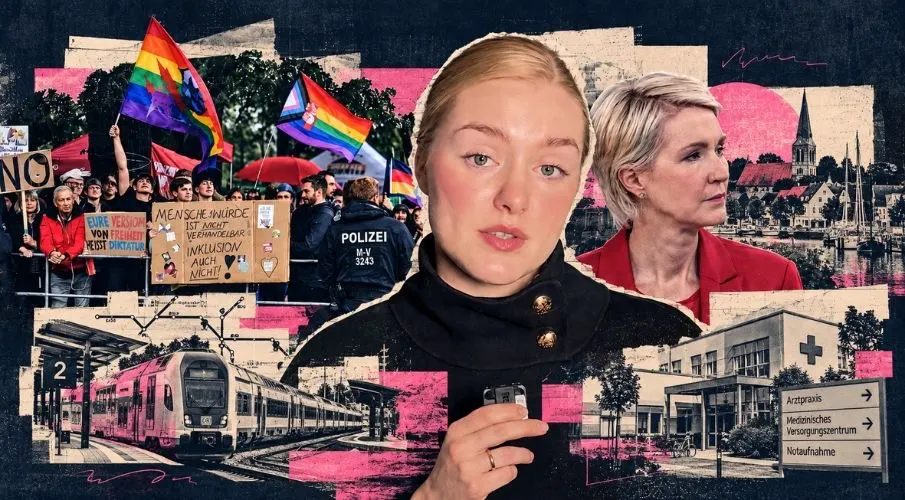
Putting a mark on a ballot takes 1 second. Its consequences live on in laws and budgets for years. That is why journalistic responsibility begins before the mark is made. Once the votes have been counted, everything can be explained, but nothing can be changed anymore. The order is simple: look first, then judge. Right now, Mecklenburg-Western Pomerania is showing just how quickly that order can get turned around, and how little anyone notices as long as the sentences sound smooth enough.

Stralsund, rain. It falls on roughly 550 supporters listening to Björn Höcke and on about 2,000 people protesting against him. Our people have been standing in it for hours. Rain has one quality every press release lacks. You cannot order it, and it sorts people out. After the first hour, only those who actually want to know something are still standing there. Höcke calls for a different policy toward Russia, saying he wants to build "bridges" to Moscow again. He demands free admission for Germans to the Königsstuhl National Park Center. He does not explain how it would be paid for afterward. After the speech, we listen to his supporters. One claims that foreigners make up 40 percent of the population of Mecklenburg-Western Pomerania. When asked what should be done better politically, our observation is that little remains beyond a single sentence: There are too many foreigners living in the state. A number repeated loudly enough replaces every further explanation for some people. German media are surprisingly scarce here too. Our people stay. At the end of a day like this, there is no headline. There are pages of tightly packed notes and a more precise picture of this state.

Read also our article: How Stralsund Left Höcke Standing in the Rain
Greifswald. We stand through almost 2 hours of Peter Hahne. In front of roughly 170 people, he piles one claim on top of another. Supposedly, 9 out of 10 forest fires are caused by arson. Millions of women supposedly suffered miscarriages because of a COVID vaccine. A flood from 1428 is supposed to put the 2021 Ahr Valley disaster into perspective. He is even off by 3 days when announcing Sahra Wagenknecht's appearance. The audience rewards it with applause, and afterward books start moving across the table. A falsehood that gets applause can be sold afterward too. Doubt, on the other hand, has never been signed by anyone. Afterward, we check every one of his claims individually. What remains are false or unsupported claims. Political reality is rarely rebuilt with a bang. Most of the time it happens quietly, over 2 hours like these, sentence by sentence. It becomes visible only to those who are willing to endure those hours and then open the sources.

Read also our article: He Calls It “Bullshit,” but the Finger Points Back at Conspiracy Theorist Peter Hahne
And then Grimmen. Weeks before an AfD event with Alice Weidel and Tino Chrupalla, we come across a required field in the registration form. Every visitor is supposed to enter their national ID card number. The party cites supposed security requirements imposed by authorities. Which authority supposedly required this remains unclear. The legal basis remains just as unclear, along with the question of how long the data would be stored. We contact the party and the authorities. We read Mecklenburg-Western Pomerania's police law and the data protection rules, and we document the form before anything on it can be changed. According to our research, at first no one can produce an official order specifically requiring this kind of storage. Citizens were supposed to submit the number of their government-issued ID to a political party in advance in order to attend a political gathering. Small matters look different. A number issued by the state so that a person can identify themselves to the state was supposed to end up in a party form. Without an explanation anyone could substantiate. The question sat openly on a website, visible to every newsroom willing to look.

Read also our article: Investigative Research - AfD: ID Card Number as the Price of Admission. The Purge Begins With a Required Field
Sometimes we sat for hours right next to AfD stands, sometimes a nearby cafe helped. We listened when people talked with voters. We listened just as closely when party officials or helpers thought nobody needed to be speaking for a camera at that moment. At events and protests, we kept noticing how thin the presence of German media was. Newsrooms that stayed longer were strikingly often English-speaking. The material was literally lying in the street. You had to pick it up yourself. That takes time and sometimes a dry coat. It does not bring reach the same evening.
An election campaign has 2 voices. One belongs to the microphone. The other can be heard when no camera is nearby. Then the sentences get rougher and the certainties harder, and the way people talk among themselves reveals more than any prepared answer. The microphone only hears what is meant to be said. The rest hangs in the air for anyone standing nearby. That applies to every party, and that is exactly why you go there. Reporters should not wait until politics sends them a press release. Watch and listen. Then check. During those hours, we heard plenty that significantly deepened our skepticism toward easy explanations. That does not give us a claim to the one correct political interpretation. It gives us a standard for the craft.
Those are the hours behind an election article that nobody sees later. Standing and listening. Driving back and securing documents. Checking numbers, and publishing a sentence 1 day later if that is what it takes for the sentence to hold up. Our observations are not statistical proof of the entire media landscape. They do explain why we held back our own election article. The reader sees an article at the end. They never see the hours that came before it, and that is how it should be.

Then September 20 arrives. After the votes are counted, a commentary appears. Sulamith Hensen, a trainee journalist at the Ostsee-Zeitung, argues that Prime Minister Manuela Schwesig should talk to the AfD. Schwesig's refusal, she says, is wrong. Among the reasons Hensen cites are long trips to the doctor and weak infrastructure. She also points to lower wages and fewer jobs in rural areas. The Ostsee-Zeitung summarizes her position this way: a blanket refusal to engage weakens social cohesion and strengthens the right. Hensen argues that people in rural areas feel they are no longer represented. The piece reads decisively. It has a clear target and a clear culprit. These are all real questions. That is precisely why a different kind of work should have come before the call for talks. Read the party platform. Check its answers. Show readers before the election what any of it can actually deliver in the state.
Link to the piece by Sulamith Hensen, trainee journalist at the Ostsee-Zeitung: https://www.facebook.com/reel/1678235453634432 and our Facebook post https://www.facebook.com/reel/1450586380279221
Hensen's publicly available articles do not provide that examination. What can be found is a candidate comparison based on 19 statements from an outside platform and a basic article about the significance of the state election. A separate, in-depth examination of the AfD platform on the very problems she later raises cannot be found on her author page. An author page is a quiet archive. It tells you what someone has written. With the same calm, it shows what is missing. Diagnosis and demand sit close together in her commentary. Between them is a hole, and a surprising amount of opinion fits through it.
The text accompanying Ms. Sulamith Hensen's video:
The state election in Mecklenburg-Western Pomerania reveals deep divisions between cities and rural areas. While Prime Minister Manuela Schwesig (SPD) rejects talks with the AfD, our reporter Sulamith Hensen warns: A blanket refusal to engage weakens social cohesion and strengthens the right.
Background: Manuela Schwesig's SPD secured roughly 36 percent of the vote, but owes that success mainly to voters in Rostock and Schwerin. In rural areas, the AfD dominates with more than 38 percent - in some villages on Rügen, more than 1 in 2 voters even chose the far-right party.
Sulamith Hensen considers Schwesig's refusal to engage in any dialogue with the AfD a serious mistake. Outside the major cities, a majority feels it is no longer represented. Although the prime minister scored well with 3 out of 4 respondents in an Infratest dimap poll for her criticism of Berlin, she underestimated frustration in rural areas: longer trips to the doctor, patchy infrastructure, lower wages and fewer jobs.
A head of government who categorically rules out talking to the AfD is sending a disastrous message to its voters, our reporter argues. Namely: Your concerns do not count. This kind of exclusion only drives people further into the arms of the AfD - and so far, she says, this tactic has helped the party more than it has hurt it.
This is by no means about a coalition or participation in government, she says, but about factual conversations on equal footing. If Schwesig wants to stop the shift to the right and bring the state together, she has to reach out to people. Anyone who genuinely wants social cohesion cannot refuse dialogue.

The name Sulamith also appears in the biographies of Jewish women and girls who were deported and murdered by the Nazis, including Sulamith Starke, born May 18, 1924, in Hamburg, deported to Auschwitz on February 12, 1943, and murdered there; Sulamith Streim, also known as Sulamed or Sulamit Streim, born May 18, 1932, in Hamburg, deported to Theresienstadt on July 19, 1942, then deported onward to Auschwitz on October 28, 1944, and murdered there; and Sulamith Lasdun, born November 18, 1918, in Hamburg, deported from Westerbork to Auschwitz on November 6, 1942, and murdered on November 9, 1942.
The platform had been sitting there all along. The AfD in Mecklenburg-Western Pomerania had adopted its governing platform back at the end of May and made it publicly available. This was no flyer with 3 demands. It contains plans that would reach deep into government and society, with very concrete consequences for individual people. The party calls for its own border and deportation police unit within the state police. It wants a state-run deportation detention facility. The platform calls for actively preparing the "remigration" of Syrian citizens if the basis for their protection no longer applies. The Refugee Council of Mecklenburg-Western Pomerania is supposed to lose state funding under the party's plans. None of this needs to be dramatized or dressed up in dramatic language. You have to read it. Then every voter can decide for themselves whether this politics matches their idea of the state. The task required paper and time. What mattered was attention. A platform often tells you more than any speech because a party writes it for its own people. It is still the thing least likely to be read.
Especially with "remigration," a passing mention is not enough. The word travels through political debates and changes meaning along the way. Words that have been traveling for a long time pick up baggage. In the governing platform, it appears in connection with the return of Syrian citizens whose protection status, in the party's view, should be reviewed and potentially ended. Alongside that are deportation police and deportation detention. You cannot put more into it than is actually there. You cannot leave anything out either. Precision cuts more sharply here than any adjective.

Alongside that come economic and social promises. The AfD wants to abolish the Tariftreue- und Vergabegesetz and calls for more flexible working hours. On energy policy, it wants a return to nuclear power. It promises relief and less bureaucracy. On top of that comes the promise of better medical care. Less bureaucracy sounds pleasant. Ending the Tariftreue- und Vergabegesetz - the law that, put simply, requires public contracting authorities to award contracts only to companies that comply with certain collectively agreed or legally defined working conditions - would have concrete consequences for public contracts and for the working conditions tied to them. A state government cannot decide on a return to nuclear power by itself. Doctors' offices do not appear because of a sentence in a platform. A promise costs the person making it nothing. The people who believed it pay later. A platform is free to promise many things. Journalism begins with the question of the bill, and with the question of whether a state even has authority over what is being promised. After that, the effects can be examined. Then the reader can decide. Nobody needs to make the decision for them.
Some demands already fail at the question of jurisdiction. The platform includes a possible halt to accepting migrants in Mecklenburg-Western Pomerania. Political scientist Wolfgang Muno said such a move would violate federal law. He also considers a state policy explicitly aimed at limiting Muslim immigration unlawful because Muslim immigrants have the same rights as other immigrants. A party can adopt whatever it wants. A state cannot carry out every political goal on its own. That is the line where campaign promises separate from the ability to govern. A newsroom does not have to tell readers what to think about it. It does have to make clear what is legally possible and what sits on a wish list. Explained after the election, that distinction is useful only as an instruction manual for a device that has already been bought.

The word "solution" demands care. The AfD promises better healthcare, and Hensen's commentary points specifically to long trips to the doctor as a reason for frustration in rural areas. Between the 2 lies the decisive journalistic stretch. How many additional doctors are supposed to come from where? Through what mechanism, paid out of which budget? A headline does not replace that calculation. You cannot comment a doctor into existence. The same question comes up with wages as soon as the Tariftreue- und Vergabegesetz is supposed to disappear at the same time. A party supposedly speaking for those left behind has to be measured against those people's actual living conditions. Otherwise, political closeness is asserted before its consequences are examined. Frustration may explain a vote. It does not come close to proving that the chosen political offer will eliminate that frustration. Questions like these belonged before September 20, in large type. An addendum after election day reaches nobody who still has a vote to cast.
Public transportation shows how quickly a demand gets promoted into an idea. The AfD did not invent on-demand buses. Greifswald is introducing the "Friedrich" on-demand bus on October 4 as an addition to regular bus service. The city had already announced the new network on September 18, with additional connections and better access to the university medical center. Rural mobility therefore works poorly as proof that some special dialogue with the AfD is necessary. An existing tool and a party demand need to be kept separate. Politics often consists of expanding what already exists and paying for it. A label does not turn that into an invention. The bus will run either way, no matter which party tries to claim it.
Fairness also requires the other side of the picture. The newspaper itself is capable of examining party platforms. Its major platform check looks at feasibility and jurisdiction and compares the parties' demands with one another. The version currently available is dated September 23, while the election was held on September 20. At the same time, the OZ archive already shows the piece in an overview dated September 14. That suggests the article, or at least its collection page, may have existed before the election and later been updated. It would therefore be unserious to accuse the entire newspaper across the board of only reading the platforms after election day. Accuracy applies to your own criticism too, otherwise it becomes the very thing it is criticizing. The more precise criticism concerns the commentary and the publicly available work of its author. The questions Hensen later gives so much weight are not connected in her own pre-election reporting to any visible examination of the AfD governing platform.
The OZ election forums only change that to a limited extent. Before the election, the newspaper organized 4 events with leading candidates, including Leif-Erik Holm of the AfD. That is journalistic work and fairness requires saying so. A candidate interview, however, does not replace a platform analysis. Politicians know how to survive 1 question with 5 minutes of speaking time. A person on a stage can smile and dodge the question. A printed platform cannot dodge anything. It sits there quietly and says what was adopted. That is exactly why it needs to be checked against reality.
The harshest criticism, then, is directed less at a political opinion than at the shortcut taken to reach it. Hensen is a trainee journalist. Young journalists are supposed to learn how to write commentary and take a position. Responsibility also belongs to the newsroom that publishes such pieces. A newspaper like the Ostsee-Zeitung puts its name behind a commentary when it publishes it. A commentary is allowed to be sharp. It is also allowed to be wrong. What it cannot carry is thin research underneath a heavy demand. Suggesting that a prime minister should sit down as an equal with an opposition party that takes radical positions in major areas requires more than an observation from the weekly market. It requires knowing what the conversation would actually be about. The call for more "dialogue" sounds cheap as long as there has been little examination of what is actually being said and demanded at those stands. And what is being prepared there politically. Accusing democratic parties of failing to engage requires having gone to the place where that dialogue is supposedly missing. Talking about people's frustration after an election is easy. It becomes credible only after making the trip to where that frustration was being turned into political offers before the vote.

Also read, including you, Ms. Hensen, our article: AfD Mecklenburg-Western Pomerania: They want to hunt. They want to deport. They want to cleanse the country. And they are writing it down across 94 pages
The reactions from our readers on Facebook got to this point faster than some headlines did. One reader wrote that Schwesig should reach out to people in rural areas, but that did not require talks with the AfD. Another explicitly distinguished between talking with AfD voters and talking with the party. Another reader pointed out that the structural problems of rural areas urgently belonged on the political agenda, but said he did not see a convincing AfD approach to solving them. Those are opinions, not statements of fact. They do show, however, that readers are perfectly capable of distinguishing between a person's concerns and a party's platform.
Other comments were even more specific. One reader described long school commutes and inadequate public transportation. Getting to a doctor was difficult too, she said. She doubted that AfD participation in government would improve any of it. Another reader criticized the fact that AfD policy, especially for rural areas, was too rarely measured against its own proposals; in his view, a few understandable graphics before the election would already have helped. Readers rarely ask for miracles. Most of the time, they ask for the work to have been done first. That is where the job lies. Nobody needs 90 pages of a party platform on the breakfast table before an election. Five central proposals can be explained and their costs examined. That includes saying which level of government actually has the authority to decide. That is what newsrooms exist for.
Talk to people and take their problems seriously, our readers put it. Political offers need to be examined alongside that, line by line. That does not create an obligation to socially elevate every party. Nor does it create a right to ignore voters. Democracy remains uncomfortable because both things have to be possible at the same time. Journalism stands in between, with one simple tool: reporting.
Wir haben unseren eigenen Wahlartikel bewusst zurückgehalten, weil weitere Recherchen nötig sind. Das kostet Zeit. Manchmal kostet es auch die schöne Geschwindigkeit, mit der andere längst kommentieren. Ein Artikel, der einige Tage später erscheint und dafür 10 Fragen mehr beantwortet, kann nützlicher sein als die erste Meinung im Netz. Schnelligkeit gilt im Nachrichtenbetrieb als Tugend. Bei politischen Urteilen wird sie leicht zur Ausrede. Die erste Meinung hat den Vorteil, dass niemand sie mehr einholt. Die richtige braucht länger, und sie kommt trotzdem an. Wir nehmen den Umweg in Kauf.
Ein Wahlprogramm ist geduldig. Es liegt monatelang da und wartet auf einen Leser. Der Wähler hat nur einen Wahltag, und an diesem Tag wartet nichts mehr auf ihn. Aufklärung verlangt deshalb, vorher da zu sein, an den Ständen und über den Programmen. Hinterher lässt sich jedes Ergebnis erklären. Vorher zeigt sich, ob Journalismus seinen Beruf ernst nimmt. Ein Kreuz dauert eine Sekunde. Die Arbeit davor dauert Wochen, und sie gehört auf die richtige Seite des Wahltags.
Updates – Kaizen News Brief
Alle aktuellen ausgesuchten Tagesmeldungen findet ihr in den Kaizen Kurznachrichten.
To the Kaizen News Brief In English


Danke für den Bericht und dafür, dass ihr soviel Energie in die Arbeit steckt.
Ich warte sehr gerne, denn ich lege Wert auf sorgfältige Reportagen.
Vielen Dank