
Russia and Ukraine spent two days negotiating an end to the war in Abu Dhabi, with the United States acting as mediator. On November 11, those talks produced an agreement on a large-scale prisoner exchange. At the same time, Vladimir Putin's negotiator Vladimir Medinsky declared that Russia would "get back every inch of our land, one way or another." He was referring to Ukrainian territory beyond Russia's internationally recognized borders. No part of Russia's own territory is under foreign occupation. That statement shows just how far Moscow remains from a peace that respects Ukraine's sovereignty.
The talks took place behind closed doors. On November 10, the delegations met for about four and a half hours. The following day, they spent less than two hours together. Medinsky, Putin's adviser and head of the Russian delegation, subsequently confirmed the agreement on a major prisoner exchange. He refused to reveal details before a final agreement was reached. But when it came to territorial demands, he had plenty to say. European newspapers reporting that Kyiv was rejecting those demands could go right on "living in their world of illusions."
Medinsky described Europe's future security order as the most important topic of the talks. The war had shown that the existing system did not work, he argued. The entire system needed to be overhauled. Russia wanted a "fair" security order that would not harm other countries. Meanwhile, Moscow continues to claim territory belonging to another country. The idea of fairness in these negotiations apparently comes with a peculiar geographical limitation: It ends wherever Russia's territorial ambitions begin.

According to Medinsky, Russia and the United States compared their positions on ending the war. They had agreed on some issues and disagreed on others. He praised the American negotiators for their "sincerity" and "effectiveness." He suggested Europe could learn a thing or two from their "realism." His delegation had not spoken with European representatives who were also in Abu Dhabi. He claimed he wasn't even sure what their status was.
At the same time, Medinsky accused European countries of contributing to civilian deaths and collectively deceiving Ukrainians. He claimed they had not put forward a single peace proposal. His invitation to Europe was appropriately condescending: "As soon as the Europeans develop a conscience, they can become participants in the negotiations." He thanked the United Arab Emirates for organizing the meeting.
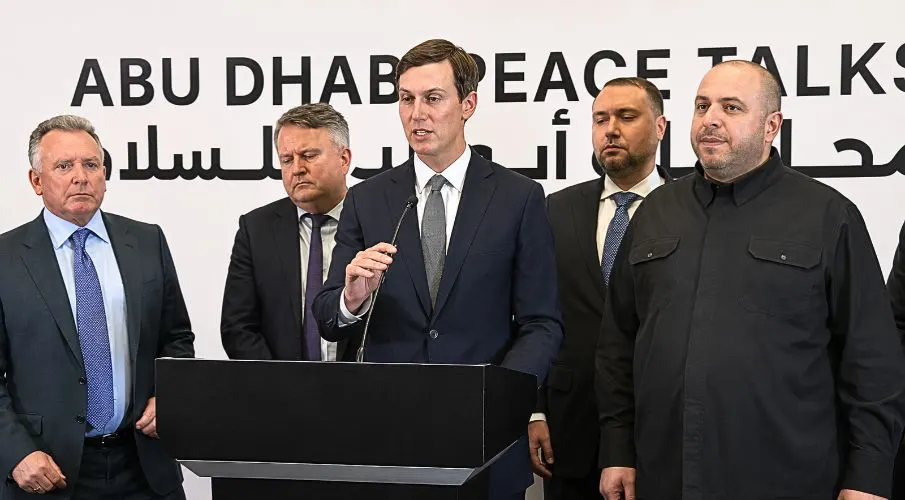
Representing Washington were Trump's special envoy Steve Witkoff and the president's son-in-law Jared Kushner. Kushner appeared before reporters alongside Rustem Umerov, the head of Ukraine's delegation. He confirmed an agreement on what he described as the largest humanitarian release of prisoners to date. The final numbers are expected to be settled on November 12. Ukrainian President Volodymyr Zelenskyy had previously mentioned possible exchanges of 1,000 prisoners for 1,000 or 1,500 for 1,500.

"One of the positives is we agreed that we're going to have the biggest humanitarian release of prisoners, and we're going to finalize the numbers tomorrow," Kushner said.
He and Steve Witkoff head to Moscow tomorrow to meet with Putin, then on to Dublin to brief Zelenskyy.
Witkoff and Kushner are scheduled to travel to Moscow on November 12 to meet with Putin. Kushner said he saw "some opportunities" in that meeting. The American envoys are then expected to meet Zelenskyy in Dublin. The itinerary shows just how actively Washington is now mediating between the two sides. Whether that leads to any political breakthrough remains uncertain.
After the three-way meeting, Ukraine's negotiators held consultations with European representatives. Ukraine's Foreign Intelligence Service announced that a joint statement was being prepared. Alongside Umerov, the Ukrainian delegation included presidential chief of staff Kyrylo Budanov and his deputy Serhiy Kyslytsya. Also present were deputy military intelligence chief Vadym Skibitskyi and Davyd Arakhamia, head of the Servant of the People parliamentary faction. Russia sent Deputy Foreign Ministers Mikhail Galuzin and Sergei Ryabkov alongside Medinsky, as well as representatives of the General Staff.
Kremlin spokesperson Dmitry Peskov declined to assess the progress of the talks while the second day's negotiations were still underway. Putin was being kept constantly informed, he said. There had been no contacts between the Russian side and European representatives, nor were any planned.

Zelenskyy had previously announced that the delegations were expected to discuss reducing hostilities and energy issues on the second day. Security in the Black Sea and a possible meeting between the three countries' leaders were also on the agenda. Russia had raised the territorial question. Zelenskyy hoped Europe would appoint its own representative to the negotiations by the end of November. Reports indicated that territorial demands were expected to be a major focus of the second day. European representatives wanted to participate directly only if substantial progress was made.
The talks began on November 10 with discussions about security guarantees and Russian demands. Ukraine's postwar future was also on the table. Zelenskyy described the meeting as "constructive and quite substantive." U.S. Secretary of State Marco Rubio called the discussions productive but warned against expecting a quick agreement.

Before the negotiations began, Ukraine and the United States issued a joint statement with the European Union, France, and Germany. Britain, Italy, and NATO also took part. Any agreement would have to respect Ukraine's sovereignty and territorial integrity and include reliable security guarantees. European Commission President Ursula von der Leyen made broader security negotiations conditional on a ceasefire. During the night before the second day of talks, Russia and Ukraine accused each other of launching new attacks.
The negotiations resumed after an interruption of almost nine months. Earlier rounds were held in Abu Dhabi on January 23 and 24 and February 4 and 5. The delegations also met in Geneva on February 17 and 18. Before the talks resumed, Witkoff had announced discussions on postwar arrangements and humanitarian issues.
A prisoner exchange is now on the horizon, although its exact scale is still being negotiated. For those affected, every release means returning from a war whose political end remains uncertain. While negotiators in Abu Dhabi discussed a shared security order, Moscow's representative was already declaring Ukrainian territory to be Russian property. Between those two visions, a war is still raging.
Updates – Kaizen News Brief
Alle aktuellen ausgesuchten Tagesmeldungen findet ihr in den Kaizen Kurznachrichten.
To the Kaizen News Brief In English


