
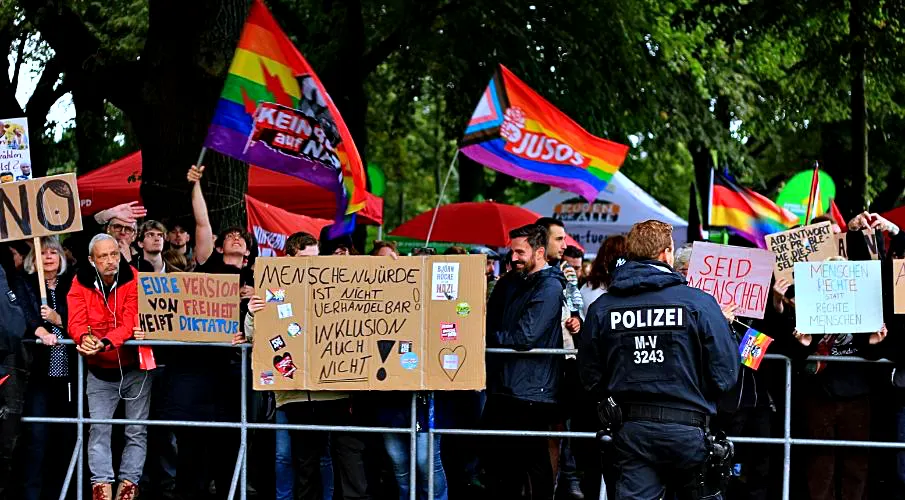
The rain came down in sheets over the Hansa-Wiese and made no distinction between those who had come for Björn Höcke and those who were standing against him. A fence separated the two camps, with police behind it and puddles in front of it reflecting the loudspeakers. On one side, a few hundred people under dripping hoods, on the other, several times as many who refused to leave. Water ran down people's collars, and nobody left. The weather remained the only thing both sides could have agreed on that evening.

The numbers carried the surprise of the evening. According to police, the counterprotest peaked at around 2,000 people, even though only about 400 had been expected beforehand. The AfD rally on the Hansa-Wiese drew around 550 at its peak. Standing in the water against the man at the microphone that evening was a clear majority.

It was another Höcke appearance in Mecklenburg-Vorpommern within two days, following a speech the previous evening on Neubrandenburg's market square. The Thuringian state party leader was campaigning for the local AfD ahead of the state election on September 20. In the polls, the party is ahead of the governing SPD.

Höcke reportedly devoted large parts of his speech to migration and called for tougher asylum policies. He held up Denmark as an example. The country, governed by Social Democrat Mette Frederiksen, plans to begin placing some migrants in deportation centers outside the European Union next year, as the responsible minister said on Friday. He borrowed the toughest demand of the evening from a Social Democratic government.

As in Neubrandenburg, he also got applause for demanding a different policy toward Russia. Germany could build a peace mode with Russia, he said, adding: "We have to build bridges to Russia. Russia and Germany must become partners." While he was saying that, the Federal Republic had long been standing at Ukraine's side, a country that became the target of a full-scale Russian invasion in 2022 and has been defending itself ever since, with money and weapons support, while Germany also participates in sanctions against Moscow. Only recently, the federal government blamed Russia for an attempted attack involving an explosive-laden drone at Leipzig/Halle Airport and responded by announcing the closure of the Russian Consulate General in Bonn as well as the termination of the agreement for the Russian House in Berlin. Höcke said a country was being put "in the dock without having evidence." Building bridges to the sender of explosive drones means confusing peace with submission.
He also took aim at the admission fee for the Königsstuhl National Park Center. Adults pay 14 euros to get in there, up on the chalk cliffs of Jasmund that Caspar David Friedrich captured in his 1818 painting "Chalk Cliffs on Rügen." Germans should be allowed in for free, Höcke demanded, saying people should imagine being charged money for German history. He did not say how the park's upkeep was supposed to be paid for. Like almost everything he presented, it remained a claim without substance.

The counterprotest had already begun filling up by 4:30 p.m., while 50 meters farther to the left it was still very empty. Shortly after 5 p.m., Rostock's Les Bumms Boys got started. The drummer had a broken arm getting in his way, and he played anyway as if something depended on it. Between speeches from the SPD and the Left Party, the Omas gegen Rechts sang, and the band Krach also made plenty of noise. Strangers passed umbrellas to one another, and the steam from wet jackets hung over the crowd. It was the warmer of the two fields, even though the same rain fell on both.


Across the fence, the loudspeakers fought a duel. AfD speeches boomed from one side, whistles and boos answered from the other, backed by the noise of the amplifiers. In between, the words broke apart in the wind.


The police deserved praise that evening. They got the operation through in a friendly manner and listened when they were told to stop filming the demonstrators. According to a police spokeswoman, no criminal offenses had become known by the time the AfD rally ended. They planned to remain on site into the night so that the two camps would not get in each other's way on their way home.

The other side looked tired, marked by long faces and speeches barely worth repeating. As the evening before in Neubrandenburg, after the final word a patient line formed for a photo with the man whose Thuringian state party organization is classified by the state's domestic intelligence agency there as confirmed right-wing extremist. Rain ran over the camera lenses, and the faces held their smiles.


The conversations with AfD supporters could be described as a lost cause. One of them rambled about foreigners making up 40 percent of Mecklenburg-Vorpommern's population, a number so far removed from reality that it almost became funny again. Asked what could be done better, nothing came back except the sentence that too many foreigners lived in the state. Without these people, the Federal Republic would simply be broke, and sometimes the truth is that brief.

There was little media presence to be seen that evening, and where there was any, the blue side dominated. The loudspeakers fell silent, and before long the puddles reflected only the streetlights. Our people stayed out in the rain for hours, and the journey continues. Where to next remains to be seen.
Updates – Kaizen News Brief
Alle aktuellen ausgesuchten Tagesmeldungen findet ihr in den Kaizen Kurznachrichten.
To the Kaizen News Brief In English


