
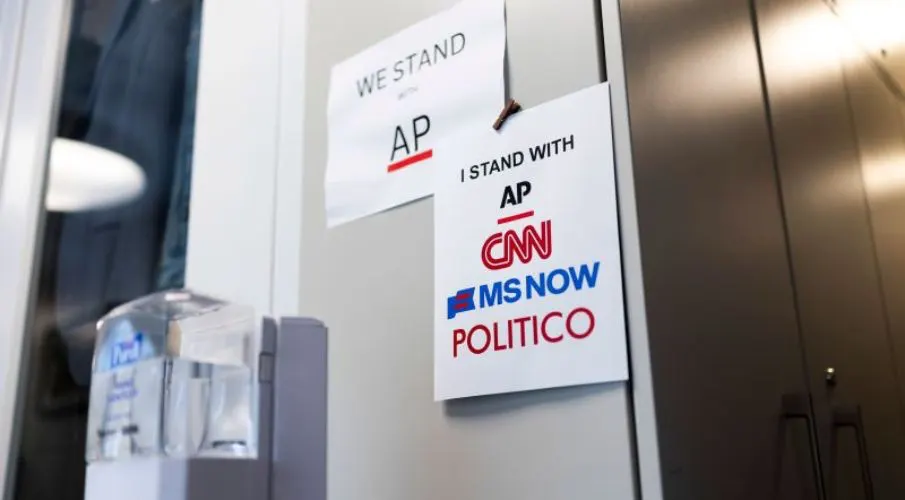
Washington, D.C. (KB) - Donald Trump wanted to get rid of 3 newsrooms. On Friday, he announced that CNN, MS NOW and Politico had no business being in the White House anymore. On Saturday, their reporters found the doors locked, and their press passes were confiscated. On Wednesday, lawyers for the news outlets appeared before federal Judge Timothy J. Kelly in Washington. That's where Trump's announcement ran into a serious legal problem: The president himself had explained why he had kicked the reporters out. He didn't like their reporting. Now his administration has to explain why it can keep news organizations off White House grounds because of their journalism. Kelly heard arguments from both sides and took the matter under advisement. He did not issue a ruling right away.
Theodore J. Boutrous, the lawyer representing the 3 news outlets, opened by addressing what an administration is allowed to do when it revokes a reporter's press pass. The White House has to establish clear rules and give those affected a chance to defend themselves against allegations. In this case, there had been "not even the semblance of due process" before the ban, Boutrous said. He described the move as unprecedented punishment. What made it especially serious, he argued, was that Trump had supplied the justification himself: In public statements, he had repeatedly made clear that he wanted to exclude the reporters because of their coverage. "He keeps proving we're right," Boutrous said. The president was practically the most important witness for the other side.
The White House is now offering a different explanation. Its court filing says CNN, MS NOW and Politico violated conduct rules and endangered national security through their reporting. It also claims they spread falsehoods. Michael Velchik, the administration's lawyer, called the news outlets' position an absurd interpretation of the First Amendment to the U.S. Constitution. In the administration's view, the president can deny reporters access when their work touches on national security interests. Access to the White House is "a privilege, not a right." That very statement was at the center of Wednesday's dispute: Can an administration revoke an existing press credential because it is unhappy with the reporting, or do the Constitution and established case law place limits on that power?
The national security allegations appeared in letters the White House sent to the 3 news outlets only on Tuesday. By then, the ban had already been in effect for days. CNN was accused, among other things, over a January 2026 report about highly classified construction details related to the bunker in the White House East Wing. MS NOW was accused of endangering national security with a June article in which a source described Trump's assessment of Iran's willingness to resume the conflict. Politico was accused of publishing a document about financing the new ballroom that contained information about planned Secret Service security upgrades. The administration has named specific publications. Whether those reports actually violated security regulations has not yet been established in court.
Boutrous pointed to the gap in timing. The articles in question had been public for months. Only after Trump excluded the news outlets and they filed suit did the administration invoke national security as its justification. During his closing rebuttal, the lawyer mocked the idea that someone at the White House had apparently decided it was time to start talking about national security. He argued that the allegations, raised after the fact, were an attempt to justify a move that had originally been driven by Trump's dislike of the reporting. Whether the court accepts that account remains to be seen. The order of events, however, is clear: First came the ban, then the detailed letters.
With those letters, the White House also tried to resolve another problem. The administration retroactively described the ban as temporary and gave the news outlets until Friday to challenge it. Its lawyers argued that this provided sufficient due process. Judge Kelly interrupted Velchik on that point. He noted that reporters first had to know the rules governing their credentials. They also had to be told what specific violation they had allegedly committed. The news outlets counter that, before the ban, they received neither a warning nor an opportunity to defend themselves. A process that begins only after the press passes have been confiscated is now at the center of the dispute.
Kelly knows this sequence of events from experience. Trump nominated him to the federal district court in Washington in 2017. In November 2018, the judge ruled on the exclusion of then-CNN correspondent Jim Acosta. After a confrontation at a news conference, the White House had revoked his access. Kelly ordered Acosta's press pass to be temporarily restored because he had not been given an adequate opportunity to challenge the move. At the time, the judge expressly declined to issue a final ruling on whether the ban also violated the First Amendment. The administration restored Acosta's access, and CNN withdrew its lawsuit. That earlier ruling gives today's plaintiffs an important legal foothold, but Kelly still has to decide the new case on its own merits.
Trump remembered 2018, too. Before the hearing, he attacked Kelly on his own social media platform and described him as disloyal, in Trump's view. The news outlets had landed a great judge, at least for them, the president wrote. He also raised the prospect of appealing a ruling that went against him. Former CNN correspondent Acosta told C-SPAN that he expected Kelly to rule in favor of the reporters again. The White House belonged to the American public, he said, and journalists had to be able to report on the president from its grounds. Acosta's assessment remains that of a reporter who was once directly affected by a similar ban. Kelly has not yet issued his ruling in the current case.
The case reaches well beyond the 3 news outlets bringing the lawsuit. The Reporters Committee for Freedom of the Press, together with the White House Correspondents' Association, submitted a brief supported by 49 media organizations. It argues that the administration must apply nondiscriminatory rules when granting and revoking press access. The government should not get to decide whether coverage is fair based on what it personally likes. Other news organizations also took practical steps in response to the ban. The major television networks that normally share responsibility for filming the president's events suspended their joint coverage. Some newsrooms temporarily stopped publishing photos supplied by that press pool. Trump could still appear in front of cameras, but he had to find other ways to do it.
Just how unfamiliar the situation was for the president became clear on Monday on the White House South Lawn. Trump cut the ribbon to inaugurate his new helipad. The usual TV pool was nowhere to be seen. A smaller news outlet recorded the event but couldn't pick up Trump's voice over the noise of Marine One. Later, footage of the president appeared on CNN anyway: Other cameras filmed his arrival in New York, where he visited Mayor Zohran Mamdani at Gracie Mansion, the mayor's official residence. Trump said the networks had announced a boycott but were still covering him. In fact, their joint decision applied to certain filming assignments and TV pool coverage at the White House, not to a complete halt in all reporting on the president.
On Tuesday, Trump ran into CNN correspondent Kaitlan Collins at the United Nations. He seemed surprised that she was there covering him. Collins replied that the United Nations had granted her access. Trump told her she shouldn't be covering him there either and referred to the networks' announcement that they were suspending their joint coverage. The brief exchange shows just how far Trump's demands extend in his public statements: His ban applied to the White House, yet he also objected to a reporter's presence at another venue where he had no say over her accreditation that day.
The group of protesting television networks includes none other than Fox News. The network participates in the White House TV pool alongside ABC, CBS, NBC and CNN. The networks take turns recording events and then make the footage available to other news organizations. On Tuesday, Fox News was supposed to film Trump's arrival aboard Air Force One at Joint Base Andrews. The network refused to cover the event. Its spokesperson pointed to the networks' joint statement: No administration should restrict a news organization because it objects to its reporting. Newsmax also opposes the ban. Its chairman, Christopher Ruddy, warned that such an exclusion would set a dangerous precedent that could eventually affect conservative media outlets as well.
For Fox News, standing up for a competitor isn't entirely new. When the Obama administration tried to exclude the network from a Treasury Department event in 2009, the other members of the press pool refused to participate without Fox News. The administration backed down. Today, Bryan Boughton, the Washington bureau chief for Fox News, chairs the group of television networks. He signed the statement announcing the suspension of joint coverage. At the same time, Fox News correspondent Jacqui Heinrich is president of the White House Correspondents' Association. That means journalists from a network whose political programming frequently supports Trump are publicly joining the opposition to his decision to exclude their competitors. The value of a shared press credential can change quickly when another administration gets to decide who comes through the door.
There is also an earlier legal dispute involving the Associated Press. After reporters from the news agency refused to adopt the name "Gulf of America," the White House restricted their access to certain events. An appeals court later recognized that the president could decide which reporters to admit in certain especially personal or space-restricted settings, such as the Oval Office or aboard Air Force One. The current ban goes considerably further. Reporters from the 3 news organizations aren't allowed onto the White House grounds at all, including the shared press areas where their equipment is stored. Whether the administration can extend that earlier ruling to such a sweeping exclusion is one of the open questions in this case.
After the hearing, the ban remained in place for the time being. Kelly took both sides' arguments under advisement and said he would issue a ruling later, without specifying when. CNN, MS NOW and Politico are demanding that their White House access be restored while their lawsuit is pending. The administration insists that it has the authority to keep them out. Its letters, sent after the fact, cite security violations; Trump's own public statements are about reporting he doesn't like. Between those 2 explanations lies the question the judge now has to decide. Meanwhile, outside the White House gates, reporters are still waiting with their press credentials revoked.
To be continued ...
Updates – Kaizen News Brief
Alle aktuellen ausgesuchten Tagesmeldungen findet ihr in den Kaizen Kurznachrichten.
To the Kaizen News Brief In English


