
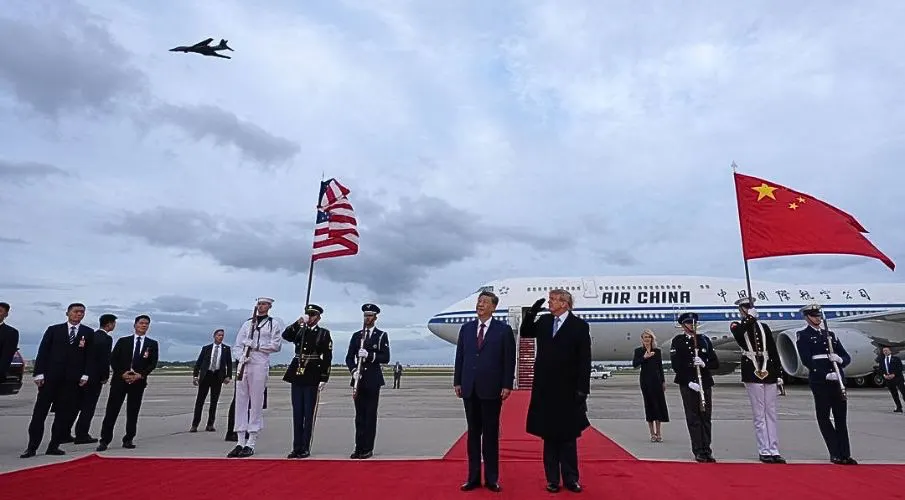
Washington, D.C. (KB) - Donald Trump waited Wednesday evening at a military airfield near Washington for a man American presidents usually don't greet until they get to the White House. Xi Jinping landed at Joint Base Andrews shortly before 6 p.m. While Chinese government officials were already standing in the open doorway of the plane, American soldiers rolled out a red carpet and smoothed it flat. Then Trump's armored limousine pulled up. The president got out with Melania Trump and walked all the way to the plane's stairs. Xi came down with his wife, Peng Liyuan. Handshakes. National anthems. Two American B-1 bombers flew overhead.
The noise was so tremendous that Trump briefly flinched and ducked his head. Xi showed no visible reaction. While the welcome was still underway, Treasury Secretary Scott Bessent announced that the United States and China had agreed to extend their trade truce by two months, through January 10. Certain American tariffs would remain suspended, and China would continue supplying rare earths. There was initially no confirmation from Beijing. Washington welcomed its economic rival with military thunder and a carpet that couldn't have a single wrinkle in it.
While Xi is still sitting on the plane, American soldiers are crawling around on the ground, smoothing out the red carpet for him. God forbid there's a wrinkle in front of the Chinese leader's shoes. Trump waits with his armored limousine, and Trump's America is busy making damn sure its guest gets to walk on a spotless carpet.
The personal welcome at the airport was unusual. Heads of state are normally greeted by the American president only when they reach the White House. When Trump traveled to Beijing in May, Xi had not gone to the airport to meet him. Now Trump went a step further than his host had back then. This is the first state visit by a Chinese president to Washington in more than 10 years. Both governments pay attention to the smallest gestures at meetings like these. That evening, Trump and Xi stood together in front of the cameras while soldiers presented the American and Chinese flags. A military band played. Another welcoming ceremony, complete with an honor guard, is already planned for Thursday at the White House. The presidents will also hold talks and attend a state dinner. On Friday, Xi is scheduled to visit the National Archives, where he is expected to see historic founding documents of the United States.

While the final preparations for the airport welcome were still underway, Treasury Secretary Scott Bessent reported an agreement whose significance for both economies extends far beyond the evening. The United States and China had agreed to extend their existing trade truce by two months, he said in a television interview. It would now remain in effect through January 10. The previous agreement would have expired in November. Under the extension, certain American tariffs and other trade restrictions would remain suspended for the time being. In return, China would continue supplying rare earths that American factories urgently need. Bessent said the additional time would give both sides a chance to discuss broader economic agreements. As of Wednesday evening, Chinese government officials had not yet confirmed the extension.

The trade truce dates back to last year. After Trump imposed steep tariffs on Chinese exports, both countries responded with measures against each other. The agreement that followed temporarily suspended parts of that trade dispute. Now it buys time for further talks. Bessent met again Wednesday with Chinese Vice Premier He Lifeng, after the two had already spoken on Sunday. Washington and Beijing were working to reduce tariffs on imports worth $30 billion on each side, the American Treasury secretary explained. Agreements on financial services and agricultural purchases were also possible. China was, however, behind schedule on some of its promised agricultural purchases. The United States was pushing for larger purchase volumes. For now, the trade truce is keeping the existing commitments together while the next ones are still being negotiated.

Rare earths, in particular, turn the tariff dispute into an issue that reaches all the way into European factory floors. The minerals are needed for semiconductors and vehicle parts. They're also found in wind turbines and military equipment. China had prepared stricter export rules that were supposed to take effect on November 10. Under those rules, Beijing could have required a permit even to transport a product across a border if Chinese rare earths accounted for at least 0.1 percent of its value. European automakers warned that, under such a rule, even shipping a car seat from a factory in Poland to a vehicle assembly plant in Germany could depend on a Chinese permit. The planned regulations would also have covered five additional types of rare earths. The announced extension of the trade truce appears to be postponing these tighter restrictions for now as well.
Bessent had already sharply criticized China's planned export rules. Now he spoke of additional time for negotiations. For European companies, that's nowhere near enough. Jens Eskelund, president of the EU Chamber of Commerce in China, said a two-month delay would not solve the problems. Companies needed transparency and reliable conditions to plan their production. A factory that has to order components for the coming months can do only so much with a short deadline. The two presidents may decide on their agreement again in January. Until then, manufacturers need to know whether their shipments will be allowed across borders. At the factory gate, patience with a diplomatic deadline runs out much sooner.

Artificial intelligence is also expected to play an important role in the talks. The United States wants to develop a system with China through which the two governments can notify each other of security-related incidents. Bessent said he considered Chinese approval likely; Beijing was interested in talks with Washington. The two countries were working to identify particularly dangerous developments. These included programs that could act independently and escape human control. The discussions also concerned groups operating outside government structures that could use artificial intelligence to attack computer systems or develop biological weapons. Bessent hoped the two governments would eventually be able to discuss incidents whose consequences cross national borders. For now, this is a proposal for cooperation between two countries that are also locked in a fierce competition over the technology.
Trump wants to bring industrial production back to the United States and is seeking agreements with Beijing to help make that happen. Xi, meanwhile, is pursuing goals of his own. The Chinese government is trying to expand its international influence; considerable tensions with Washington also persist over Taiwan. According to Trump, China's role in the war against Iran is also expected to come up during the talks. The American president announced that he wanted to discuss that and other issues with Xi. The crucial negotiations are scheduled for Thursday. Wednesday's festive welcome answered none of those questions. For the moment, it ensured that the presidents greeted each other in person after Xi's arrival and that the visit began with an elaborately prepared military ceremony.
On Washington's streets, another side of the state visit was unfolding at the same time. Hundreds of people had already gathered along the planned motorcade route in the afternoon. Xi's supporters stood there alongside opponents of the Chinese government. Clashes broke out near the military airfield. One video showed a woman and a man struggling over a sign opposing the Chinese Communist Party. Outside the Waldorf Astoria on Constitution Avenue, where protesters expected Xi to stay, police officers and National Guard members had to separate the two groups. Supporters waved large Chinese flags. Some protesters wore Winnie the Pooh costumes. Sirens and patriotic Chinese songs blared from megaphones as supporters tried to drown out the protests.
The route protesters have to take to get to the White House has grown longer. Trump had new fences and barriers installed around Lafayette Square, the park north of the presidential residence. For decades, people had gathered there to protest against American presidents right in front of the White House. Now demonstrations are held farther away from the grounds. At the same time, Trump has altered the building for the visit: The columns at the north entrance have been refurbished, and a helicopter landing pad in the shape of the presidential seal has been added, which Trump also wants to use for events. The White House is welcoming the Chinese leader behind new barriers. Outside, his supporters and opponents are fighting for visibility and space.
Of all occasions, this state visit could leave Trump with fewer television images from his official residence than he's used to getting from his other appearances. His decision to deny CNN, MS NOW and Politico journalists access to the White House led to a joint protest by the major American television networks. Fox News is taking part, too. The networks, which normally share footage of the president's events, suspended their joint coverage. None of the major American networks carried Xi's arrival live on Wednesday, not even Fox News. Instead, Fox aired an interview with Treasury Secretary Bessent. An international news agency provided its subscribers with footage from the airport. A pro-Trump television network covered the event with its own cameras.
Late that evening, Trump nevertheless spoke about the welcome at the White House. The house would be packed for Xi at the state dinner the following evening, he told reporters. He also praised the speed at which his new ballroom for future state dinners was being built. More in-person meetings between the two presidents are already being discussed. Xi will host the Asia-Pacific Economic Cooperation summit in Shenzhen in November. Trump will host the G20 heads of state and government in Miami in December. If the Washington visit goes according to both governments' plans, Trump and Xi could meet again at those events. That would leave them until January 10 to turn the temporary trade truce into further agreements. On Wednesday evening, the negotiations still stood between the red carpet and any such result.
Updates – Kaizen News Brief
Alle aktuellen ausgesuchten Tagesmeldungen findet ihr in den Kaizen Kurznachrichten.
To the Kaizen News Brief In English


