
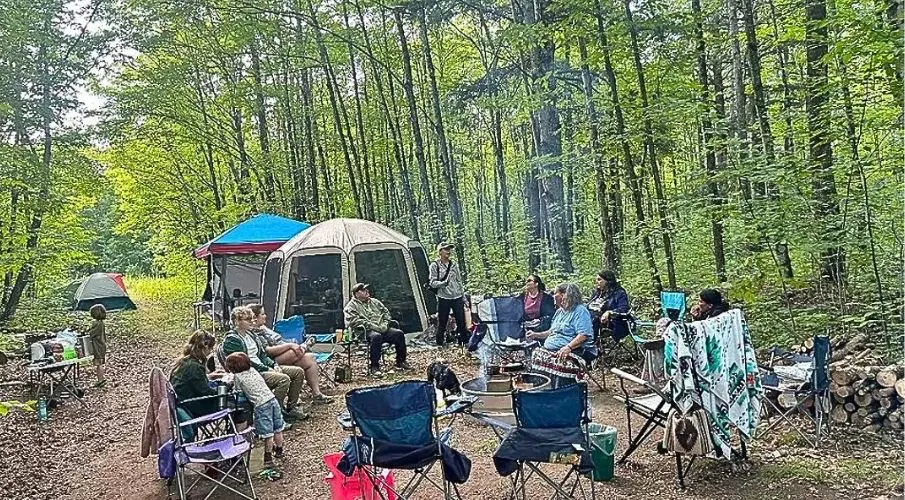
A fire has been burning among the old trees of the Porcupine Mountains in northern Michigan since August. Members of several Indigenous communities have set up camp near the proposed Copperwood copper mine. They call it Animikiiwadiswan, the Thunderbird Nest. Anahkwet, also known as Guy Reiter, is a member of the Menominee Nation. Together with Charlotte Loonsfoot of the Keweenaw Bay Indian Community, he is organizing the resistance. Twenty people came for the opening weekend, August 14 to 16, and twice as many showed up the following weekend. They camp on Ottawa National Forest land, about 20 miles north of Wakefield. Cell service is almost nonexistent out there. But they are right next to the area where a copper sulfide mine is supposed to be built. A place the people involved have considered their ancestral homeland for generations could be burdened with an estimated 40 million tons of mining waste, according to calculations by opponents of the project.

The proposed mine is located near Porcupine Mountains Wilderness State Park and the southern shore of Lake Superior. The region is home to the last untouched old-growth forest in the area. Opponents fear severe environmental damage to the surrounding wetlands from mining waste that also contains heavy metals. The Keweenaw Bay Indian Community strongly opposes the project. In a letter to the Michigan Legislature, the community points to damage that Highland Copper has already caused to wetlands, according to its account, and describes the company's approach to mining as irresponsible. Behind the project is Copperwood Resources, the American subsidiary of the Canadian company Highland Copper. Mining there is still only a proposal. The feared contamination from millions of tons of mining waste is a potential consequence, not damage that has already occurred.
The project is slated to receive $50 million in public funding. The money is intended as a grant to prepare the site. On August 25, the Michigan Strategic Fund board approved the funds, even though Copperwood, according to critics, still had not met the financing conditions the fund had established back in 2024. The state legislature has not approved the funding either. Its Senate appropriations committee did not vote on the funding in 2024, and in 2025 it again declined to vote on 2 additional proposals. State Senator Jeff Irwin called the fund's decision wrong and possibly illegal. Cindy Warner, a former member of its board, said Copperwood had failed to provide the required proof of its financial viability in 2024 and still had not done so. While the company's financing remains in dispute, the fund has already approved the grant.

When asked, Danielle Emerson, spokesperson for the Michigan Economic Development Corporation, defended the source of the funds. The agency had internally set aside the money for other projects, but those projects ultimately had not gone forward, she said. That answered the question of why the money was available. The objections concerning the unmet financing conditions and the lack of legislative approval remain unresolved. The citizens' group Protect the Porkies is calling for an official investigation by the state attorney general's office and the relevant appropriations committees. On September 15, it announced that it had filed an appeal with the court in Ingham County challenging the funding decision. Further legal action concerning the financing was being prepared. Tom Grotewohl, the group's founder, described the fund's actions as a coup d'état. His choice of words is drastic. The specific question at issue in the proceedings remains the legal basis on which $50 million was approved.
Economist Scott Beaulier knows Michigan's Upper Peninsula from his childhood. Today, he heads the College of Business at the University of Wyoming. In an analysis published on August 28, he criticized the proposed funding on fundamental grounds. It was the wrong way to pursue economic development in the region, he argued. The Economic Development Responsibility Alliance of Michigan, meanwhile, is working on a different development model that would combine agriculture with sustainable, mixed-use development. Its founder, Marjorie Steele, drove more than 8 hours from Grand Rapids to visit the resistance camp on its opening weekend. She described a nonstop exchange among people who had barely known one another before. Steele is particularly interested in how public funding is awarded. The Michigan Economic Development Corporation is also expected to decide on tax breaks for artificial intelligence data centers that Governor Gretchen Whitmer put into effect in April 2025. A disputed decision over a copper mine thus raises questions that extend far beyond mining.

Copper has been used around Lake Superior for thousands of years. Archaeological finds show that Anishinaabe people were extracting copper there more than 8,000 years ago and making tools from it. Around 1500 BC, they increasingly returned to using stone. According to archaeologists, the particularly pure, unalloyed copper offered little advantage over stone in terms of durability, while stone tools took less time to make. Anahkwet points out that his community has used the area continuously. Industrial mining began in 1845 with the Cliff Mine near Eagle River and ended in 1997 with the closure of the White Pine Mine in Ontonagon County. Those years saw economic growth and bitter labor struggles. The miners' strike of 1913 to 1914 was met with violent repression. A memorial now marks the tragedy at Italian Hall on Christmas Eve 1913. A celebration for the families of striking miners had ended in catastrophe there.
The environment still bears the history of industrial mining. About 200 million tons of mining waste lie at the bottom of Torch Lake, which is roughly 19 miles long. The lake was designated a federal cleanup site because of severe environmental contamination. Abby Newman is 23 years old and drives 2 and a half hours to the camp every weekend. Her family made its living from mining for generations. She knows its economic importance as well as the damage it left behind. According to Newman, even though eating fish caught in Torch Lake is considered generally safe, people are advised to eat no more than 1 fish from the lake per year. Newman organizes with the Keweenaw Socialists but describes the conversations at camp as open. For her, deciding how the land is used is inevitably a political question.

According to opponents of the project, earlier copper mining worked with ore containing as much as 95 percent pure copper. The Copperwood project, by contrast, involves ore with a stated copper content of just 1.45 percent. By far the greater share of the rock extracted would be left behind as mining waste. While old mining facilities now attract visitors and souvenir shops trade on the region's mining history, Loonsfoot and Anahkwet want to know who would be held responsible for the potential consequences of renewed mining. Members of the Lac Vieux Desert Band and the Bad River Band live at the camp alongside other supporters. Loonsfoot describes the weekends as an opportunity to connect with the area's plants and animals. Anahkwet talks about porcupines, whose slow movements, in an explanation passed down through his community, are connected to their willingness to provide food for people who are hungry. He asks how people could pollute land that has given them so much.
The camp is expected to remain in place until October 4. A ceremony featuring the traditional jingle dress dance is planned for the closing day, which Loonsfoot describes as a healing dance for people and the land. Until then, those involved will continue gathering around the fire on weekends. Meanwhile, the legal proceedings challenging the funding decision are underway. The proposed $50 million is therefore still being disputed in Michigan. The 40 million tons of mining waste that the people in the forest are warning about, however, could not simply be gathered up again after a political decision has been made.
Updates – Kaizen News Brief
Alle aktuellen ausgesuchten Tagesmeldungen findet ihr in den Kaizen Kurznachrichten.
To the Kaizen News Brief In English


