
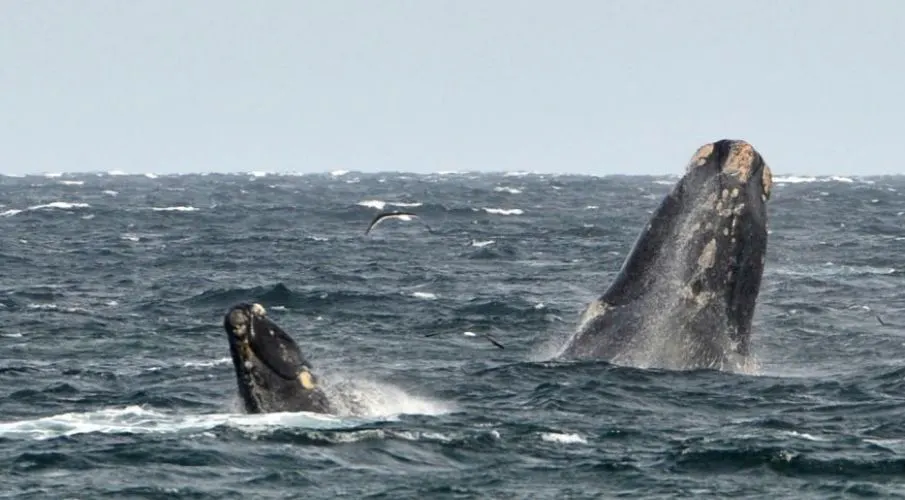
Trump's environmental terrorism continues and seemingly stops at nothing anymore. A North Atlantic right whale surfaces off Cape Cod. Around 380 animals of this species are still alive. Under an internal memo from the Trump administration, whether its death falls under the U.S. Endangered Species Act could soon come down, of all things, to intent. The September 14 memo narrows the definition of the illegal taking of protected animals. An accidental killing or injury would no longer be enough under that interpretation. Only an action specifically directed at the animal would meet the legal standard.
The memo spells out the consequence with cold clarity. If a ship accidentally strikes a whale, it has not taken the animal within the meaning of the law because its course was not directed at the whale. If a tree is cut down with protected bats roosting inside it, that would likewise not constitute an illegal taking as long as the tree was not cut down for the purpose of killing or capturing the animals. On paper, intent would come before the result. In the water, a dead whale is still a dead whale.

Read also our article: Trump Destroys Marine Protections - for More Catch and More Profit
That is exactly why the change would be so far-reaching. Endangered animals in the United States are usually not killed deliberately. They die as a result of economic activity. Until now, companies and individuals could be held responsible for foreseeable deaths. That possibility created an incentive to limit dangers before they happened. Responsibility began where the consequences became foreseeable, long before a carcass ever had to be found.
The existing permitting system is built around that idea. If someone wants to build on land where endangered salamanders live, a permit currently has to be obtained. The U.S. Fish and Wildlife Service can require protective measures in return. Money can also be set aside to protect the species somewhere else. In exchange, a certain number of salamanders may be killed unintentionally without that becoming a violation of the law. The process is meant to reconcile species protection with economic activity. Its purpose lies precisely in the fact that unintended harm is taken into account legally before it happens. Companies get planning certainty, while the agency requires safeguards. If accidental death is removed from the prohibition, a duty to take precautions quickly becomes a voluntary question. The new memo calls that entire structure into question.

The memo was signed by Brian Nesvik, director of the U.S. Fish and Wildlife Service. It was distributed to the agency's field offices. The U.S. Department of the Interior, which oversees the agency, did not directly answer questions about the reasons for the new interpretation or whether the memo would take effect immediately. Its press office merely stated that the law would continue to prohibit harassing and pursuing protected animals. Hunting and shooting would also remain covered. Wounding and killing would remain prohibited. Trapping and collecting would also fall under the law. Attempts to do so would also remain covered.
The response was unsigned. It also stated that the recent removal of the regulatory definition of harm had not eliminated the prohibition on taking protected animals. It was precisely this reinterpretation of what constitutes a taking that surprised environmental lawyers. Andrew Mergen, a professor at Harvard University, described the move as an attack on the law on a scale not seen before. He had previously spent 2 decades at the U.S. Department of Justice supervising appeals involving the Endangered Species Act.
In Mergen's view, the administration is stripping the law of a substantial part of its force. An endangered species could be killed without that resulting in a violation as long as no one intended the death. People can, however, also be held responsible for consequences they did not intend if they should have recognized the danger. Mergen cited the killing of a person as an example. In law, responsibility does not simply end where someone claims they did not mean for something to happen. The move follows a decision by the administration in July. At that time, the regulatory definition of harm was removed from endangered species protections. According to opponents, the change would make it easier to open endangered species habitat to drilling and mining. Agriculture would also benefit. Other development projects would be easier as well. States filed lawsuits against the decision. Former senior wildlife officials from Democratic and Republican administrations called on the administration to reverse course. They warned that the change could overturn the law and push some of the best-known animal species closer to extinction.

According to environmental lawyers, the new memo goes significantly further than the July decision. Its legal basis lies in a dissent written by then-Supreme Court Justice Antonin Scalia in a 1995 case. The Supreme Court majority rejected his narrow interpretation at the time. The Trump administration now argues that the legal reasoning behind that majority decision no longer holds after a 2024 Supreme Court ruling. That ruling limited the broad authority of federal agencies to interpret laws.
Patrick Parenteau, professor emeritus at Vermont Law and Graduate School, disagrees with that conclusion. The majority rejected Scalia's interpretation in 1995 based on the text of the law itself, regardless of how much discretion federal agencies had in interpreting it. In his view, the claim that the law has now been settled in favor of Scalia's position from back then is therefore wrong.
A law can argue over intent. A whale cannot. Neither can a bat in a tree that has been cut down. The administration wants to tie part of the protection to the internal purpose behind an action, even though endangered animals usually die from consequences that no one openly declares as the goal. That is where the question is decided of how much the word protection still means when the damage is already lying in the grass or floating in the water.
Updates – Kaizen News Brief
Alle aktuellen ausgesuchten Tagesmeldungen findet ihr in den Kaizen Kurznachrichten.
To the Kaizen News Brief In English


