
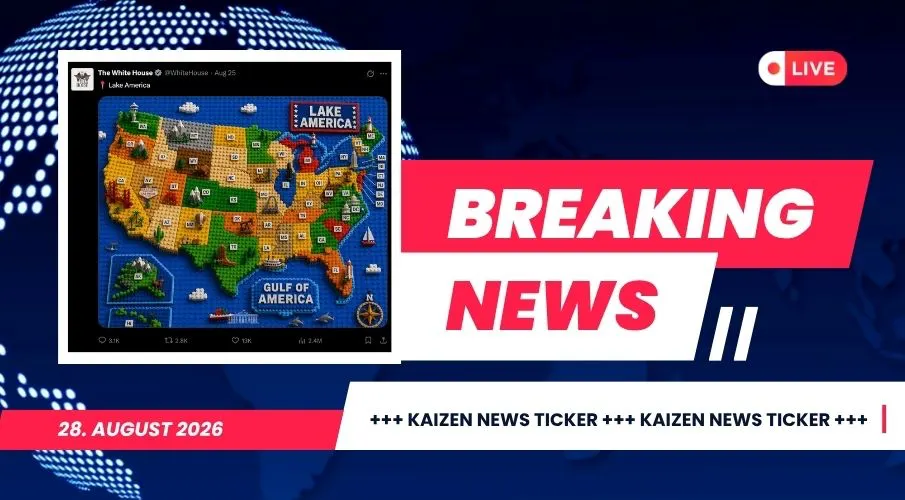
Today in our brief news: Trump turns Lake Ontario into “Lake America,” a judge once again blocks his name from going back on the Kennedy Center, two airport employees in Frankfurt die after apparently contracting malaria from an imported mosquito, U.S. corporations report record profits while workers fall behind, Washington considers further troop cuts in Europe - and may soon use a 19th-century legal tool to seize tankers and their oil more quickly.
Unhinged: Trump Turns Lake Ontario Into “Lake America” - Canada Isn’t Going Along
Donald Trump signed an order Thursday under which Lake Ontario will officially be known as “Lake America” in the United States. The U.S. Interior Department must now update the name in American geographic records. Trump declared the renaming effective immediately while signing the order in the Oval Office, even though his own directive gives the government 30 days. Behind him stood a large map of the Great Lakes with “Lake America” written in big red letters over Lake Ontario. Next to it was another sign declaring that they were going to make the Great Lakes even greater.
The move comes right in the middle of an escalating trade fight with Canada. Washington imposed 50 percent tariffs on $20 billion worth of Canadian goods after talks broke down, and Canada responded with retaliatory tariffs of the same size. Trump said the renaming was not meant to send any particular geopolitical message, then immediately added that Canada had been ripping off the United States for years on trade and military matters. “They wanted to be treated like a state and they’re not a state,” he said. His order, however, cannot force Canada to do anything. For Canadian authorities and the rest of the world, the lake remains Lake Ontario. Prime Minister Mark Carney rejected Trump’s decision and pointed out that the name comes from the Indigenous word “oniatarí:io” and predates both Canadian Confederation and the U.S. Declaration of Independence. “Canadians also know that naming reality means calling it Lake Ontario - then, now and always,” Carney wrote. Ontario Premier Doug Ford was just as blunt: for Canadians and the rest of the world, it remains Lake Ontario, “now and forever.” Nova Scotia Premier Tim Houston went even further and said they had now reached the point of “real foolishness.” New York Gov. Kathy Hochul also said her state would not use the new name.
There is no single international authority with the power to impose binding names on bodies of water shared by more than one country. Within the U.S. federal government, however, the president has considerable latitude over geographic names. Trump already used that power last year when he renamed the Gulf of Mexico the “Gulf of America” for official U.S. use. And apparently Lake Ontario may not be the end of it. After signing the order, Trump said that now they had a gulf and a lake, all they really needed was an ocean. Maybe, he said, they would have to rename the Atlantic or the Pacific next. The line was delivered as a joke, but with this administration it has become increasingly difficult to tell where the joke ends and the next executive order begins.
Judge Once Again Blocks Trump’s Name From Going Back on the Kennedy Center

Donald Trump wants his name back on the facade of the Kennedy Center, but once again a federal judge is standing in his way. Christopher Cooper made clear Thursday that he was skeptical about why the center needed to begin putting up the new inscription as early as September 8, even though he had already ruled in May that Trump’s name had been placed on the building illegally and had to be removed. The administration’s lawyer had barely started making his argument when Cooper asked what exactly was so special about that date. Later he wanted to know what enthusiasm for renovations had to do with what Congress had actually intended in the relevant laws.
By Thursday evening, the administration had backed off for the time being and told the court it would make no changes to the building before October 8. The dispute stems from a vote earlier this month by the Kennedy Center board, which is now firmly aligned with Trump. The board approved permanently putting the president’s name back on the building. The proposed inscription would read: “The John F. Kennedy Center for the Performing Arts Restored and Renovated By President Donald J. Trump.” If the so-called Trump Kennedy Center Fund reaches $100 million, another inscription would be added saying that the building was endowed by that fund. Trump and his allies clearly have no intention of accepting the fact that a court struck down the first renaming. The Kennedy Center has become one of the few places in Washington where Trump’s construction plans have actually been stopped. While the East Wing of the White House has been demolished to make way for a ballroom, a triumphal arch is planned near Arlington and a golf course along the Potomac is also set for renovation, of all things it is the facade of a cultural institution that keeps pushing back. Cooper now has to decide whether this new attempt is legally any different from the first one. Until then, Trump’s name stays off the building again.
Two Dead at Frankfurt Airport - Malaria Likely Spread by Mosquito Brought in on a Plane

Six employees at Frankfurt Airport contracted malaria this summer, and two of them have died. According to airport operator Fraport, the most likely explanation is that an infected mosquito arrived in Germany on an airplane and transmitted the disease there. Four of those infected have since recovered, while officials have not yet said exactly when the other two died. The first five cases appeared in early July, and another was reported in mid-August. Health authorities are calling it airport malaria, an extremely rare form of transmission outside tropical or subtropical regions. Officials currently see no danger to travelers, employees or the general public because malaria does not spread from person to person, but through infected mosquitoes. Where exactly the mosquito or mosquitoes came from remains unknown. Mosquito traps have now been set up at the airport, and any insects caught will be examined at the Institute of Tropical Medicine in Antwerp to determine their species and origin. Fraport currently considers it most likely that the mosquitoes were brought in by plane.
The problem is not entirely new in Frankfurt. Two airport employees developed severe malaria there in 2019, and three more cases were diagnosed in 2022. Even so, infections like these remain exceptionally rare. Malaria is caused by parasites transmitted through mosquito bites and occurs mainly in tropical and subtropical regions. Cases in people who have not previously traveled to those areas are unusual in Europe and are therefore investigated particularly closely. Fraport says it remains in close contact with the responsible authorities so that any additional measures can be put in place quickly. For now, the investigation continues as officials try to determine how exactly a disease normally associated in Germany with long-distance travel managed to reach several employees at one of Europe’s largest airports.
Record Profits for U.S. Corporations While Workers Get an Ever Smaller Piece of the Pie

American corporations are making more money than ever while workers’ share of the income being generated has fallen to a historic low. In the second quarter, pre-tax corporate profits reached an annualized $4.8 trillion, or 18 percent of total national income, the highest level since the years immediately after World War II. Workers’ share from wages and benefits, meanwhile, fell to 60 percent, the lowest level since the 1950s. The money is not disappearing, it is simply ending up somewhere else.
An ever larger share is flowing into corporate profits and to people who already own stocks, investments and other financial assets. The artificial intelligence boom is delivering enormous profits to the big tech companies, while higher energy prices caused by Trump’s Iran war have pushed oil company margins upward. The stock market has responded accordingly and hit new record highs, which also benefits retirement accounts, assuming someone has enough wealth to participate in the first place. For many workers, the math looks very different. Inflation has recently risen faster than wages, leaving real hourly earnings in July 0.2 percent lower than a year earlier. The United States has long since become home to two different economic realities: people whose income grows through wealth and investments, and millions of workers who show up every day and still end up with less in real terms. At the same time, Trump has enacted sweeping tax cuts that primarily benefit corporations and wealthier Americans while cutting social programs such as food assistance.
That is not staying out of politics. Both parties are now talking more loudly about inequality because more and more voters feel that economic growth and record corporate profits simply are not reaching them. Even Vice President JD Vance is now calling for workers to have a stronger voice in corporate decision-making, while Trump himself accuses companies of “profiteering” and “price gouging.” The numbers in the executive suites show just how far things have pulled apart. Between 2019 and 2025, pay for the CEOs of large low-wage employers rose 41 percent, while the median worker got 21 percent more. Prices rose 26 percent over the same period. Workers at the bottom therefore lost purchasing power in real terms while those at the top gained substantially. The trend is not new. Since the early 1980s, unions have been losing members, companies have outsourced more and more jobs to outside contractors, and workers have lost influence over corporations.
What is new is the speed at which this development has intensified in recent years. Whether artificial intelligence will permanently accelerate it, or whether high inflation and the aftermath of the pandemic explain part of the change, cannot yet be said with certainty. What is clear is this: corporate profits are at record highs while the share going to the people whose work produces those profits keeps shrinking. And sooner or later, somebody is going to pay the political price for that equation.
Washington Considers Troop Cuts in Europe - NATO Countries Told to Prove They Can Take Over

The United States is increasing pressure on its NATO partners and is now making it pretty clear where this is headed. Washington wants to further reduce its military presence in Europe and is demanding proof from its allies that they can take over the conventional defense of the continent themselves. Around 80,000 American troops are still stationed in Europe, but the Pentagon is already reviewing how much further that number can be cut. U.S. backup would remain available, including nuclear weapons, but only if it is actually needed.
What matters to Washington now is how seriously Europe and Canada take the demand to assume much more responsibility. After a meeting at NATO headquarters in Brussels, U.S. Under Secretary of Defense Elbridge Colby explicitly praised Germany, Poland and several Scandinavian countries. Britain, on the other hand, got a pretty unmistakable jab. Washington wants to “see more” from countries like the United Kingdom, Colby said. The Pentagon has sent allies an extensive questionnaire demanding written explanations of how they plan to meet U.S. expectations. Some responses have already come in. What makes this particularly sensitive is that Washington is asking about more than NATO matters. The United States also wants to know whether its forces would have unrestricted access to allied bases and airspace. That is exactly where things get uncomfortable, because some European countries hesitated after the United States launched its war against Iran without consulting them beforehand. Colby made clear that Washington does not want that kind of uncertainty in the future. Europe also has an interest in preventing Iran from getting a nuclear weapon, he said, and the United States needs to be able to operate effectively at all times. In plain English: Europe is supposed to pay more for its own defense while at the same time giving American forces as much freedom of action as possible.
How deep the planned reduction in U.S. forces will actually go therefore depends not only on defense spending, but also on how willing European governments are to accommodate Washington in future operations. For NATO, this is not a theoretical debate. American forces remain a crucial part of deterrence against Russia. If Washington cuts them substantially, Europe will have to deliver very quickly on what it has put off for years.
Washington Wants to Seize Tankers and Oil Faster - Using a 19th-Century Legal Tool

The U.S. government is working to revive so-called prize courts, a legal mechanism from the age of sailing ships, in order to move seized tankers and their cargo into American ownership more quickly. The first such court could be set up in Houston, Texas, because the port there is considered a natural destination for detained ships. Federal prosecutors could then treat oil and other cargo as a so-called prize, have it sold and send the proceeds to the government. The idea comes from an era when enemy ships and their cargo were treated as spoils after a victory. After World War II, this procedure essentially disappeared in the United States, with Washington instead relying on civil forfeiture.
Apparently that now takes too long for the government. Cases can drag on for months because shipping companies, owners and other parties challenge the seizures. One example is the tanker Skipper carrying Venezuelan oil, which the United States seized late last year. Washington sought the ship and roughly 1.8 million barrels of crude oil, but several third parties intervened and delayed the process. The revived old system is supposed to shorten those hurdles while also getting money from seized cargo into government coffers faster. Supporters are selling it as a way to offset some of the cost of war.
Legally, however, this is likely to be anything but smooth, because the question of when a modern commercial vessel can be treated as war booty is almost certain to end up in court. The fact that Washington is considering this route at all fits a policy in which tankers and oil cargoes have long since become part of the confrontation with countries such as Iran and Venezuela. Donald Trump described that approach unusually openly in May. The U.S. Navy had taken a ship, the cargo and the oil, he said, and it was a very profitable business. Then he added: “We’re like pirates. We’re sort of like pirates, but we don’t play games.” Now his administration is apparently looking at whether that exact principle can be made even easier with a legal tool from the 19th century.


Die NATO ist keine US-amerikanische Organisation.
Die NATO muss Washington nicht beweisen, ob sie Aufgaben der US-Streitkräfte übernehmen kann.
Die NATO ist (eigentlich war) ein Bündnis als Gegenpol zu den Zwangsstaatenbündnis hinter dem Eisernen Vorhang.
Die USA und schon gar nicht Trump stehen nicht an der Spitze. Sie befehligen Die NATO nicht nach Gutdünken.
Ich glaube, dass sollte die NATO Trump klarmachen.
Es ist ein Bündnis, keine Gefolgschaft.
Und es gibt Länder die diesen Fragenkatalog zurück geschickt haben?
Mich würde interessieren, welche Staaten wie geantwortet haben.
Meinst Du, dass es da eine Chance gibt?
Zu sehen wer heimlich still und leise den Kniefall vor Trump gemacht hat?
Trump will, wie ein Hund, alles bepinkeln (mit seinem Namen versehen).
MAGA findet das toll, dieser Personenkult steigert sich immer weiter.
Das perfekte Beispiel einer Sekte.
MAGA würden für Trump von der Klippe springen. Ohne zu hinterfragen.
Ich sehe ja einige Interviews (ähnlich wie Marcant hier in Deutschland) und es graust einem bei den Aussagen.
Bildungstechnisch sind die alle in der ersten Klasse ausgestiegen und schauen seit dem nur noch FOX News und beten die evangelikale Bibel rauf und runter.
Genau wie die AfD-Deppen hier. Bis auf den kirchlichen Part
Lake America…..
America, lieber Donny, ist ein Kontinent. Der sich in Nord- Mittel- und Südamerika teilt.
Nun ja, Geographie ist nicht Trumps Stärke.
MapQuest hat schon angekündigt, da nicht mit zu ziehen.
Google wird sich bestimmt überschlagen es umzusetzen. Wie schon beim Gulf of America 🙈
Die Seneca Nation hart scharfe Kritik geübt, da es wohl gegen ein altes Gesetz verstößt.
Das Kanada nicht mitzieht ist auch klar.
Hoffentlich die restliche Welt ebenso wenig.
Rekordgewinne für US-Konzerne, die Beschäftigten haben nichts davon.
Ja, der vielbeschworene Mythos des „Trickle-Down-Effects“ funktioniert nicht.
Hat er nie und wird er nie.
Es ist nur die Augenwischerei Begründung um die Reichen noch reicher zu machen.
Staatlich genehmigte Piraterie.
Die Macht des Stärkeren.
Wir nehmen uns, was wir wollen.
Alleine diese Idee und Prüfung zur Durchführung zeigt, wie absurd die Politik der USA geworden ist.
Und bis Gerichte tätig werden, wird es erstmal durchgeführt.
Denn mit echten Konsequenzen ist nicht zu rechnen.. wer sollte sie durchsetzen?
Mein Beileid an die Angehörigen der Flughafenmitarbeiter.
In Zeiten von Klimawandel und global engineering Handels/Reisen, sollten die Arbeitsschutzbedingungen für die Mitarbeiter überdacht/überarbeitet werden.